
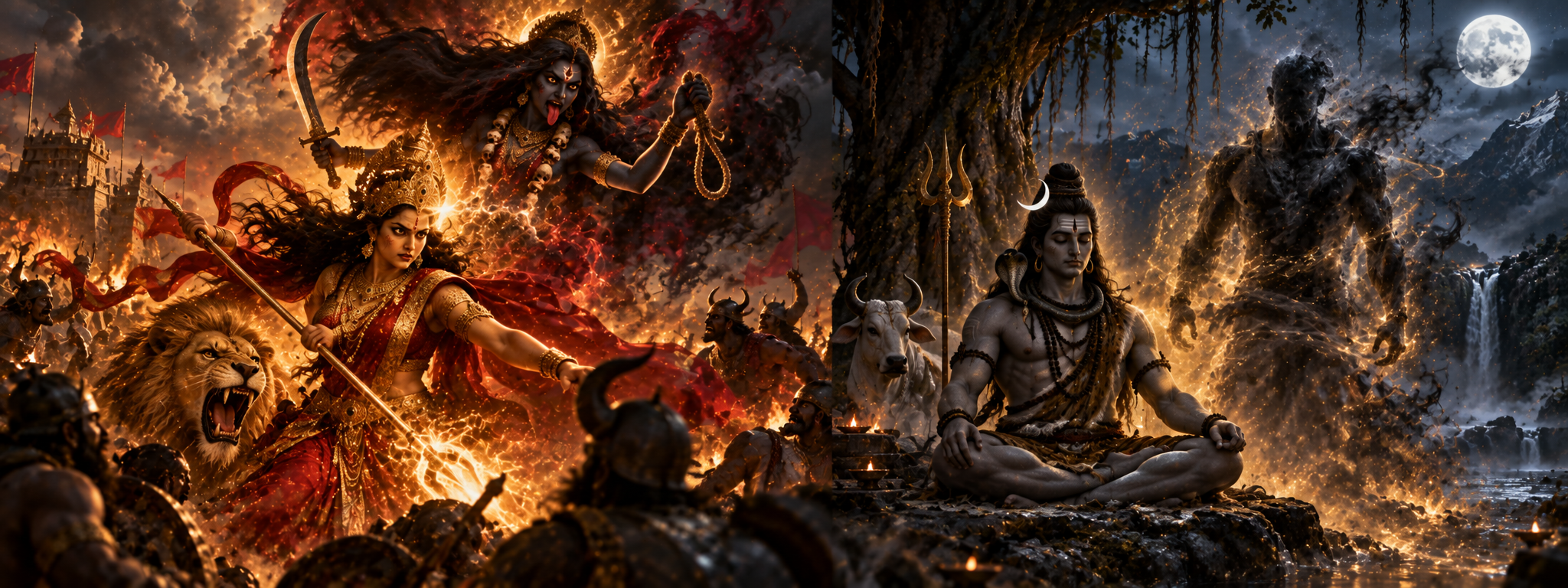
This Part covers a mechanism distinct from every other one in the series: a being condensing directly out of another deity's own body, in a moment of extremity or in ordinary course, with no conception, no vessel, and no diverted seed involved at all. The six cases here span the full range of intention behind that condensation — one summoned on purpose for a specific and urgent task, one an unwanted accident disowned almost as soon as it exists, and four deliberate makings or boons carrying no urgency at all.
Kali: Summoned From Fury
The Devi Mahatmya, embedded in the Markandeya Purana, gives the primary account: in the course of battle against the demon Raktabija — whose blood spawns a fresh clone of himself with every drop that touches the ground — the goddess Ambika's face darkens with rage, and from her forehead Kali springs forth fully formed: gaunt, dark, garlanded with skulls, armed with a sword and noose. She is summoned for exactly one purpose, and executes it without pause — drinking Raktabija's blood directly from his wounds before any of it can reach the ground and multiply him further.
A related, earlier-stage episode complicates the direct Ambika-to-Kali lineage above. In the Kaushiki episode, Parvati — taunted by Shiva over her dark complexion — sheds that darkness as a separate being: the shed sheath (kosha) becomes the golden warrior-goddess Kaushiki, while Parvati herself emerges as fair Gauri. In this fuller telling, it is Kaushiki, not Parvati directly, who later produces Kali from her own forehead during the Raktabija battle — making Kali two removes from Parvati rather than one. Puranic sources are not consistent on whether Durga, Ambika, and Kaushiki are strictly the same figure under different names or genuinely sequential emanations, and this piece does not attempt to flatten that inconsistency into a single clean lineage.
This Kali shares nothing but a name with the vice-line Kali covered in this project's Personifications series, Part I — there, Kali is male, a grandson of Adharma through Durukti, part of a genealogical chain of moral abstractions with no connection whatsoever to the Devi Mahatmya's warrior-goddess. The two figures have entirely separate origins, separate genders, and separate textual traditions; the shared name is coincidental rather than indicating any relationship, and this project treats them as fully distinct entries rather than variants of one figure.
Andhaka: An Unwanted Byproduct
The Shiva Purana gives the account of Andhaka's origin: Parvati, playfully covering Shiva's eyes with her hands, plunges the three worlds into sudden darkness. The strain of sustaining creation through that dark interval generates heat in Shiva's body — his own exertion, rather than any act of union — and from that condensed heat a being is formed: black, misshapen, and blind, taking the very name Andhaka, "the blind one," from the darkness that produced him.
Shiva, displeased with what the incident has produced, gives the child away to the asura king Hiranyaksha, who is childless, to be raised as his own — making Andhaka an asura by upbringing despite originating entirely from Shiva's own body. He grows into a formidable demon-king, and the story closes with a bitter irony tied directly back to his origin: Andhaka, not recognizing her, is struck with desire for his own mother Parvati, and it is this that leads to his death at Shiva's hands — softened in some later tellings into liberation rather than mere destruction, with Andhaka becoming one of Shiva's own ganas afterward.
Devala: Born From the Third Eye
Later Puranic tradition credits the sage Devala with an origin of exactly this same kind, on the opposite end of intention from Andhaka's: he is said to spring forth instantly from Shiva's third eye, fully formed as an ascetic, rather than condensing gradually from exertion or accident. Unlike Andhaka, Devala's emergence is treated as a deliberate boon rather than an unwanted byproduct — closer in spirit to Kali's purposeful summoning than to Andhaka's disowned one, though Devala's appearance carries no battlefield urgency behind it. He goes on to be counted among the tradition's sages, with no further complication attached to the manner of his birth.
Saraswati: Speech Given a Body
Puranic tradition gives the goddess Saraswati a birth of the same general kind: rather than being conceived, she manifests directly from Brahma's own mouth, as his wisdom and creative faculty of speech taking visible form. Sources are not consistent on the exact faculty involved — some accounts describe her as issuing from his mouth specifically, others from his mind or breath more generally — but all agree that she appears fully formed, with no conception or gestation of any kind, in the same register as Kali and Devala rather than as a mind-born Manasaputra in the sense covered in Part I.
Later tradition frequently merges this Puranic Saraswati with the Vedic goddess Vac, the personification of speech covered in this project's Personifications series, Part III — the two are treated by many sources as the same figure under an earlier and a later name, though the Rigveda's own Vac hymn makes no mention of an origin from Brahma's mouth. This piece covers only the specific mouth-emanation birth-account and does not attempt to resolve whether Vac and this Saraswati are one figure or two; readers wanting Vac's fuller treatment, including her self-glorification hymn, should refer to the Personifications entry directly.
Ganesha: Made From a Mother's Body
In the Shiva Purana's account, Parvati, wanting an attendant who answers to no one but her, gathers the paste or scurf from her own body, shapes it into a boy, and breathes life into it, then posts him at the door of her bath. Shiva has no part in the making. The child is her creation alone, drawn from her own body as Kali is drawn from Ambika's forehead, but made with no crisis behind it, only a wish for a guard. What follows when the boy refuses to admit Shiva himself belongs to Ganesha's later life, not his origin, and this piece leaves it aside.
The paste-creation account is the most widely told, but not the only one. Some Puranic traditions credit Shiva rather than Parvati with Ganesha's making, and the Brahma Vaivarta Purana gives him a different origin altogether. This piece follows the paste account as primary and flags the others rather than merging them.
Jambavan: A Yawn, or a Drop of Sweat
Valmiki's Ramayana, in the passage listing the allies brought into being for Rama's cause (Bala Kanda, sarga 17), records that Jambavan, the bear-king, came into being from Brahma's yawn. He has no mother, no father in the ordinary sense, and no act of birth, only a breath of the creator's own body given a form. Saraswati, earlier in this Part, comes from the same source by another route, Brahma's mouth.
A second, Puranic tradition places Jambavan's origin in the episode of Madhu and Kaitabha and has him arise from a drop of sweat from Brahma's body instead of a yawn. Both accounts make him a direct emanation of Brahma, and this piece keeps them as two versions of one mechanism rather than choosing between them. Comparable emissions from Brahma's body appear elsewhere in the tradition, a sneeze for the sage Kshupa and his shadow for Kardama.
The six cases in this Part span the full range of intention behind a deity-body emanation. Kali is summoned deliberately, for an immediate and specific purpose, and her origin is treated by the text as entirely appropriate to the crisis at hand. Andhaka is an incidental byproduct of a moment of play, disowned by his own source almost immediately — closer in spirit to an unwanted precursor than to a weaponized ally. Devala and Saraswati sit at a third point entirely: deliberate emanations, like Kali's, but with no crisis behind either — a sage granted existence from a third eye, and speech itself given a body from a mouth, neither with anything urgent to justify the manner of arrival. Ganesha and Jambavan extend the same third point, a boy made deliberately from a mother's own body-substance and a bear-king exhaled from his creator's breath, again with no crisis behind either. All six, however, share the one trait that separates this Part from everything else in the series: no conception occurs in any case, only a deity's own body yielding a second being.
Andhaka's status as an unwanted, quickly disowned byproduct echoes the treatment of Alakshmi, covered in this project's Personifications series, Part IV, The Goddess and Her Shadow: Lakshmi and Alakshmi — both figures emerge from a source that immediately seeks to distance itself from what has appeared. The unrelated vice-line Kali, flagged above, is covered in Personifications, Part I, Two Trees, One Root: Dharma and Adharma. Saraswati's possible identity with the Vedic goddess Vac, and Vac's own self-glorification hymn, are covered in Personifications, Part III, Speech, Boundlessness, and the Wild: The Vedic Goddesses.
References
Primary Sources
- Devi Mahatmya (Markandeya Purana), Chapters 7–8 — for Kali's emergence from Ambika's forehead during the battle against Raktabija.
- Shiva Purana and Devi Bhagavata Purana — for the Kaushiki episode, Parvati's shedding of her dark sheath, and the more distant lineage of Kali from Kaushiki rather than Parvati directly.
- Shiva Purana, Rudra Samhita — for Andhaka's origin from Shiva's exertion during Parvati's playful darkening of the world, his fosterage under Hiranyaksha, and his eventual death and liberation at Shiva's hands.
- Skanda Purana and later Puranic sage-genealogy tradition — for Devala's origin from Shiva's third eye.
- Puranic tradition on Brahma and Saraswati (Devi Bhagavata Purana and Brahma Vaivarta Purana strands) — for Saraswati's manifestation from Brahma's mouth as speech given form.
- Shiva Purana, Rudra Samhita (Kumara Khanda) — for Ganesha's creation from Parvati's body-paste.
- Valmiki Ramayana, Bala Kanda, sarga 17, and the Puranic Madhu-Kaitabha tradition — for Jambavan's origin from Brahma's yawn, and the alternative account from Brahma's sweat.
The Devi Mahatmya's Kali and the vice-line Kali of Personifications, Part I share only a name; no relationship between them is implied anywhere in this project's material. Devala's third-eye origin rests on later Puranic sage-genealogy tradition rather than an early Mahapurana account, and is noted as such. Saraswati's relationship to the Vedic goddess Vac — whether the same figure under two names or two distinct figures later merged — is left open rather than resolved. Ganesha's paste-creation is the most widely told of several accounts; Jambavan's yawn-birth is from Valmiki's Bala Kanda, and his sweat-birth is a separate Puranic tradition.