
Puranic and epic literature returns again and again to birth-stories that refuse the ordinary pattern. This series groups those accounts not by which figure they concern, but by how the birth happens — the mechanism, ritual or accident, standing in for a conventional womb.
As with this project's other series, entries stay close to primary sources — principally the Mahabharata, the Vishnu Purana, the Harivamsha, the Bhagavata Purana, and the Devi Mahatmya — and cross-textual disagreement is flagged rather than smoothed over.
Part I — Ayonija
Born Without Womb, Born Without a Mother
Mind-born and earth-born origins, where the ordinary biological pairing is absent entirely.
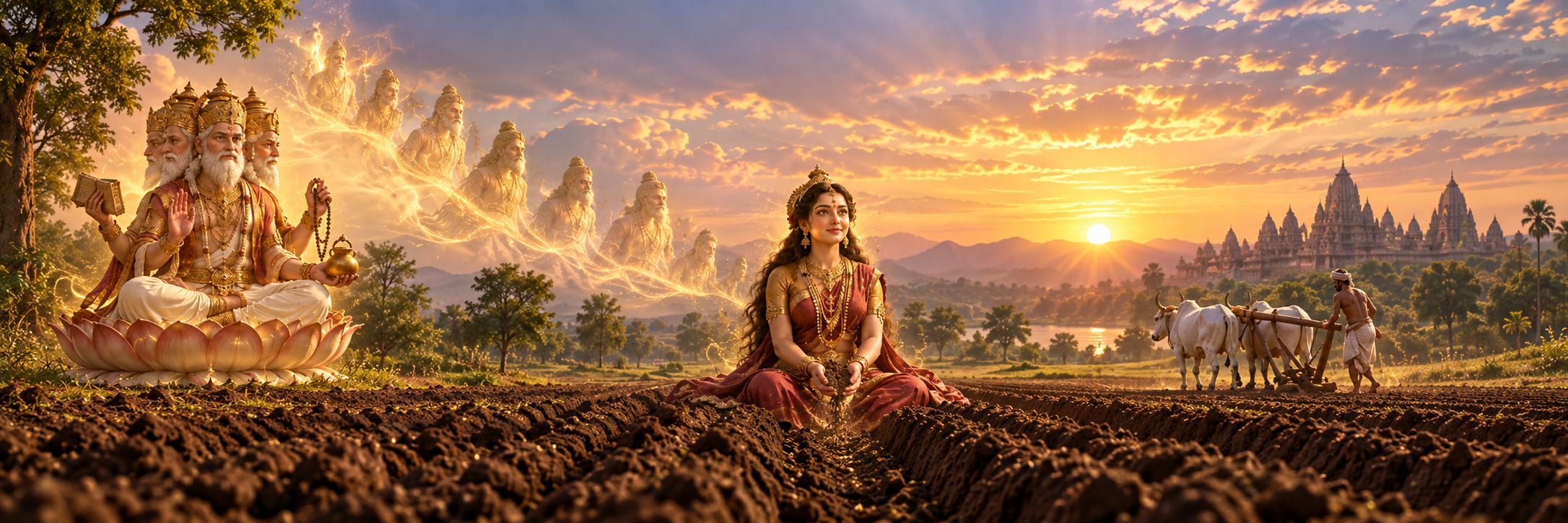
Born Without Womb, Born Without a Mother Live
Brahma's first sons are thought into being rather than born. A queen's daughter rises from a ploughed furrow. A child conceived by two male-form deities has no precedent to be measured against at all. A warrior and a princess step fully grown from a sacrificial fire. A woman is built, not born, from the finest fragment of everything that exists. And, in a later telling, a sage makes a boy from a handful of grass.
Read the full piece →Part II — Seed Diverted
Vessel- and Medium-Born
The sight of an apsara, a seed that never reaches its natural end, and a birth that happens in a pot, a reed-clump, or a fire-stick instead.

Vessel- and Medium-Born Live
Six figures, one recurring trigger: an apsara appears, a sage's concentration breaks, and what follows is never a conventional birth — a pot, a clump of reeds, an island, a piece of sacrificial wood.
Read the full piece →Part III — Animal-Incubated
Stray Seed, Foreign Womb
An incidental bodily substance, carried unknowingly and brought to term inside an animal rather than a person.

Stray Seed, Foreign Womb Live
A king's seed, sent by falcon, ends up swallowed by a cursed apsara living as a fish — and becomes the great-grandmother of the Kuru line. Elsewhere, a hero's stray sweat and a sage's own conception both run through an animal body first. And a god's seed, too fierce for any body to hold, is passed from fire to river to reed-bed.
Read the full piece →Part IV — Oceanic Emergence
The Samudra Manthan Births
No father, no mother, no womb at all — beings churned directly out of the ocean of milk.
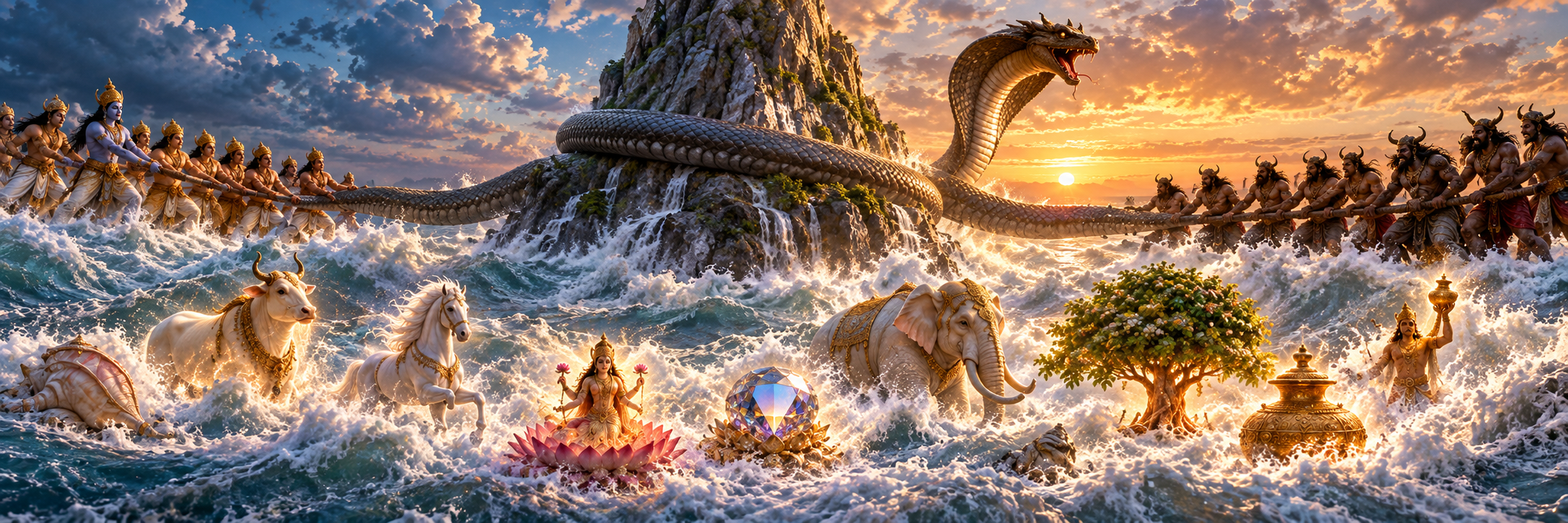
The Samudra Manthan Births Live
Fourteen or more treasures emerge from a single churning of the ocean, each with no biological parent at all — the purest case in the series of a being with no birth-event to speak of, only an appearance.
Read the full piece →Part V — Consecrated Substance
Nature and Multiplicity by Ritual Food
A sacrificial substance, divided or swapped, determining a child's nature or number before birth.

Nature and Multiplicity by Ritual Food Live
A divine payasam, unevenly shared, produces twins by simple arithmetic. Two consecrated charus meant for a brahmin's wife and a queen are swapped. A king drinks his own wives' fertility water by accident. A yajna meant for a son produces a daughter instead. And a single misplaced accent turns "killer of Indra" into "killed by Indra."
Read the full piece →Part VI — Split, Divided, and Fused
One Becomes Many, Two Become One
A single origin divided by an outside agent, or separate fragments joined by one — four cases, four very different agents.
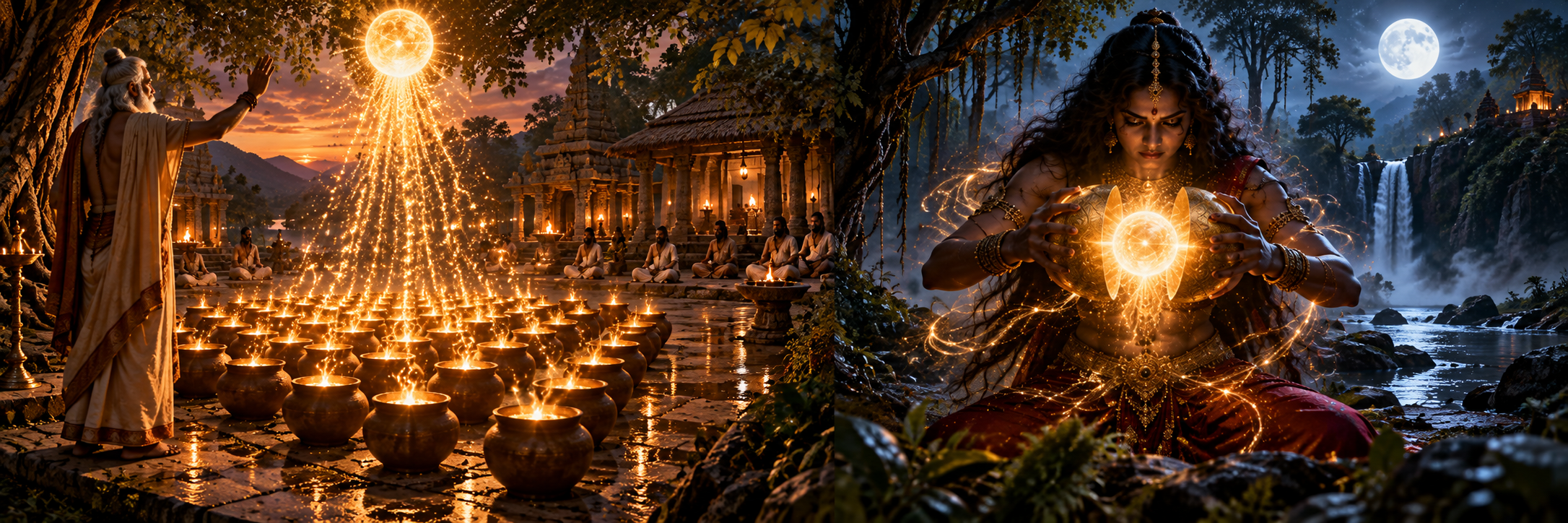
One Becomes Many, Two Become One Live
A single mass split into a hundred jars by a sage trying to help. A single gourd divided into pots as a practical fix. Two abandoned halves fused by a demoness's accident. And a single embryo struck apart, again and again, by a hostile god's weapon.
Read the full piece →Part VII — Deity Emanation
Wrath and Incident: Born from Another God's Body
Not conceived at all — struck, shed, or made from a deity's own body, in fury, by accident, or by design.
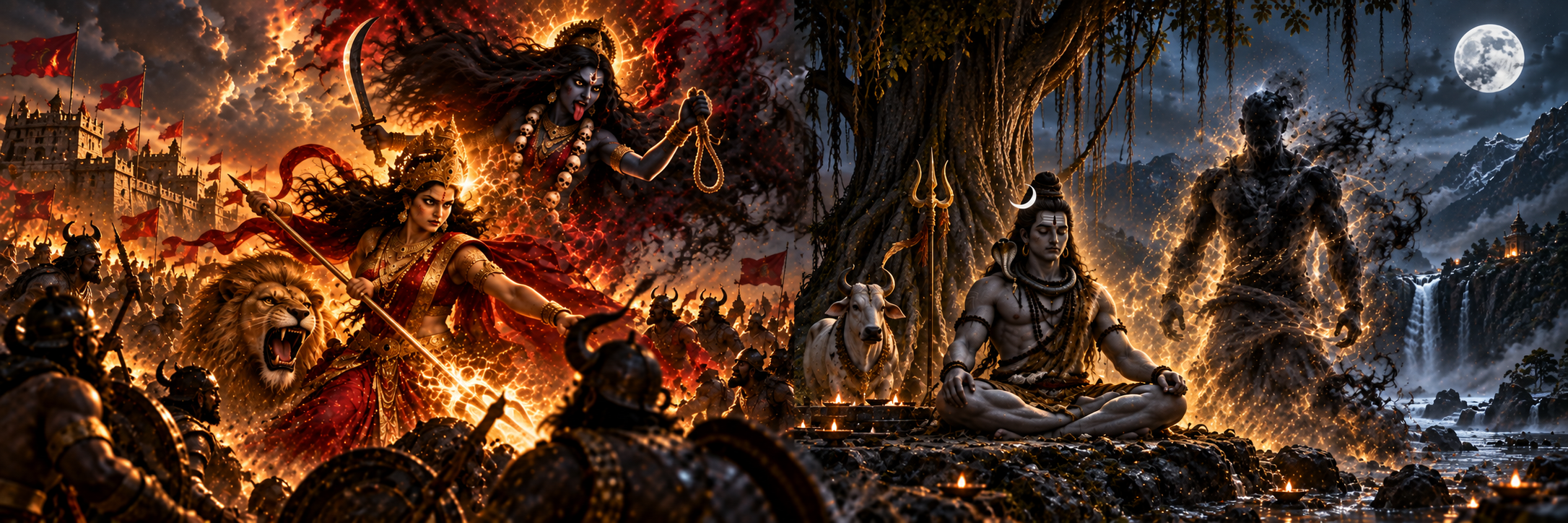
Wrath and Incident: Born from Another God's Body Live
One goddess is summoned deliberately from another's forehead to solve a battlefield problem no ordinary weapon could. One demon condenses, unwanted, from a moment of divine exertion, and is given away before he's even named. A sage steps instantly from a third eye. Speech itself is given a body from a single mouth. A boy is shaped from a goddess's own body-paste. And a bear-king is exhaled in a yawn.
Read the full piece →Part VIII — Given, Not Conceived
Given, Not Conceived
A deity's boon substitutes for union entirely — either before an ordinary birth, or instead of one.
Given, Not Conceived Live
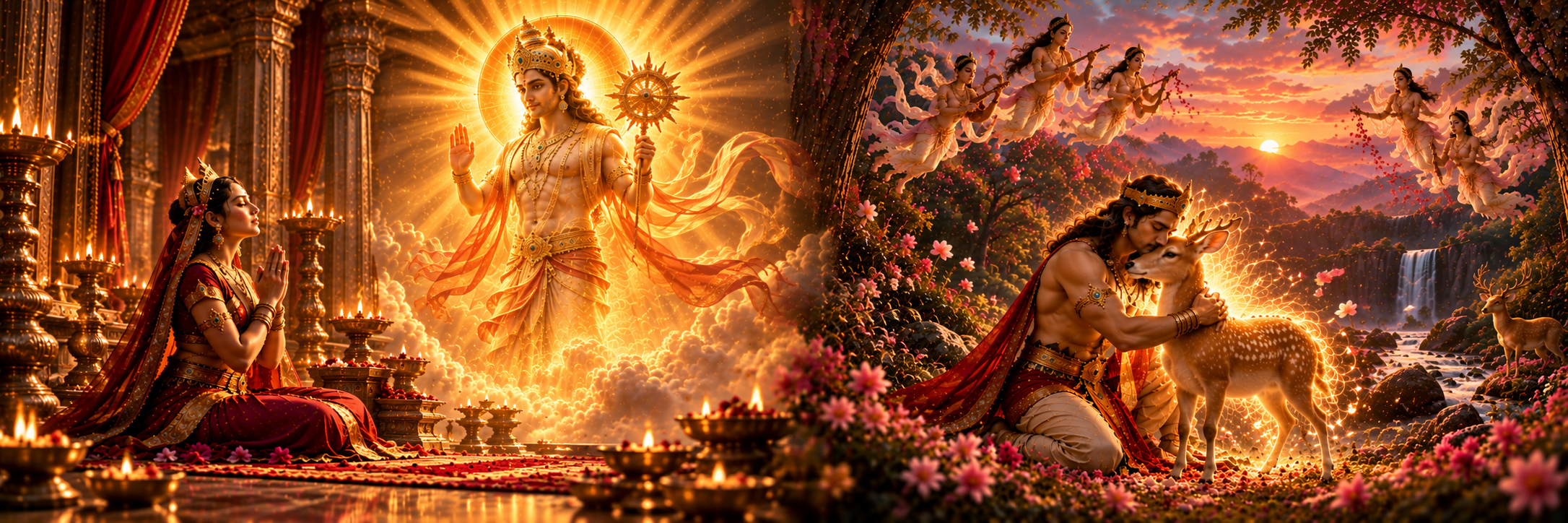
Six sons granted to two queens by invoked gods, conception substituted but gestation left ordinary. Five future kings foretold by a sage's touch alone. A doe who delivers the instant she is embraced, by a forest deity's grace alone. A child of the wind who arrives by several routes. And a boon that delivers a daughter promised to become a man.
Read the full piece →Part IX — In the Womb, Already Shaped
In the Womb, Already Shaped
A child's trait, affliction, knowledge, or fate fixed before birth ever occurs — during conception, or across the months of gestation.
In the Womb, Already Shaped Live
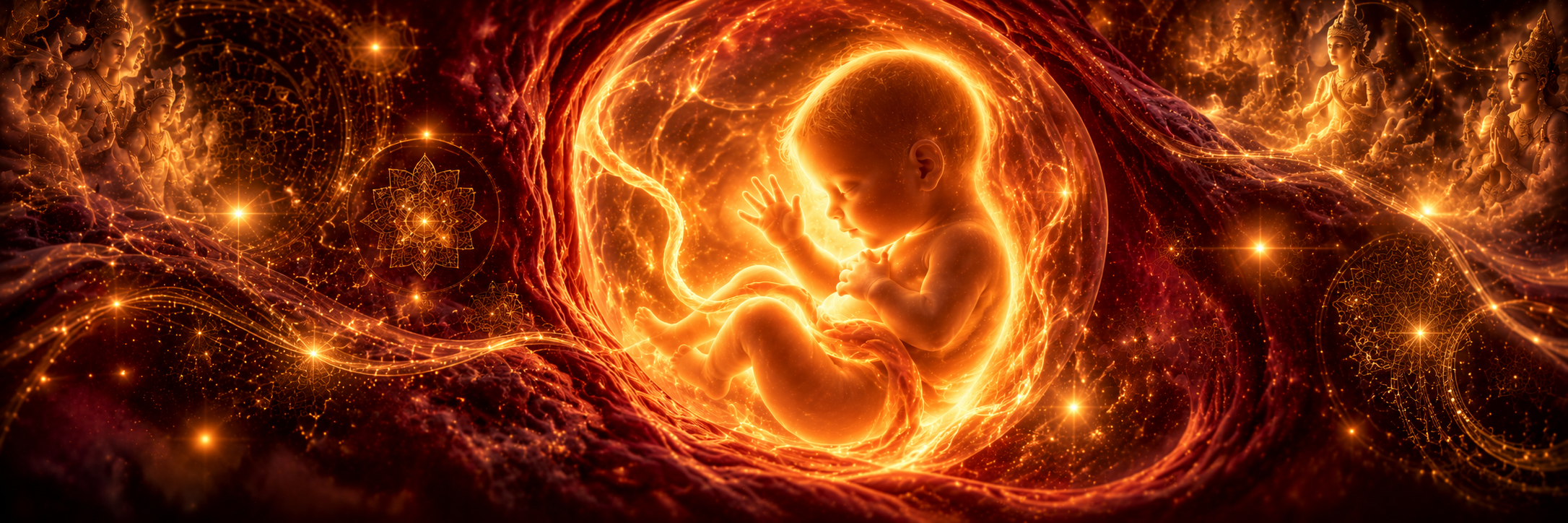
A mother's fear during a sanctioned union marks the child. A fetus's own boldness draws a curse before it is born. Another recites the Vedas or absorbs a sage's teaching from the womb. And one is struck down and remade, the event itself fixing who he will spend his life searching for.
Read the full piece →Part X — Hatched, Not Born
Hatched, Not Born
Births by egg, or by union in animal form, with the human womb absent either way.
Hatched, Not Born Live
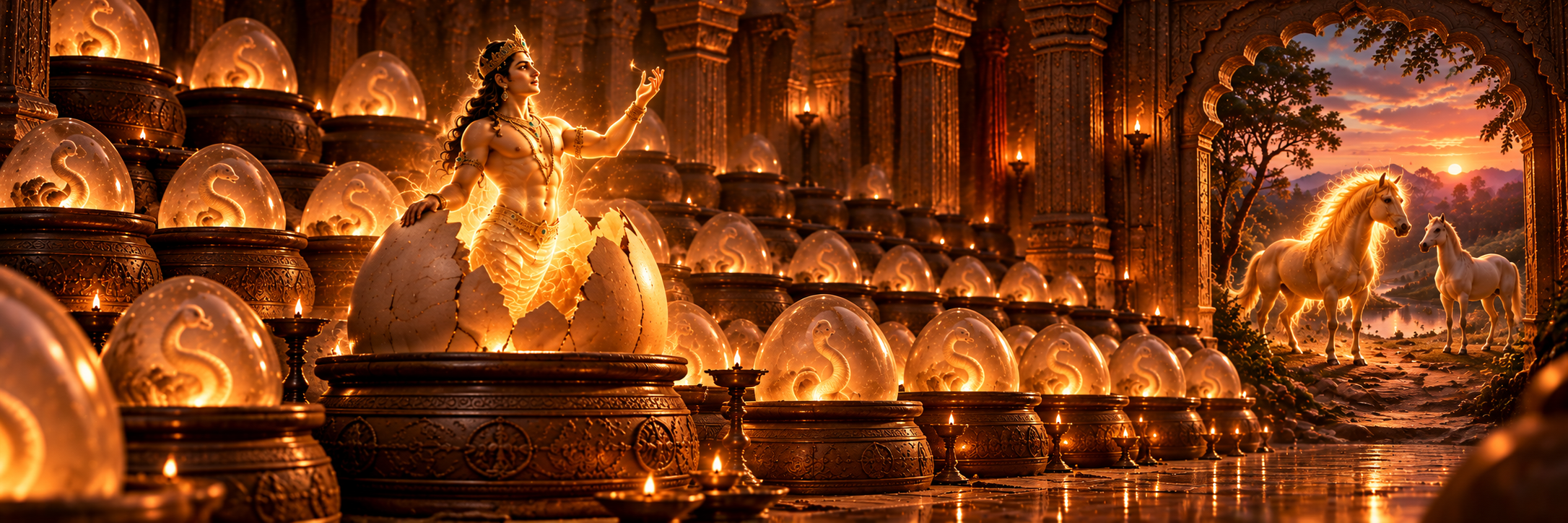
A thousand eggs kept warm in jars for five hundred years. One broken open too soon, leaving a son unfinished. And twin gods born when a goddess takes the form of a mare and the sun follows as a stallion.
Read the full piece →Unusual Births is part of the Puranic Stories narrative track on FamilyRoots.in, alongside the Saptarishi Chronicles, the Jyotirlingas, Text and Tradition, and Personifications. Where Personifications asks how an abstraction becomes a deity, this series asks a narrower question of each figure: not what they represent, but what stood in for the ordinary act of birth when the tradition needed them to exist.