
This article covers Vamana as an incarnation in its own right — why Vishnu took this particular form and what it represents theologically and iconographically. The full narrative, including Bali's rise to sovereignty over the three worlds and the confrontation over his boon, is told in complete detail in The Twelve Cosmic Wars — Bali's Sovereignty.
Context of Incarnation
Vamana marks a real turn in the character of the avatara's opponents. Bali, grandson of Prahlada — the devotee Narasimha protected a generation earlier — is not a tyrant in the mold of Hiranyakashipu. He is generous, pious, keeps his word absolutely, and by most measures rules justly. His fault is scale, not cruelty: through his own austerities and his grandfather's legacy, he has extended his sovereignty over all three worlds, displacing Indra and the Devas from their own domain. There is no atrocity here to punish, which makes Vamana the first avatara in the sequence built around restraint rather than destruction — Bali is not killed, and by several accounts is treated with more honor after his defeat than most kings receive in victory.
The chosen form makes the same point as the outcome. Vishnu does not confront Bali as a warrior or a rival king; he arrives as a modest brahmin dwarf, asking for the smallest conceivable gift — three paces of land, measured by his own small steps. Bali's undoing is not force meeting force but his own generosity meeting a gift whose true size he has no way to anticipate.
Bali's rise to sovereignty over the three worlds, his court's attempt to warn him against the request, and the full sequence of the three steps are told in complete detail in the Twelve Cosmic Wars series.
Read the Bali War →Symbolism & Iconography
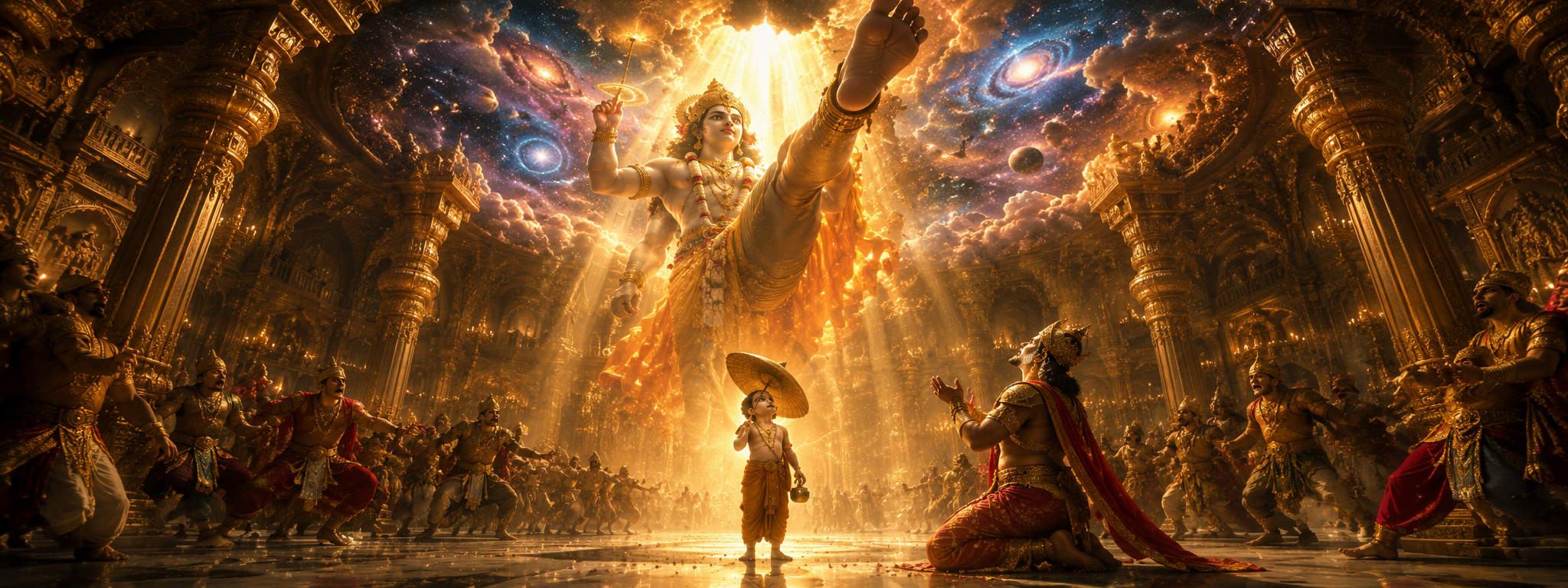
Vamana's story turns on a single image: the dwarf who becomes a giant mid-stride. In two steps, Trivikrama — "the one who took three strides," the form Vamana expands into — covers the earth and the sky; the third step, by every version's telling, has no more room to go, and Bali offers his own head as the place for it to land. The escalation from smallest to largest possible form, compressed into three literal steps, does more theological work than a lengthy battle could: it demonstrates that Vishnu's power was never absent from the humble form, only withheld, and that the measure of the cosmos was always available to him in three paces.
Iconographically, Vamana appears in two distinct and clearly separated moments rather than one composite image: as the small, unassuming brahmin with a water pot, sacred thread, and palm-leaf umbrella, standing before Bali's court; and as Trivikrama, shown with one leg raised vertically past his own head, sometimes to a right angle or higher, spanning earth and heaven in a single captured stride. Temple sculpture and painting generally choose one moment or the other rather than blending them, unlike the ardha-forms of Matsya, Varaha, and Narasimha.

The small, unassuming form in which Vishnu approached Bali's court — the counterpart to Trivikrama's cosmic stride.
The essential sequence — the brahmin's request, Bali's guru Shukracharya's warning, the granting of the boon, and the three steps — is stable across the Bhagavata Purana, Vishnu Purana, and Vamana Purana, which again takes its name from this avatara while ranging well beyond the avatara narrative in its actual content. Accounts differ chiefly on Bali's fate afterward: most describe him honored with sovereignty over the netherworld Patala and a promise of eventual Indraship in a future age, rather than any form of punishment, though the precise terms of that promise vary between sources.
Vamana closes the four-avatara block that this project treats separately from its Twelve Cosmic Wars companion articles, and does so on a markedly different note than Varaha or Narasimha: no adversary dies, and the "defeated" king is honored rather than destroyed. It also completes a genealogical arc spanning three avataras — Narasimha protects Prahlada, and here, a generation later, Vishnu returns to humble Prahlada's own grandson, not out of hostility toward that lineage but because even righteous power, left unchecked, eventually needs a boundary set on it.
References
Primary Sources
- Bhagavata Purana 8.15–23 — Bali's rise, the brahmin's request, and the three steps in full.
- Vishnu Purana 1.20 — parallel account of the boon and Bali's subsequent fate.
- Vamana Purana, chapters 1–7 — avatara narrative within a larger compendium.
Secondary Sources
- Dimmitt, Cornelia, and van Buitenen, J.A.B. Classical Hindu Mythology: A Reader in the Sanskrit Puranas. Temple University Press, 1978.
- Mani, Vettam. Puranic Encyclopaedia. Motilal Banarsidass, 1975. Entries: "Vamana," "Bali," "Trivikrama."
This article covers the avatara's theology, symbolism, and sourcing only. For the complete narrative of Bali's sovereignty and its resolution, see The Twelve Cosmic Wars — Bali's Sovereignty.