
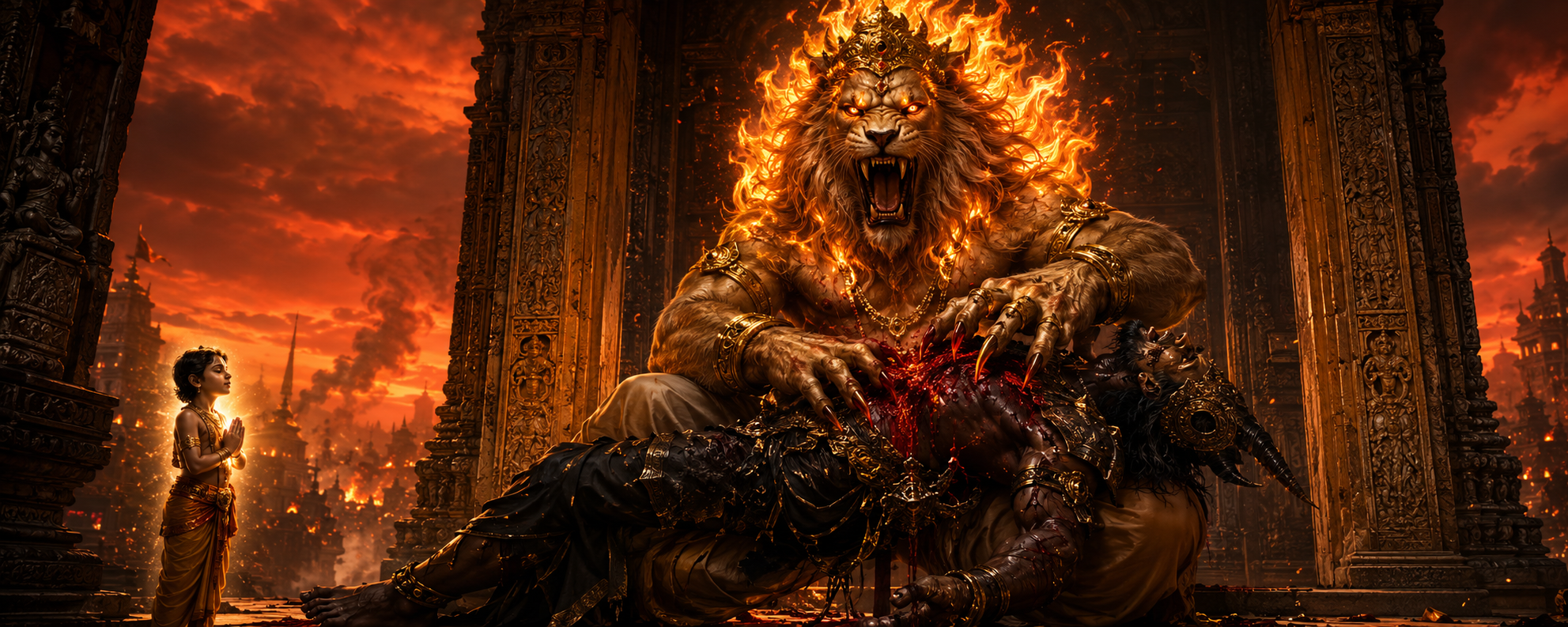
This article covers Narasimha as an incarnation in its own right — why Vishnu took this particular form and what it represents theologically and iconographically. The full battle narrative, including Hiranyakashipu's tyranny, Prahlada's devotion under threat, and the confrontation at the pillar, is told in complete detail in The Twelve Cosmic Wars — the Hiranyakashipu War.
Context of Incarnation
Narasimha solves a problem none of the preceding avataras faced: an adversary rendered functionally invincible not by strength but by the precise wording of a boon. Hiranyakashipu, brother of the slain Hiranyaksha, undertakes severe austerities and wins from Brahma a boon that he cannot be killed by man or animal, indoors or outdoors, by day or by night, on the earth or in the sky, nor by any weapon, living or dead being. He takes the protection as license, turns tyrant, and demands worship in Vishnu's place — a demand he presses even against his own son Prahlada, whose devotion to Vishnu never wavers despite his father's escalating cruelty.
Vishnu's answer is not force but form itself: a being that is neither man nor animal, neither of the day nor the night, appearing neither indoors nor outdoors, wielding no weapon but his own claws, at the threshold of a doorway at twilight. Narasimha does not overpower the boon; he simply falls entirely outside every category the boon was written to cover. It is the only avatara in the sequence whose central act is essentially an act of interpretation — finding the gap in the wording rather than the gap in the tyrant's defenses.
Hiranyakashipu's rise to tyranny, Prahlada's trials, and the confrontation at the pillar are told in full in the Twelve Cosmic Wars series.
Read the Hiranyakashipu War →Symbolism & Iconography
Narasimha is usually read as the fiercest (ugra) of the ten avataras, and its iconography reflects that directly: bared claws, a mane rendered mid-motion, an expression of undisguised rage rarely given to Vishnu's other forms. Temple and devotional traditions balance this ferocity with its opposite — Narasimha calmed, most often shown seated in serene meditation once Hiranyakashipu is dead and Prahlada's devotion is vindicated, sometimes accompanied by Lakshmi placating him. The two moods, ugra and shanta, are treated as two faces of the same avatara rather than two different beings, and both appear extensively across South Indian temple traditions in particular.
Iconographically, Narasimha follows the hybrid convention seen in Varaha rather than Kurma's fully theriomorphic form: a lion's head on a powerful human body, usually four-armed, frequently shown in the specific narrative posture of the pillar-emergence or the lap-disembowelment rather than in a static standing pose — one of the few avataras whose most common image is a frozen action rather than a portrait.
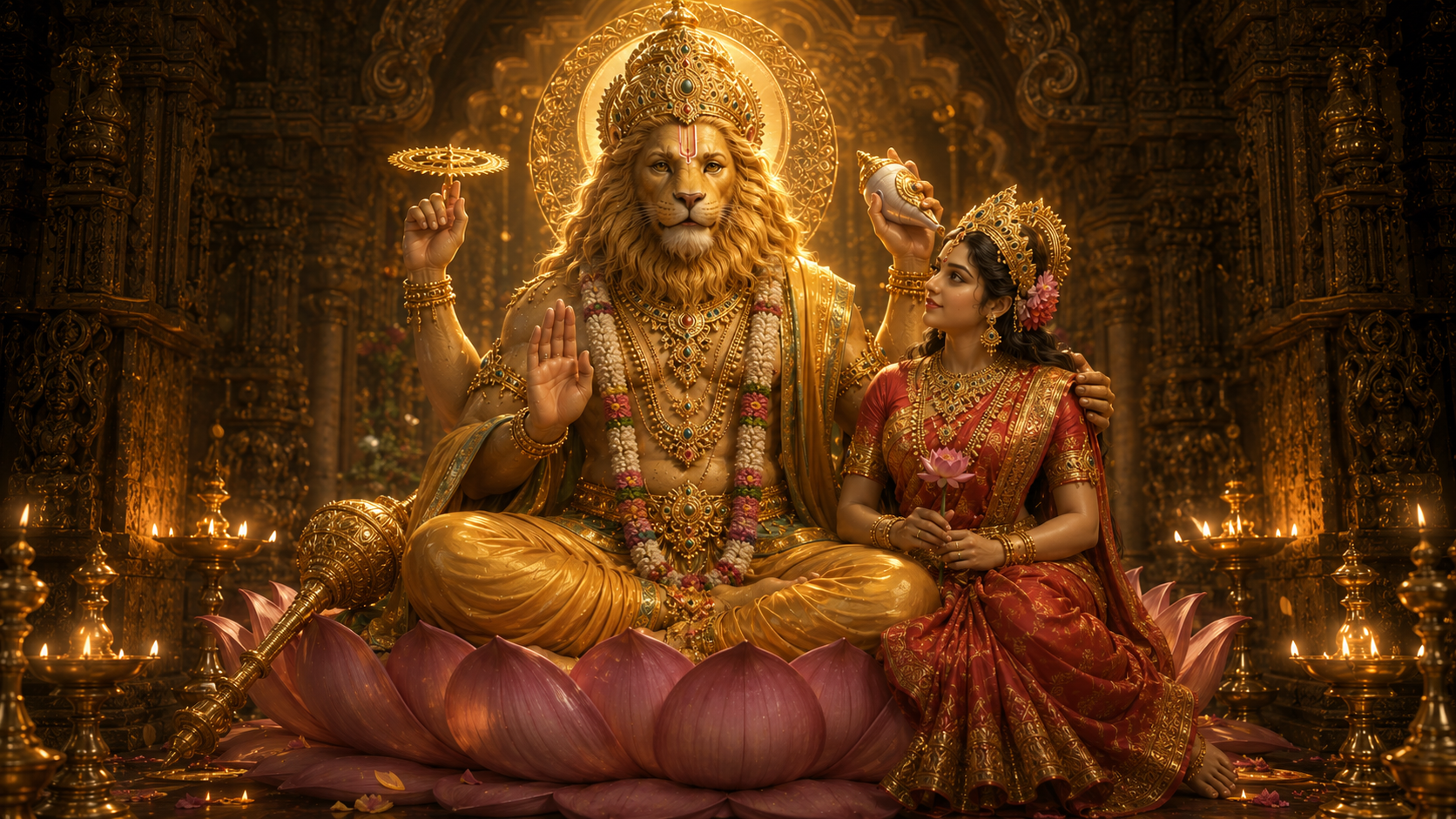
The shanta (calmed) form, temple tradition's counterpart to the fierce moment of the pillar and the threshold.
The core structure of the boon and its circumvention is stable across the Bhagavata Purana, Vishnu Purana, and Narasimha Purana — itself another Purana carrying an avatara's name while covering considerably more ground than the avatara narrative alone. Sources vary in the precise wording and count of the boon's conditions (some tellings list five, others enumerate as many as seven), and in whether Hiranyakashipu is killed with claws alone or with an additional weapon fashioned from wood or bone at the threshold of the doorway; this article follows the more widely attested claws-only version.
Narasimha completes the pair begun with Varaha — both brothers, Hiranyaksha and Hiranyakashipu, meet Vishnu in the same age, each requiring a different kind of solution to a different kind of threat. It also establishes protection of a devotee, rather than defense of a cosmic principle, as sufficient grounds for an avatara — a theme Krishna will return to at far greater scale. The lineage this avatara protects continues directly into the next: Prahlada's grandson, Bali, is the very king whom Vishnu will confront — far more gently — as Vamana.
References
Primary Sources
- Bhagavata Purana 7.8 — the confrontation at the pillar and Hiranyakashipu's death.
- Bhagavata Purana 7.3–7 — Hiranyakashipu's austerities, the boon, and Prahlada's trials.
- Vishnu Purana 1.20 — parallel account of the boon and its circumvention.
- Narasimha Purana, chapters 36–39 — avatara narrative within a larger compendium.
Secondary Sources
- Dimmitt, Cornelia, and van Buitenen, J.A.B. Classical Hindu Mythology: A Reader in the Sanskrit Puranas. Temple University Press, 1978.
- Mani, Vettam. Puranic Encyclopaedia. Motilal Banarsidass, 1975. Entries: "Narasimha," "Hiranyakashipu," "Prahlada."
This article covers the avatara's theology, symbolism, and sourcing only. For the complete battle narrative, see The Twelve Cosmic Wars — the Hiranyakashipu War.