
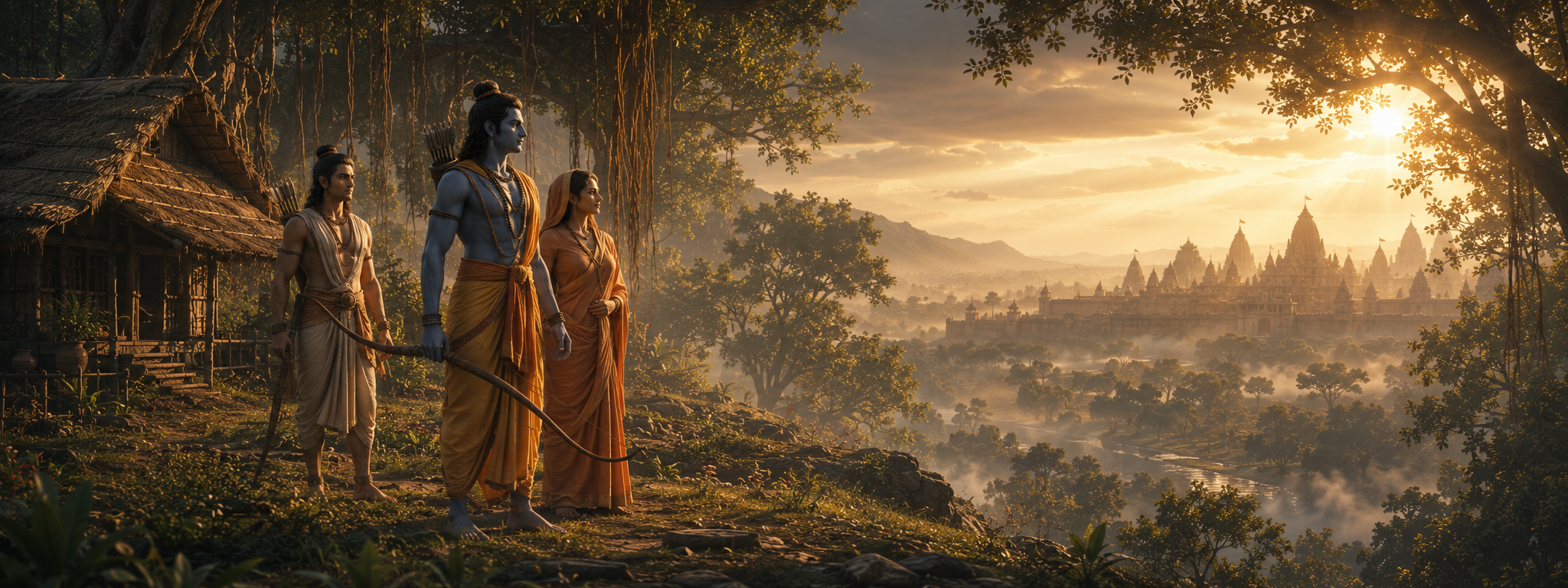
Rama's story is the longest single narrative in the Dashavatara series, and this master article follows the Ramayana's own seven-kanda structure directly — each traditional kanda becomes its own chapter below, including the Uttara Kanda, whose place in the canon is genuinely disputed and is addressed on its own terms rather than silently folded in.
Context of Incarnation
Ravana, the Rakshasa king of Lanka, wins from Brahma a boon of near-total invulnerability — protection against gods, demons, gandharvas, and other classes of supernatural being, a request that in his pride leaves out one category he judged beneath any real threat: ordinary humans. The pattern echoes Hiranyakashipu's boon two avataras earlier, and the solution echoes the earlier logic too: Vishnu answers a boon's blind spot not by overpowering it but by incarnating exactly where the boon does not reach. Where Narasimha achieved this through a form outside every category, Rama achieves it through the most ordinary category available — full, unambiguous human birth, growth, marriage, exile, and loss, lived out over an entire lifetime rather than a single confrontation.
This is also the clearest expression in the entire Dashavatara of dharma enacted through personal constraint rather than force. Rama's defining trait across all seven kandas is not martial power — considerable as that is — but his refusal to break a promise regardless of what it costs him: exile accepted without complaint to honor his father's word, single-minded fidelity to one wife, a public standard of conduct he holds himself to even when it visibly costs him personal happiness. The epithet Maryada Purushottama — the ideal man, bound by propriety — is Rama's alone among the ten avataras.
| Figure | Role |
|---|---|
| Dasharatha | King of Ayodhya, Rama's father |
| Kausalya, Kaikeyi, Sumitra | Dasharatha's three queens; mothers of Rama, Bharata, and Lakshmana & Shatrughna |
| Sita | Rama's wife, daughter of King Janaka of Mithila |
| Lakshmana, Bharata, Shatrughna | Rama's three brothers |
| Ravana | Rakshasa king of Lanka, Rama's central adversary |
| Hanuman | Vanara devotee, central to the search for Sita and the war |
| Sugriva & Vibhishana | Rama's vanara and Rakshasa allies respectively |
The Seven Kandas
Each chapter below is summarized here and told in full in its own article.
Birth and Youth
The birth of the four princes through Dasharatha's Putrakameshti sacrifice, Rama and Lakshmana's training under the sage Vishwamitra, the killing of the demoness Tataka, and Sita's swayamvara at Mithila — where Rama breaks Shiva's great bow and, in the same episode, meets Parashurama in the encounter already told in this series.
Read Kanda I →Exile
Dasharatha's plan to crown Rama unravels when Kaikeyi calls in two old boons — Rama's fourteen-year exile and Bharata's coronation. Rama accepts without protest, Dasharatha dies of grief, and Bharata refuses the throne he never sought, ruling instead as regent in Rama's name.
Read Kanda II →The Forest and the Abduction
The years of forest exile, Surpanakha's mutilation and the battle against Khara and Dushana that follows it, Maricha's disguise as a golden deer, and Ravana's abduction of Sita — with the vulture Jatayu's doomed attempt to stop him.
Read Kanda III →The Vanara Alliance
Rama's meeting with Hanuman and Sugriva, the killing of the usurper Vali, and the mobilization of the vanara search parties across the four directions to find Sita.
Read Kanda IV →Hanuman's Leap
Hanuman's crossing of the ocean, his discovery of Sita in the Ashoka Vatika, the burning of Lanka, and his return with news that turns the search into a war.
Read Kanda V →The War
The building of the great bridge, the war against Lanka's armies, the deaths of Kumbhakarna and Indrajit, Rama's final duel with Ravana, Sita's trial by fire, and the return to Ayodhya for Rama's coronation.
Read Kanda VI →Aftermath
Sita's second exile amid public doubt, her years at Valmiki's hermitage, the birth of Luv and Kusha, and the story's end — told here with an explicit note on why many traditions treat this final kanda as a later addition to Valmiki's original text.
Read Kanda VII →Symbolism & Legacy
Rama's most distinctive theological contribution to the Dashavatara is the idea of divinity expressed through voluntary limitation rather than power exercised freely. He observes eka-patni-vrata (fidelity to a single wife) and eka-vachana (a single, unbreakable word) as absolute personal disciplines, even where they cause him direct suffering — most visibly in the exile itself and, depending on how a reader approaches the Uttara Kanda, in what follows it. The ideal of Rama Rajya — governance so just that it becomes the standard against which all later kingship is measured — draws directly from this same constraint: a ruler bound by the same dharma he asks of his subjects, rather than exempt from it.
Rama's cultural presence extends well beyond the Sanskrit textual tradition. Tulsidas's Awadhi-language Ramcharitmanas and Kamban's Tamil Ramavataram are both major devotional retellings in their own right, each shaping regional Rama worship as much as Valmiki's original does, and Diwali's most widespread association — Rama's return to Ayodhya after exile — is itself drawn from the Yuddha Kanda's close.
The Uttara Kanda's authorship and canonical status are genuinely contested within scholarship — many textual historians consider it, along with the Bala Kanda, a later addition to a core narrative that may originally have run from the Ayodhya through the Yuddha Kanda alone. This series includes it as its own chapter, consistent with its place in the received Valmiki Ramayana as most traditions transmit it, but the variant-canonicity question is addressed directly in that chapter rather than left unstated.
Rama is the first avatara whose story this project follows across an entire human lifetime, birth to reign, with the constraint of personal virtue functioning as the central plot mechanism rather than force. He shares Parashurama's fully human birth but not his method — where Parashurama corrects by the axe, Rama corrects by example, at a cost to himself the text never minimizes. Krishna, the avatara that follows him, will draw on both approaches at once, and at a scale — statesman, teacher, and warrior together — that the tradition regards as the fullest single expression of the avatara doctrine.
References
Primary Sources
- Valmiki Ramayana, Bala Kanda — birth, training, and marriage.
- Valmiki Ramayana, Ayodhya Kanda — the exile.
- Valmiki Ramayana, Aranya Kanda — the forest years and Sita's abduction.
- Valmiki Ramayana, Kishkindha Kanda — the vanara alliance.
- Valmiki Ramayana, Sundara Kanda — Hanuman's mission to Lanka.
- Valmiki Ramayana, Yuddha Kanda — the war and coronation.
- Valmiki Ramayana, Uttara Kanda — the disputed final book.
Secondary Sources
- Goldman, Robert P. (ed.). The Ramayana of Valmiki: An Epic of Ancient India. Princeton University Press, several volumes, 1984–2016 — the standard critical edition and translation, with extensive notes on textual layers and dating.
- Mani, Vettam. Puranic Encyclopaedia. Motilal Banarsidass, 1975. Entry: "Rama."
- Richman, Paula (ed.). Many Ramayanas: The Diversity of a Narrative Tradition in South Asia. University of California Press, 1991.
Regional and devotional retellings (Kamban's Ramavataram, Tulsidas's Ramcharitmanas, the Adhyatma Ramayana) are noted where they meaningfully diverge from Valmiki's account; detailed sourcing for each divergence is given in the relevant chapter article.