
The Bala Kanda covers Rama's birth through his marriage to Sita — the youth that precedes everything the rest of this series will follow. It also contains the encounter with Parashurama, told in full elsewhere in this project; here it is treated briefly, as one event within a fuller sequence, rather than repeated in detail.
The Putrakameshti Yagna
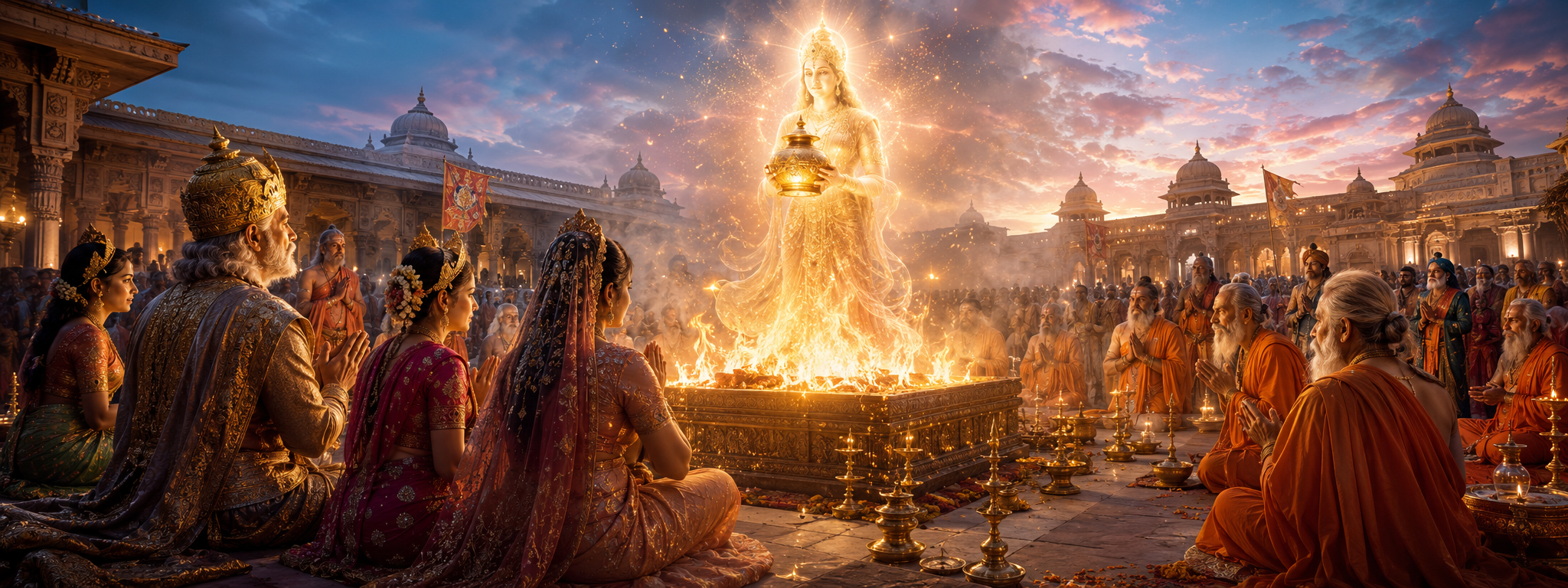
King Dasharatha of Ayodhya, aging and without an heir despite three queens — Kausalya, Kaikeyi, and Sumitra — performs the Putrakameshti, a great sacrifice for the birth of sons, at the sage Rishyasringa's guidance. From the sacrificial fire itself, a divine figure emerges bearing a vessel of sacred payasam, which Dasharatha divides among his queens. Kausalya bears Rama; Kaikeyi bears Bharata; Sumitra, receiving a double portion, bears the twins Lakshmana and Shatrughna. Vishnu's decision to incarnate as Rama specifically — the eldest, Kausalya's son — is treated by the tradition as already settled before the sacrifice itself, the birth arranged rather than accidental.
Vishwamitra's Protection
Years later, the sage Vishwamitra arrives at Dasharatha's court asking that the young Rama, barely into his teens, accompany him to protect an ongoing sacrifice from demonic interference — specifically from the demoness Tataka and her allies, who have been disrupting Vedic rites in the forest. Dasharatha, reluctant to send his son into danger, is persuaded by Vishwamitra's insistence and by his own sage Vasishtha's counsel. Rama, accompanied by Lakshmana, kills Tataka at Vishwamitra's direct instruction — a killing the text itself treats as morally weighted rather than casual, since Tataka is a woman, and Rama's initial hesitation before Vishwamitra insists the act is necessary is preserved in the telling rather than smoothed over.
The sacrifice secured, Vishwamitra takes the two princes onward toward Mithila, teaching them advanced weapons and, along the way, recounting the story of Ahalya — a sage's wife turned to stone (in some tellings, rendered invisible or subtly present rather than literally stone) after a lapse involving the god Indra, and released from the curse at Rama's mere touch or presence as he passes through the site.
| Figure | Role in This Kanda |
|---|---|
| Dasharatha | King of Ayodhya, father of the four princes |
| Vishwamitra | Sage who takes Rama and Lakshmana for training and protection |
| Tataka | Demoness disrupting Vishwamitra's sacrifice, killed by Rama |
| Ahalya | Sage's wife released from a curse at Rama's presence |
| Janaka | King of Mithila, Sita's father, host of the swayamvara |
| Sita | Janaka's daughter, won by Rama at the swayamvara |
The Swayamvara at Mithila
At Mithila, King Janaka has set an unusual condition for his daughter Sita's marriage: whoever can string — or, in the more dramatic tellings, break — Shiva's great bow, kept in his court since ancient times, will win her hand. Numerous kings and princes have already failed even to lift it. Rama approaches the bow at Vishwamitra's urging and breaks it with what the text describes as minimal visible effort, a moment that instantly resolves the contest and horrifies the assembled court with its display of power.
The breaking of the bow draws Parashurama to the assembly — furious at what he reads as an insult to Shiva and to himself as Shiva's disciple. His challenge to Rama, and Rama's response, are told in full in this project's Parashurama chapter rather than repeated here. The encounter ends with Parashurama's recognition of Rama and his own withdrawal from the story. Following it, Janaka arranges not one marriage but four: Sita to Rama, and her sister and cousins — Urmila, Mandavi, and Shrutakirti — to Lakshmana, Bharata, and Shatrughna respectively, in a single joint ceremony.
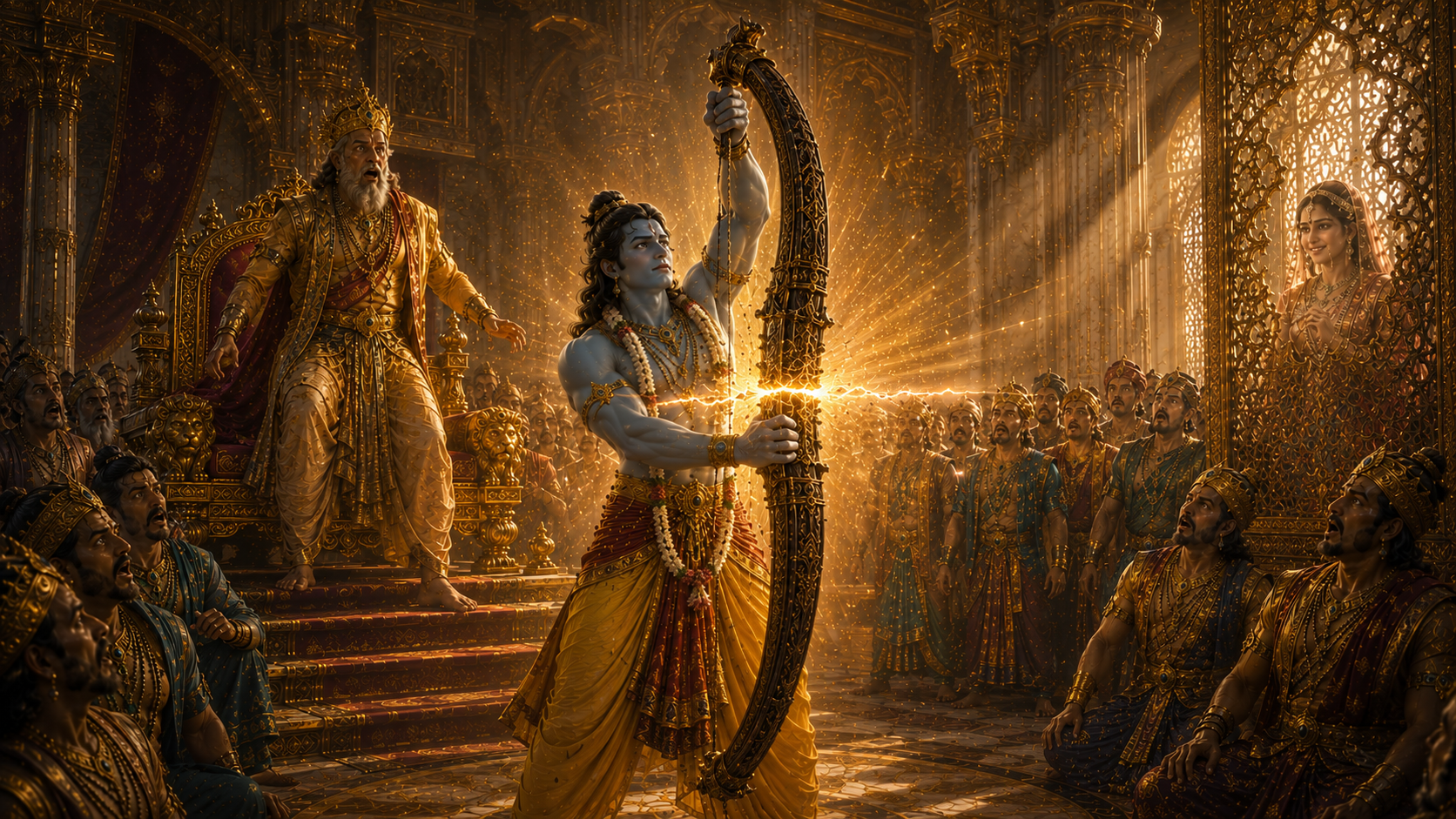
The moment that ends the swayamvara contest — and begins the encounter with Parashurama told elsewhere in this series.
Accounts vary on whether the bow is merely strung or fully broken — Valmiki's text favors breaking, while some regional retellings (notably Tulsidas's Ramcharitmanas) linger on the moment differently, with Sita's own reaction given more attention than in the Sanskrit original. The Ahalya episode also varies meaningfully across sources on the nature of her curse — literal petrification, invisibility, or a subtler diminished state — and on whether her release comes from Rama's touch, his glance, or simply his presence nearby; this article follows the touch-or-presence version most widely cited without asserting it as the single correct reading.
The four newly married couples return to Ayodhya, where Dasharatha, now aged, begins to plan for Rama's coronation as heir — a plan the Ayodhya Kanda overturns within its opening chapters.
References
Primary Sources
- Valmiki Ramayana, Bala Kanda, chapters 14–17 — the Putrakameshti and the princes' birth.
- Valmiki Ramayana, Bala Kanda, chapters 22–30 — Vishwamitra's protection, Tataka, and Ahalya.
- Valmiki Ramayana, Bala Kanda, chapters 66–76 — the swayamvara, the breaking of the bow, and the encounter with Parashurama.
Secondary Sources
- Goldman, Robert P. (ed.). The Ramayana of Valmiki: Bala Kanda. Princeton University Press, 1984.
- Mani, Vettam. Puranic Encyclopaedia. Motilal Banarsidass, 1975. Entries: "Rama," "Ahalya," "Tataka."
The Parashurama encounter within this kanda is documented in full in this project's Parashurama chapter (Kartavirya Arjuna and the Campaigns) rather than repeated here.