
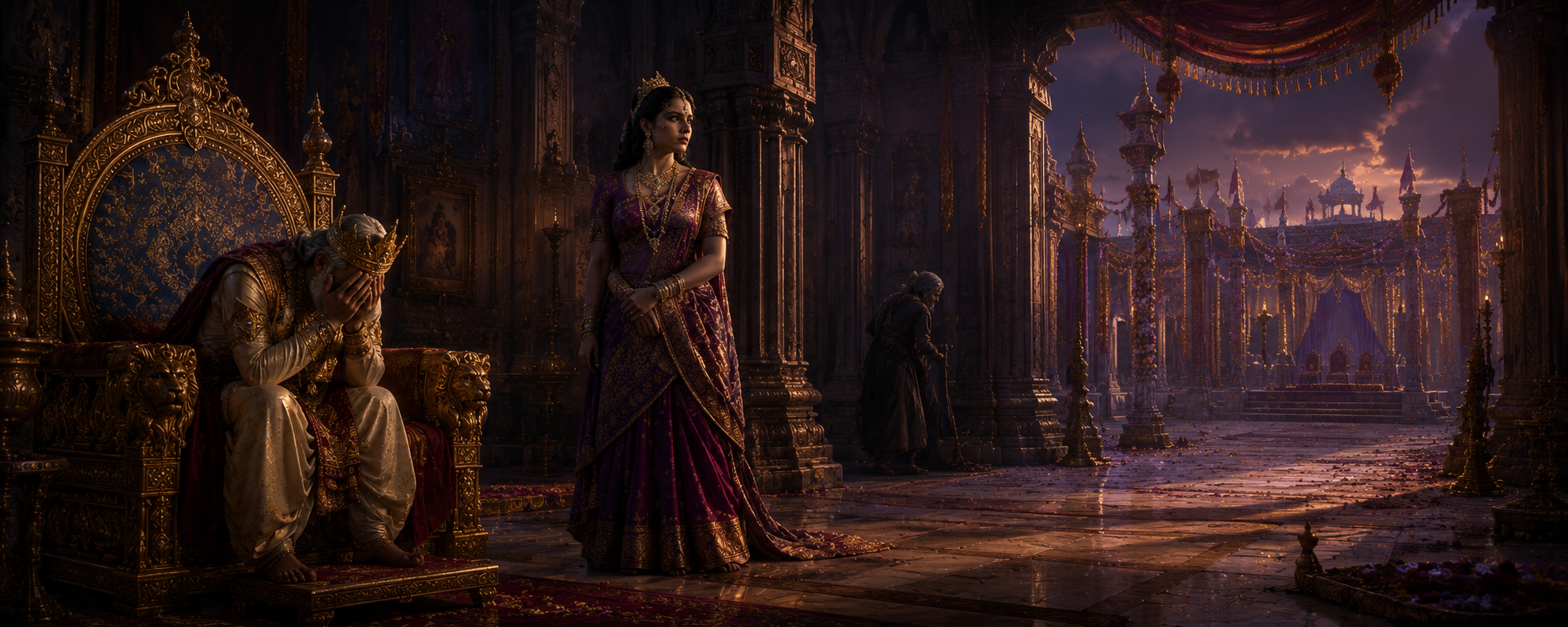
The Ayodhya Kanda contains no battle and no demon, and is nonetheless among the most consequential books of the entire epic: a father's promise, a mother's fear, and a son's refusal to let either be broken, even at the cost of everything he was about to inherit.
The Coronation That Was Never Held
Dasharatha, now old, resolves to crown Rama as his heir and co-regent, and the announcement is met with near-universal joy across Ayodhya. On the eve of the ceremony, Kaikeyi's maidservant Manthara — described across the tradition as sharp-tongued and deeply loyal to her mistress's own standing — plants the fear that Rama's coronation means Kaikeyi's and Bharata's marginalization at court. Manthara reminds Kaikeyi of two boons Dasharatha swore her years earlier, after she saved his life in battle during a war against the Asuras, boons Kaikeyi had never yet claimed.
Kaikeyi, persuaded, calls in both: Bharata crowned in Rama's place, and Rama exiled to the forest for fourteen years. Dasharatha, bound by his own word — a king's promise, in this tradition, functioning as an inviolable debt regardless of what it costs to honor — is destroyed by the demand but cannot refuse it without breaking a vow he had sworn absolutely.
| Figure | Role in This Kanda |
|---|---|
| Kaikeyi | Dasharatha's second queen, Bharata's mother, who calls in the two boons |
| Manthara | Kaikeyi's maidservant, who first raises the fear that leads to the demand |
| Dasharatha | King of Ayodhya, bound by his own promise |
| Bharata | Crowned against his will; refuses the throne on his return |
| Sumantra | Royal charioteer who carries Rama, Sita, and Lakshmana into exile |
| Urmila | Lakshmana's wife, who remains in Ayodhya during the exile |
Rama's Acceptance
Rama receives the news without protest, anger, or any attempt to contest the succession by force — a response the text treats as the moment his defining character fully declares itself. He insists on leaving immediately rather than delaying, refuses every suggestion that he simply take the throne regardless, and comforts his grieving father rather than the reverse. Sita insists on accompanying him despite his direct attempts to dissuade her from a life of forest hardship, and Lakshmana likewise refuses to remain behind, leaving his own wife Urmila in Ayodhya for the duration.
Sumantra drives the three of them out of the city in the royal chariot; grieving citizens follow the procession for some distance before being persuaded to turn back. The three cross the Ganga and begin the forest years that will occupy the rest of Rama's exile.
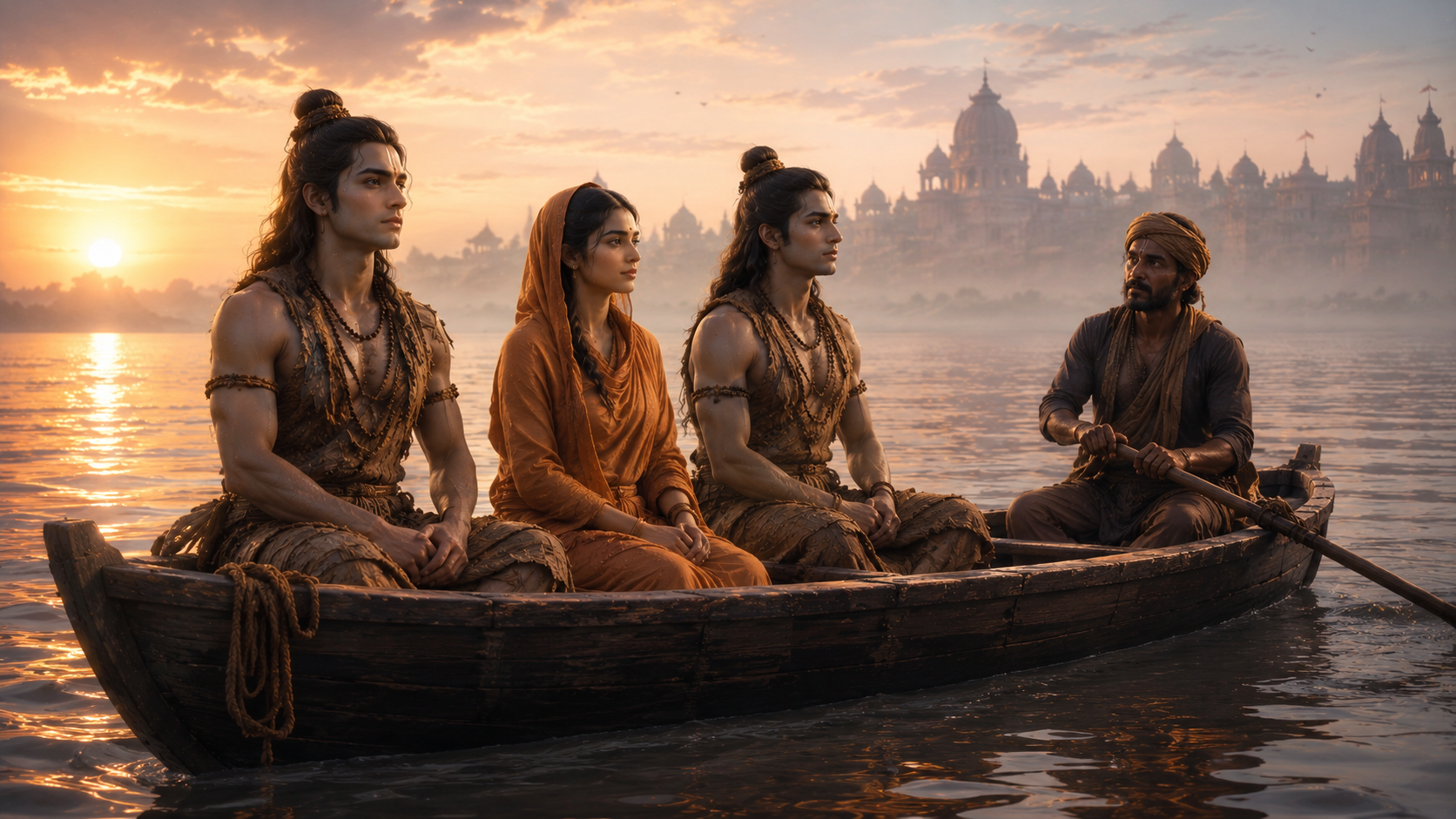
The crossing that marks the true beginning of the exile — the last sight of Ayodhya for fourteen years.
Dasharatha's Death and Bharata's Return
Dasharatha, unable to bear the separation, dies within days of Rama's departure, calling his son's name. Before his death he recalls an old curse laid on him in his youth: hunting by sound alone, he had accidentally killed a young man named Shravana Kumar as he drew water for his blind, elderly parents, and the grieving father had cursed Dasharatha to one day die of sorrow for his own son — a curse the text presents as having waited decades to come due.
Bharata, away at his maternal uncle's kingdom of Kekaya at the time of these events, returns to find his father dead and himself crowned against his knowledge or consent. Horrified, he publicly rebukes his mother for what she has done, refuses the throne outright, and travels to the forest to beg Rama to return and rule. Rama, bound now by his father's word even after his father's death, refuses to break the exile early. The two brothers reach a resolution that satisfies neither completely: Bharata carries Rama's sandals back to Ayodhya, places them on the throne as a symbol of Rama's continuing sovereignty, and rules as regent from Nandigrama just outside the capital, living an ascetic's life himself and counting the days until the fourteen years end.
The two boons and Manthara's role in provoking Kaikeyi are consistent across sources, though some retellings give Kaikeyi's own political anxiety about the Kekaya-Ayodhya succession balance more independent weight, rather than treating her decision as entirely the product of Manthara's manipulation. One widely known element of the exile — that Urmila slept through all fourteen years so that Lakshmana, who forgoes sleep to guard Rama and Sita, would not have to bear the burden alone — is a popular regional and folk elaboration found in later Awadhi and Maithili tradition rather than in Valmiki's original Sanskrit text, and is presented here as such rather than as part of the base narrative.
With Ayodhya settled under Bharata's careful regency, Rama, Sita, and Lakshmana move deeper into the forest, beginning the years covered in the Aranya Kanda — years that end with the event the rest of the epic turns on.
References
Primary Sources
- Valmiki Ramayana, Ayodhya Kanda, chapters 7–12 — Manthara's persuasion and Kaikeyi's demand.
- Valmiki Ramayana, Ayodhya Kanda, chapters 16–40 — Rama's acceptance and the departure.
- Valmiki Ramayana, Ayodhya Kanda, chapters 63–65 — Dasharatha's death and the Shravana Kumar curse.
- Valmiki Ramayana, Ayodhya Kanda, chapters 90–116 — Bharata's return and the sandals.
Secondary Sources
- Goldman, Robert P. (ed.). The Ramayana of Valmiki: Ayodhya Kanda. Princeton University Press, 1986.
- Mani, Vettam. Puranic Encyclopaedia. Motilal Banarsidass, 1975. Entries: "Kaikeyi," "Bharata," "Manthara."
The Urmila-sleep tradition is a well-known folk and regional elaboration, noted here as distinct from Valmiki's Sanskrit text.