
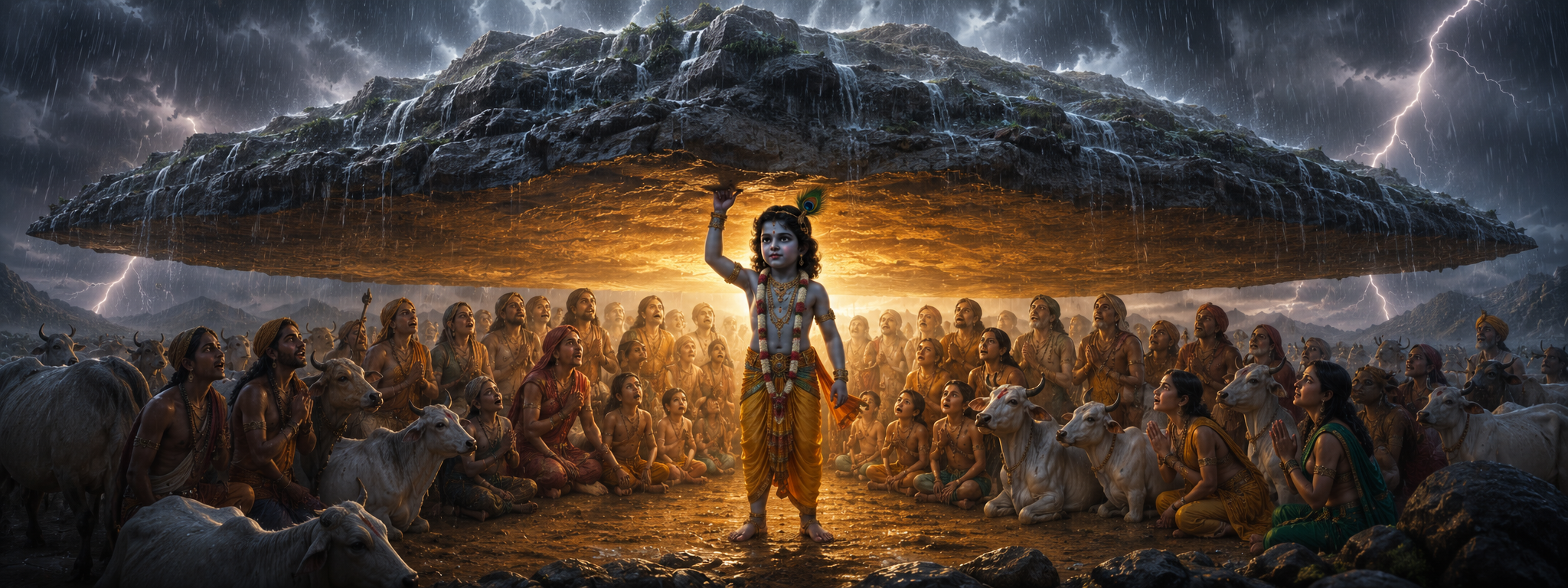
This chapter covers Krishna's birth through his youth in Vrindavana — the childhood that gives Krishna devotion its most beloved imagery, and lays the groundwork, in Kamsa's fear and hostility, for the confrontation the next chapter resolves.
Birth in Captivity
Kamsa, tyrant king of Mathura, is warned by a divine voice that the eighth child of his own sister Devaki will cause his death. He imprisons Devaki and her husband Vasudeva, killing each of their children as they are born; six die this way, and in most tellings a seventh — Balarama — is mystically transferred from Devaki's womb to that of Rohini, Vasudeva's other wife, escaping Kamsa's notice entirely and being born separately in Vrindavana. Krishna, the eighth child, is born at midnight under circumstances the text renders as openly miraculous: the prison's chains fall away and its guards fall asleep, allowing Vasudeva to carry the newborn across a flooding Yamuna river to the cowherd settlement of Gokul, where he exchanges Krishna for the newborn daughter just born to Nanda and Yashoda, carrying the girl back to Devaki's cell before dawn.
When Kamsa, informed of an eighth child regardless, comes to kill the infant girl, she rises from his grasp into the sky, reveals herself as a form of the goddess Yogamaya, and warns him that his true destroyer has already been born elsewhere and is safe from his reach — a moment the tradition treats as Kamsa's fear finally catching up with the truth, too late to act on it directly.
| Figure | Role in This Chapter |
|---|---|
| Vasudeva & Devaki | Krishna's birth parents, imprisoned by Kamsa |
| Kamsa | Tyrant king of Mathura, Devaki's brother, driven by the prophecy of his own death |
| Nanda & Yashoda | Krishna's foster parents, who raise him in Vrindavana believing him their own son |
| Balarama | Krishna's elder brother, transferred to Rohini's womb, raised alongside him |
| Putana | Demoness sent by Kamsa to kill the infant Krishna by poisoned nursing |
| Kaliya | Multi-hooded serpent poisoning the Yamuna, subdued rather than killed |
Childhood Among the Cowherds
Raised in Vrindavana as Nanda and Yashoda's son, Krishna's childhood is remembered above all for two intertwined qualities: mischief and protection. The butter-thief tales — Krishna and his companions raiding neighbors' stores of butter and curd, Yashoda's exasperated but adoring pursuit of him, the episode in which she ties him by the waist to a large mortar as punishment (the Damodara-lila) only for him to drag it between two trees and free two cursed celestial beings trapped within them — form the most widely retold layer of this period, presented in Puranic tradition as ordinary childhood affection made luminous by whose child this actually is.
Running alongside the mischief is a steady sequence of threats sent by Kamsa, still hunting the child he cannot locate directly: Putana, who attempts to poison the infant Krishna through nursing and is killed by him even as she tries; the whirlwind demon Trinavarta; the crane-demon Bakasura and the serpent-demon Aghasura, both dispatched during ordinary village play. The pattern across nearly all of these episodes is the same — apparent childish vulnerability concealing complete command of the situation, revealed only once the threat has already been neutralized.
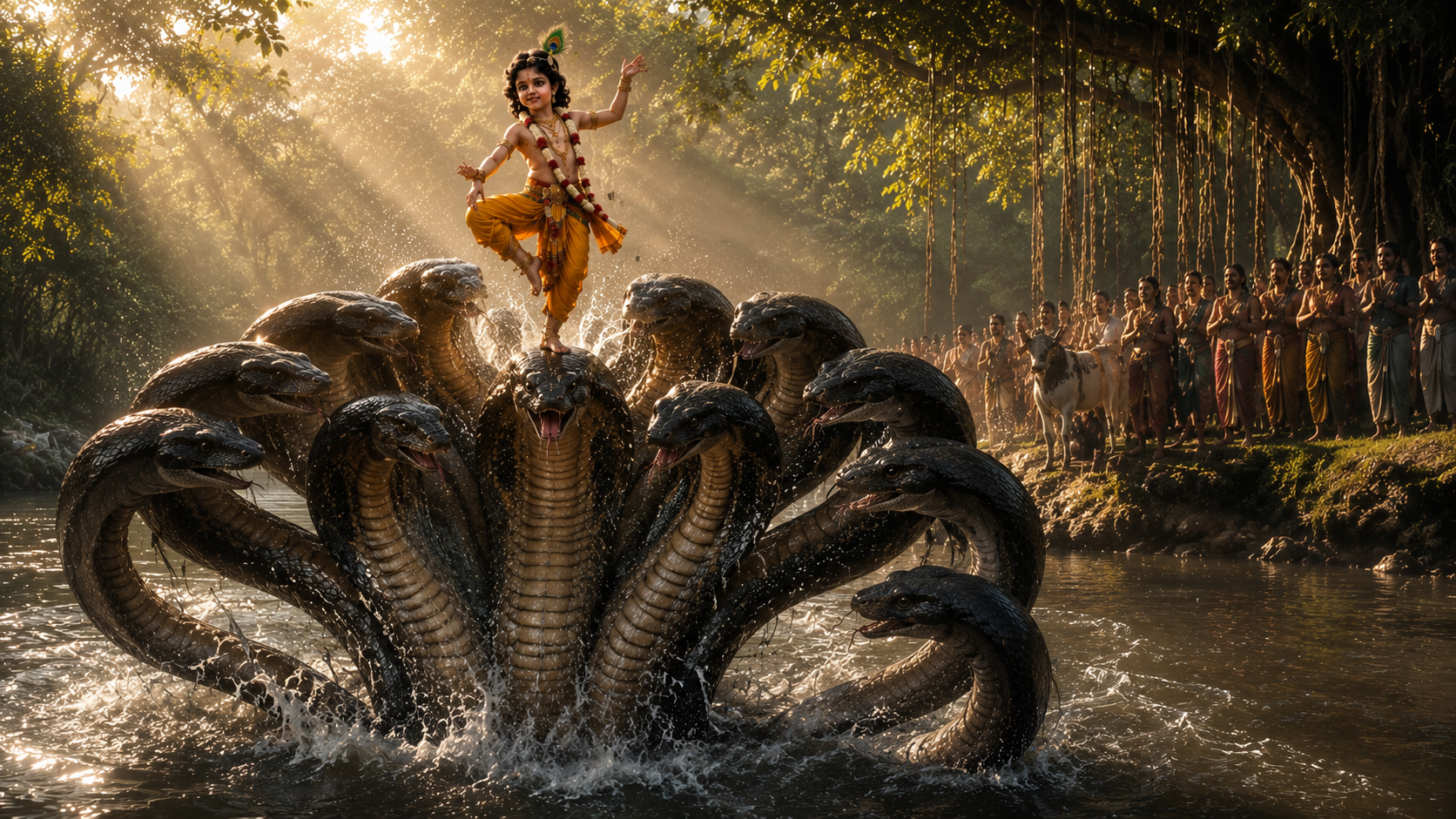
Kaliya's subjugation — like several threats in this chapter, resolved through mastery rather than destruction.
Kaliya and Govardhana
Two episodes stand somewhat apart from the pattern of demon-slaying. The serpent Kaliya, whose venom has poisoned a stretch of the Yamuna, is confronted by Krishna directly — he dances upon the serpent's many hoods until Kaliya, exhausted and humbled, submits, and is banished from the river rather than killed, at the intervention of his wives who plead for his life. It is one of the clearest instances in Krishna's story of mercy chosen over destruction where destruction was fully available.
The Govardhana episode carries more explicit theological weight. Krishna persuades the cowherds of Vrindavana to redirect their traditional offerings from Indra, god of rain and storm, to Govardhana Hill itself — the mountain, forest, and cattle that sustain their actual daily lives — a suggestion some readers have taken as an early Puranic critique of ritual directed at distant, abstract deities over the immediate natural world that people actually depend on. Indra, offended, sends the Samvartaka clouds to flood Vrindavana in punishment. Krishna lifts the entire hill on the tip of his little finger, sheltering the village's people and cattle beneath it for seven days until Indra, humbled, comes personally to apologize and consecrate Krishna with a ritual bathing.
The Gopis, the Rasa Lila, and Radha
Krishna's youth among the gopis — the cowherd women of Vrindavana — is the foundation of an entire devotional tradition built around the theology of divine love. The rasa lila, the circular dance in which Krishna is said to multiply himself so that each gopi experiences dancing with him alone, becomes a central devotional image for a love understood as simultaneously intimate and universal, exclusive and infinite. Radha, Krishna's most celebrated devotional consort within this tradition, functions as the emotional and theological center of much later Krishna bhakti — though, as the note below explains, her prominence is considerably a product of later textual development rather than the earliest layers of Krishna's story.
Radha does not appear by name in the Mahabharata, and is not named directly in the Bhagavata Purana's account of the rasa lila either, though later commentators have identified her with an unnamed favored gopi described there. Her emergence as Krishna's central devotional consort develops considerably through the medieval period — most influentially through Jayadeva's twelfth-century Sanskrit poem the Gita Govinda, and later through texts such as the Brahmavaivarta Purana, which elaborate her role at length. This does not diminish her centrality to how Krishna is devotionally understood across much of the subcontinent today; it simply means that centrality is a later development within the tradition rather than a feature of its earliest textual layer, and this article notes that distinction rather than presenting Radha's prominence as original to the oldest sources.
Sources also differ on some details of the Putana episode — whether she approaches disguised as a nursemaid known to the family or as a stranger, and on the exact means by which her death also releases her, in several tellings, from an earlier curse or demonic form, granting her a kind of liberation even in her defeat.
As Krishna and Balarama grow into young men, Kamsa's fear finally overcomes his patience: he sends his minister Akrura to bring the two brothers to Mathura under the pretext of a festival, setting in motion the confrontation the next chapter tells in full.
References
Primary Sources
- Bhagavata Purana 10.1–10.6 — birth and the exchange in Gokul.
- Bhagavata Purana 10.6–10.17 — Putana, Trinavarta, Bakasura, Aghasura, and Kaliya.
- Bhagavata Purana 10.24–10.27 — the Govardhana episode.
- Bhagavata Purana 10.29–10.33 — the rasa lila.
- Harivamsha, chapters 47–79 — parallel childhood narrative.
Secondary Sources
- Hardy, Friedhelm. Viraha-Bhakti: The Early History of Krishna Devotion in South India. Oxford University Press, 1983.
- Hawley, John Stratton. Krishna, the Butter Thief. Princeton University Press, 1983.
- Mani, Vettam. Puranic Encyclopaedia. Motilal Banarsidass, 1975. Entries: "Krishna," "Radha," "Kaliya."
Radha's textual emergence is treated here as a documented feature of the tradition's development, not as a diminishment of her devotional significance.