
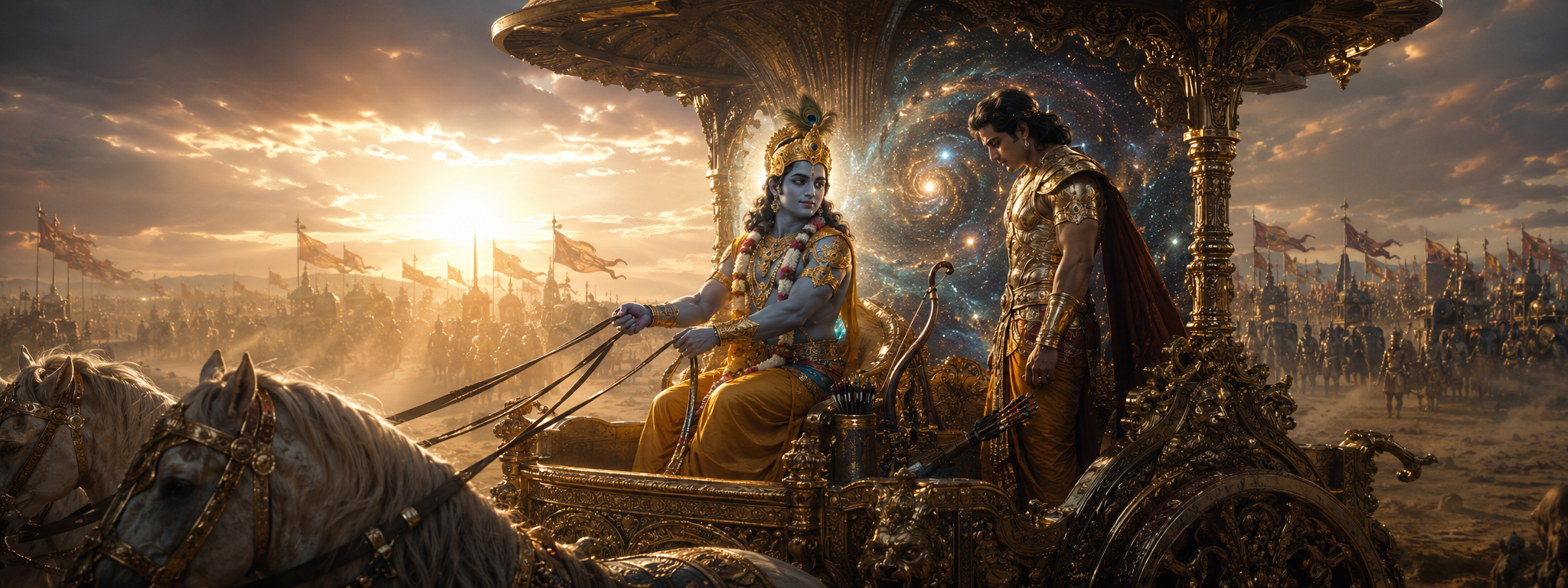
Krishna's story is the largest single avatara in this series, spanning an entire lifetime across five chapters below, from cowherd childhood to the philosophical center of the Mahabharata to a quiet, almost anticlimactic death. His elder brother Balarama — himself regarded as an avatara in several textual traditions — appears throughout rather than in a separate article; the reasoning for that structural choice, and the Buddha/Balarama variant it relates to, is addressed in this project's Buddha chapter.
Context of Incarnation
The Bhagavata tradition classifies Krishna as purna avatara — a full and complete descent, carrying the entirety of divine attributes rather than the partial expression associated with the avataras before him. Where Rama embodies dharma through personal constraint across a single, focused narrative, Krishna operates simultaneously across roles that, in most lives, would never combine: a child raising a village's affection through mischief, a young man at the center of an intense devotional and romantic tradition, a political strategist who topples one kingdom's tyranny and founds another, a diplomat who tries and fails to prevent a catastrophic war, and finally a battlefield counselor whose teaching — the Bhagavad Gita — becomes one of the most widely read philosophical texts in the world independent of the epic that contains it.
The crisis Krishna answers is correspondingly broad: not a single tyrant or a single boon's loophole, but a widespread erosion of dharma among Dvapara Yuga's ruling houses, culminating in the near-total civilizational rupture of the Kurukshetra war. Krishna's approach throughout is notably indirect compared to earlier avataras — persuasion, strategy, and carefully timed intervention feature as prominently as direct combat, and in several of his story's most debated moments, more so.
| Figure | Role |
|---|---|
| Vasudeva & Devaki | Krishna's birth parents, imprisoned by Kamsa in Mathura |
| Nanda & Yashoda | Krishna's foster parents, who raise him in Vrindavana |
| Balarama | Krishna's elder brother, present across nearly every phase of his life |
| Kamsa | Tyrant king of Mathura, Krishna's maternal uncle, killed by Krishna as a young man |
| Rukmini & Satyabhama | Among Krishna's principal wives at Dwaraka |
| Arjuna | Krishna's closest companion and disciple, recipient of the Bhagavad Gita |
| Jarasandha | Powerful king of Magadha, a recurring adversary across Krishna's Mathura and Dwaraka years |
The Five Chapters
Each chapter below is summarized here and told in full in its own article.
Childhood and Vrindavana
Birth in a Mathura prison, secret exchange with Yashoda's newborn daughter, survival of Kamsa's assassins, and a childhood of mischief, protection, and devotion among the cowherds of Vrindavana — Putana, the Kaliya serpent, the lifting of Govardhana, and the rasa lila.
Read Chapter I →Mathura and Kamsa
The journey to Mathura, the killing of Kamsa, the restoration of Ugrasena to the throne, Krishna and Balarama's education under the sage Sandipani, and the long conflict with Jarasandha that eventually leads to the founding of Dwaraka.
Read Chapter II →Dwaraka and the Wars
The founding of the sea-girt city, Rukmini's marriage, the Syamantaka jewel episode, the defeat of Narakasura, and Krishna's expanding political role as statesman and power broker across Bharatavarsha's royal houses.
Read Chapter III →Kurukshetra and the Gita
Krishna's failed peace mission to Duryodhana, his role as Arjuna's non-combatant charioteer, the Bhagavad Gita delivered on the battlefield's edge, and the war's most strategically and ethically debated turning points.
Read Chapter IV →Prabhasa and the End
Gandhari's curse, the Yadu clan's self-destruction at Prabhasa, Balarama's departure, and Krishna's own quiet death — struck by a hunter's arrow in a moment that closes a debt opened generations earlier, in the Rama avatara.
Read Chapter V →Symbolism & Legacy
No other avatara in the sequence is asked to hold as many distinct roles as Krishna, and the tradition treats that breadth itself as the theological point of calling him purna — not a specialist intervention but the full range of divine capacity expressed across an ordinary human lifespan. His iconography reflects this range more than any other avatara's: the infant butter-thief, the flute-playing cowherd among the gopis, the royal statesman of Dwaraka, and the charioteer-philosopher of Kurukshetra are each visually distinct traditions within devotional art, unified mainly by his characteristic dark or blue-hued skin and the peacock feather in his crown.
The Bhagavad Gita's influence extends well beyond the epic that contains it, read and commented on as an independent philosophical and spiritual text by traditions and audiences with no particular investment in the surrounding Mahabharata narrative — a degree of standalone reach no other single episode in the Dashavatara approaches.
Krishna's life draws on two source traditions that do not always agree in emphasis: the Mahabharata, where he functions primarily as strategist, diplomat, and Arjuna's counselor within an epic centered on the Kurukshetra war; and the Bhagavata Purana, which gives far fuller treatment to his childhood and youth in Vrindavana, and to the devotional relationships — Radha prominent among them in later tradition — that the Mahabharata does not develop. Radha's own textual history is addressed directly in the first chapter below, since her prominence in popular devotion considerably outpaces her presence in the earliest layers of the textual record.
Krishna is where the Dashavatara's gradual movement — from cosmological rescue, through single-adversary combat, through Parashurama and Rama's operation within human history — reaches its fullest expression: an avatara who governs, loves, teaches, strategizes, and fights across an entire life, rather than intervening at one decisive moment. Buddha, the avatara that follows, marks a deliberate contraction after this expansion — withdrawal and renunciation rather than statecraft — before Kalki closes the cycle entirely.
References
Primary Sources
- Bhagavata Purana, Skandha 10 — Krishna's birth, childhood, and youth in Vrindavana and Mathura.
- Bhagavata Purana, Skandha 11 — the Dwaraka years and Krishna's final teachings.
- Mahabharata, multiple parvas — Krishna's role as statesman, diplomat, and charioteer.
- Bhagavad Gita (Mahabharata, Bhishma Parva) — the teaching delivered at Kurukshetra.
- Harivamsha — a supplementary text closely associated with the Mahabharata, detailing Krishna's Vrishni lineage and early life.
Secondary Sources
- Hawley, John Stratton, and Donna M. Wulff (eds.). Devi: Goddesses of India. and related volumes on Krishna bhakti traditions, University of California Press.
- Hardy, Friedhelm. Viraha-Bhakti: The Early History of Krishna Devotion in South India. Oxford University Press, 1983 — for the historical development of Krishna devotional traditions, including Radha's emergence.
- Mani, Vettam. Puranic Encyclopaedia. Motilal Banarsidass, 1975. Entry: "Krishna."
Detailed sourcing and variant notes for each phase of Krishna's life are given in the individual chapter articles.