
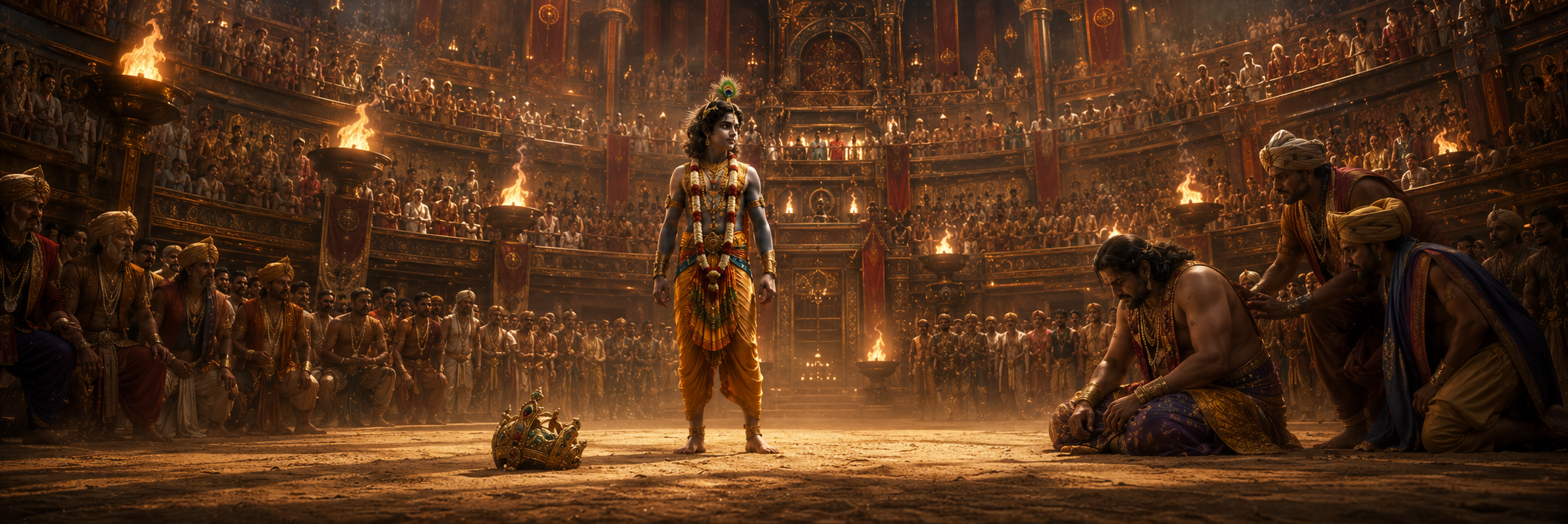
This chapter covers Krishna's transition from Vrindavana's cowherd world to Mathura's royal politics — the fulfillment of the prophecy that has driven Kamsa's fear since before Krishna was born, and the beginning of a much longer political conflict that will eventually reshape where Krishna's people live.
The Summons to Mathura
Kamsa, unable to locate the child he fears directly, eventually resolves to bring the threat to him instead. He sends his minister Akrura to Vrindavana with an invitation to a grand festival and wrestling tournament in Mathura, ostensibly an honor extended to two promising young men, in truth a trap: the wrestlers assigned to the ring are chosen and instructed to kill Krishna and Balarama in the contest, and even should they somehow survive that, further ambushes are prepared along the way. Akrura, though loyal to Kamsa's court, is himself a devotee, and the journey to Mathura — recounted at length in the Bhagavata Purana — becomes an occasion for his own private reverence toward the boy he is nonetheless obligated to deliver into danger.
| Figure | Role in This Chapter |
|---|---|
| Akrura | Kamsa's minister, sent to bring Krishna and Balarama to Mathura, secretly devoted to Krishna |
| Kamsa | Tyrant king of Mathura, killed by Krishna in the wrestling arena |
| Ugrasena | Kamsa's father, the rightful king, restored to the throne after Kamsa's death |
| Sandipani | Sage under whom Krishna and Balarama complete their formal education |
| Jarasandha | Powerful king of Magadha, Kamsa's father-in-law, who wages repeated war on Mathura in revenge |
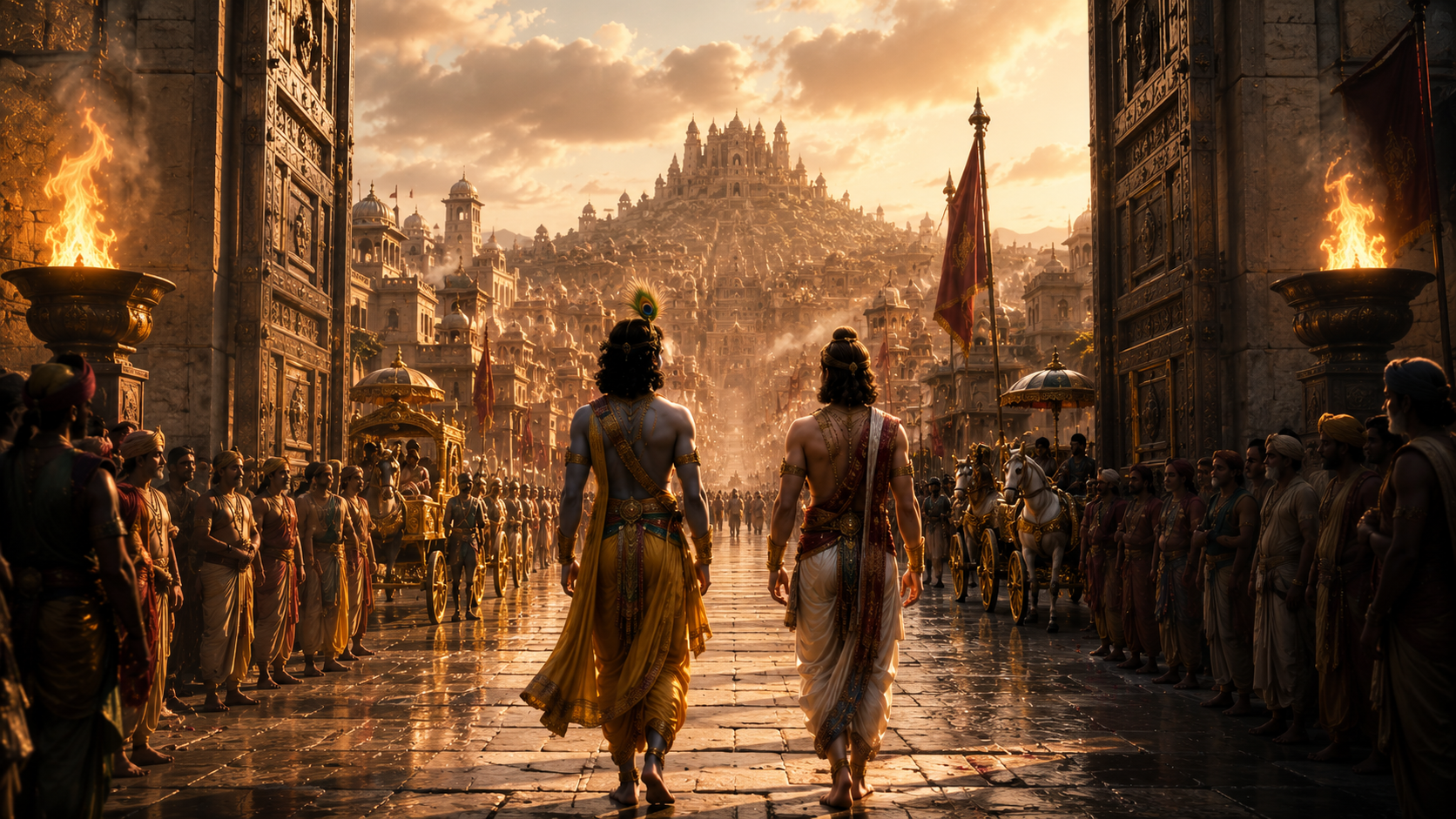
The brothers' arrival in Mathura, where a wrestling tournament conceals an assassination attempt.
The Death of Kamsa
In Mathura, Krishna and Balarama dispose of the preliminary obstacles set against them — an enraged elephant sent to trample them at the arena's entrance, and the professional wrestlers Chanura and Mushtika in the ring itself, both killed with ease that stuns the assembled court. Kamsa, watching his carefully prepared plan collapse, orders the brothers seized and killed outright; Krishna instead leaps directly onto the royal dais, drags Kamsa from his throne, and kills him before the entire court — fulfilling, at last, the prophecy that has shaped Kamsa's entire reign of fear. Ugrasena, Kamsa's own father and the kingdom's rightful ruler, deposed years earlier, is restored to the throne, with Krishna and Balarama declining to rule Mathura themselves.
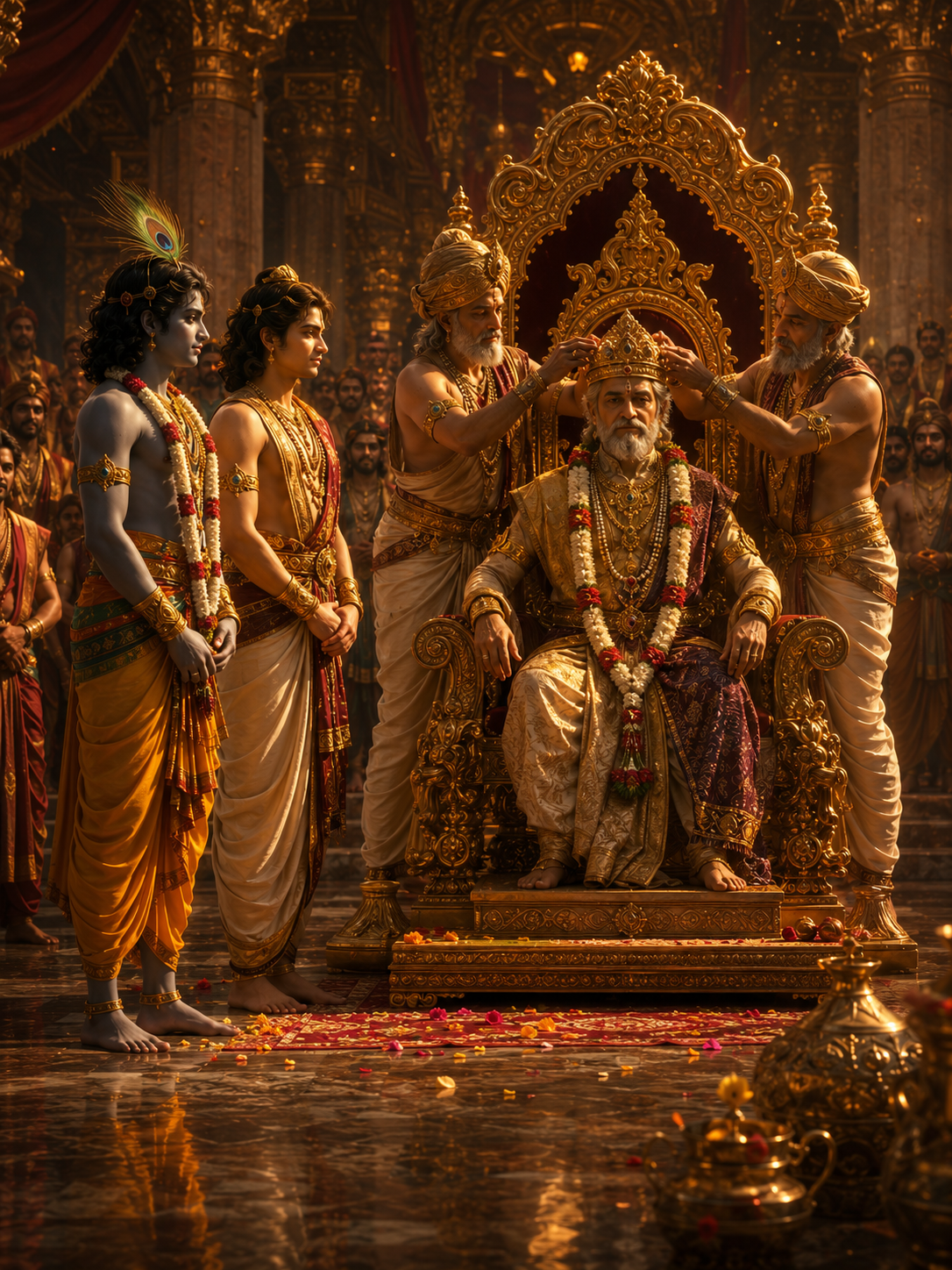
Restoration rather than conquest — a pattern that recurs across Krishna's political interventions.
Education and the Rise of Jarasandha
With Kamsa dead, Krishna and Balarama are sent to complete a formal education under the sage Sandipani at Ujjain, mastering the full range of scriptural and martial knowledge expected of princes in a remarkably short span of time — a detail the tradition reads as evidence of divine capability rather than ordinary talent. On completing their studies, in a gesture of guru-dakshina — the traditional gift a student offers a teacher on completing their education — Krishna retrieves Sandipani's own deceased son from the realm of the dead and restores him to his parents.
Kamsa's death does not end the threat to Mathura. Jarasandha, the powerful king of Magadha and father of two of Kamsa's widows, holds Krishna and Balarama responsible and launches a sustained campaign against Mathura — seventeen separate invasions in most tellings, each repelled but at real and mounting cost to the city and its people. Rather than continue absorbing repeated assault indefinitely, Krishna makes the strategic decision to relocate his people entirely, leading the construction of a new capital on the western coast: Dwaraka, built on reclaimed land and considered, in later tradition, impregnable to Jarasandha's repeated attacks.
Krishna's withdrawal from Mathura ahead of Jarasandha's eighteenth invasion has attracted a particular epithet in later tradition — Ranchhod, "the one who fled the battlefield" — used affectionately in some regional devotional contexts (notably in Gujarat, where a major temple bears this name) but historically also cited by critics as evidence against Krishna's martial reputation. The tradition's own resolution treats the relocation as strategic wisdom protecting an entire population rather than personal cowardice — Krishna is not shown fleeing alone, but organizing the wholesale, successful evacuation and resettlement of his people — though this article notes the epithet's more critical historical readings rather than presenting the flattering interpretation as the only one on record.
Sources vary somewhat on the exact number of Jarasandha's invasions (most commonly given as seventeen, with an eighteenth prompting the move to Dwaraka) and on how much of the final defeat of Jarasandha himself belongs to this period versus the later Mahabharata-adjacent events covered in Chapter III.
With Dwaraka founded and Mathura's citizens resettled, Krishna's role expands from regional defender to a much broader political and marital network across Bharatavarsha's ruling houses — the subject of the next chapter.
References
Primary Sources
- Bhagavata Purana 10.36–10.44 — the journey to Mathura and the death of Kamsa.
- Bhagavata Purana 10.45 — Sandipani's ashram and the restoration of his son.
- Bhagavata Purana 10.50–10.52 — Jarasandha's invasions and the founding of Dwaraka.
- Harivamsha, chapters 80–116 — parallel account of the Mathura and early Dwaraka period.
Secondary Sources
- Mani, Vettam. Puranic Encyclopaedia. Motilal Banarsidass, 1975. Entries: "Kamsa," "Jarasandha," "Ugrasena," "Akrura."
- Hawley, John Stratton, and Vasudha Narayanan (eds.). The Life of Hinduism. University of California Press, 2006 — for the Ranchhod tradition and its regional devotional context.
The Ranchhod epithet is presented with both its devotional and critical readings, rather than only the tradition's own more flattering resolution.