
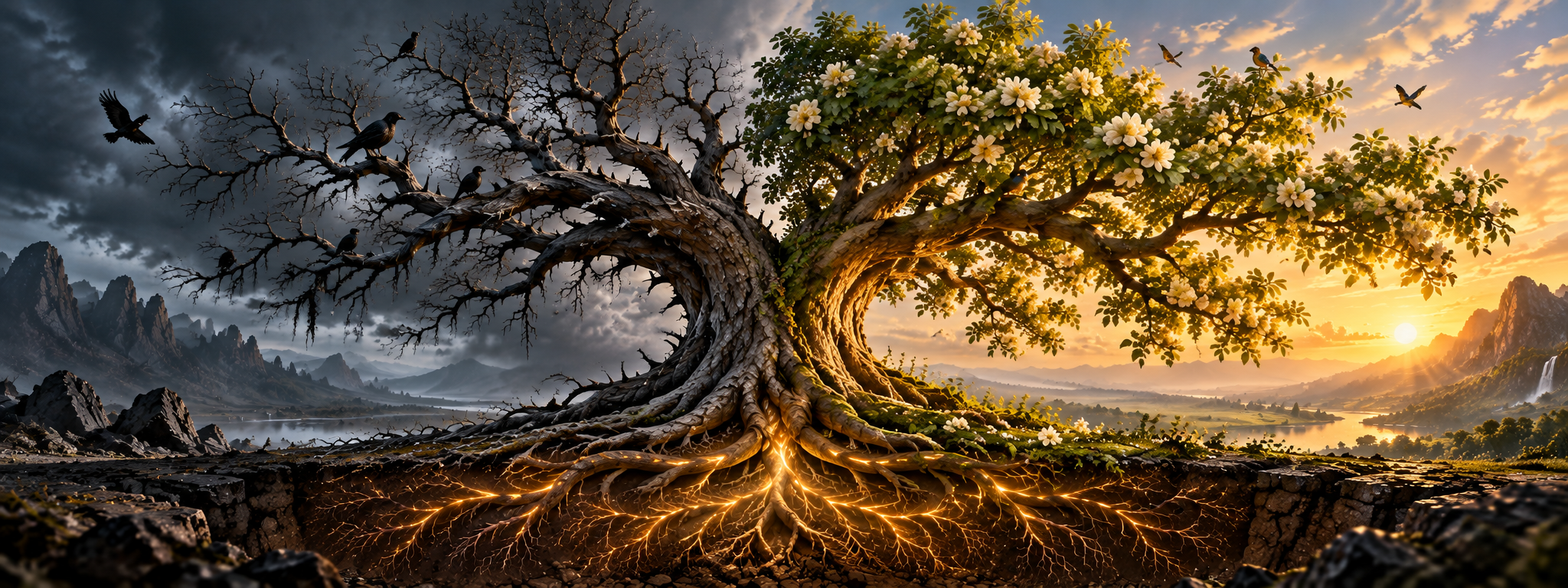
Ask which came first, virtue or vice, and the tradition's answer is: neither, exactly. In the Vishnu Purana's account of creation, Brahma produces Dharma from his own breast and Adharma from his own back in close succession — one drawn from the front of the body, where the heart sits, the other from behind it, out of sight. What follows from each of them is not a single figure but an entire lineage, and the two lineages are close enough in shape that they read as answers to the same design problem, worked out twice.
This piece follows both trees as this project's own genealogical database keeps them: a short, three-generation line descending from Dharma, and a longer, seven-generation line descending from Adharma. Where that structure lines up with the more widely circulated Vishnu Purana recension and where it diverges from it are both noted as they come up, rather than smoothed into a single version.
The Virtue Line: Eight Vasus, and a List Left Open on Purpose
Dharma — moral law, righteousness, the principle that holds things in their right order — is personified from the moment of creation itself, one of the beings the Puranas describe issuing directly from Brahma's body rather than being born in the ordinary way. He marries Vasu, a daughter of Daksha, and their eight sons are known collectively as the Vasus — a branching tree rather than a single line, and a closer structural match to the vice line below than a lone descent through one grandson would be.
Most of the eight Vasu branches lead to functional or place-bound deities rather than personified abstractions — guardians of cities, gods of lifespan, a celestial architect — and sit outside the scope of this series for the same reason Agni and Vayu sit slightly apart in Part II: being in the family tree isn't the same as being an idea given a body. Two branches earn a place here on those terms. One is **Dhruva's** son **Kala** — Time itself, personified, textually a grandson of Dharma, and the direct sourced link to this series' own Part II article on Kala and Yama. The other is **Dhara's** line, which carries the most-discussed children of any Vasu — and carries them in two accounts that don't agree with each other.
The Vishnu Purana and Harivamsha name the eight Vasus as Dhara, Dhruva, Soma, Apa, Anila, Anala, Pratyusha, and Prabhasa. The Bhagavata Purana (Skandha 6, Chapter 6) gives a different eight entirely: Drona, Prana, Dhruva, Arka, Agni, Dosha, Vastu, and Vibhavasu. Only Dhruva appears on both lists. The Dhara discussed below is, on the Bhagavata's own naming, Drona — the same figure under a different name, not a separate one.
Two accounts of Dhara's children
The Bhagavata Purana gives Drona (Dhara) a wife named Abhimati, and their sons are named directly: harṣa-śoka-bhaya-ādayaḥ — "Harsha, Shoka, Bhaya, and so on." That closing phrase, ādayaḥ, is doing real work in the Sanskrit: the text isn't reporting three names because the rest were lost, it's naming three examples of an open class — presiding deities of the emotional states of living beings — and declining to close the list. Joy, sorrow, and fear are the ones the verse bothers to name; the "and so on" is original to the source, not a gap in transmission.
A second, separate account — drawn from the Mahabharata tradition and the Puranic Encyclopaedia — gives Dhara a different wife, Manohara ("one who captivates the mind"), and a closed, five-name list of sons: Dravina and Hutahavyavaha directly, with the Agni and Padma Puranas adding Shishira, Prana, and Ramana. Nothing here overlaps with the Abhimati account's three names. Both are on record as accounts of the same figure's children, through two different wives, and neither is treated here as the corrected version of the other.
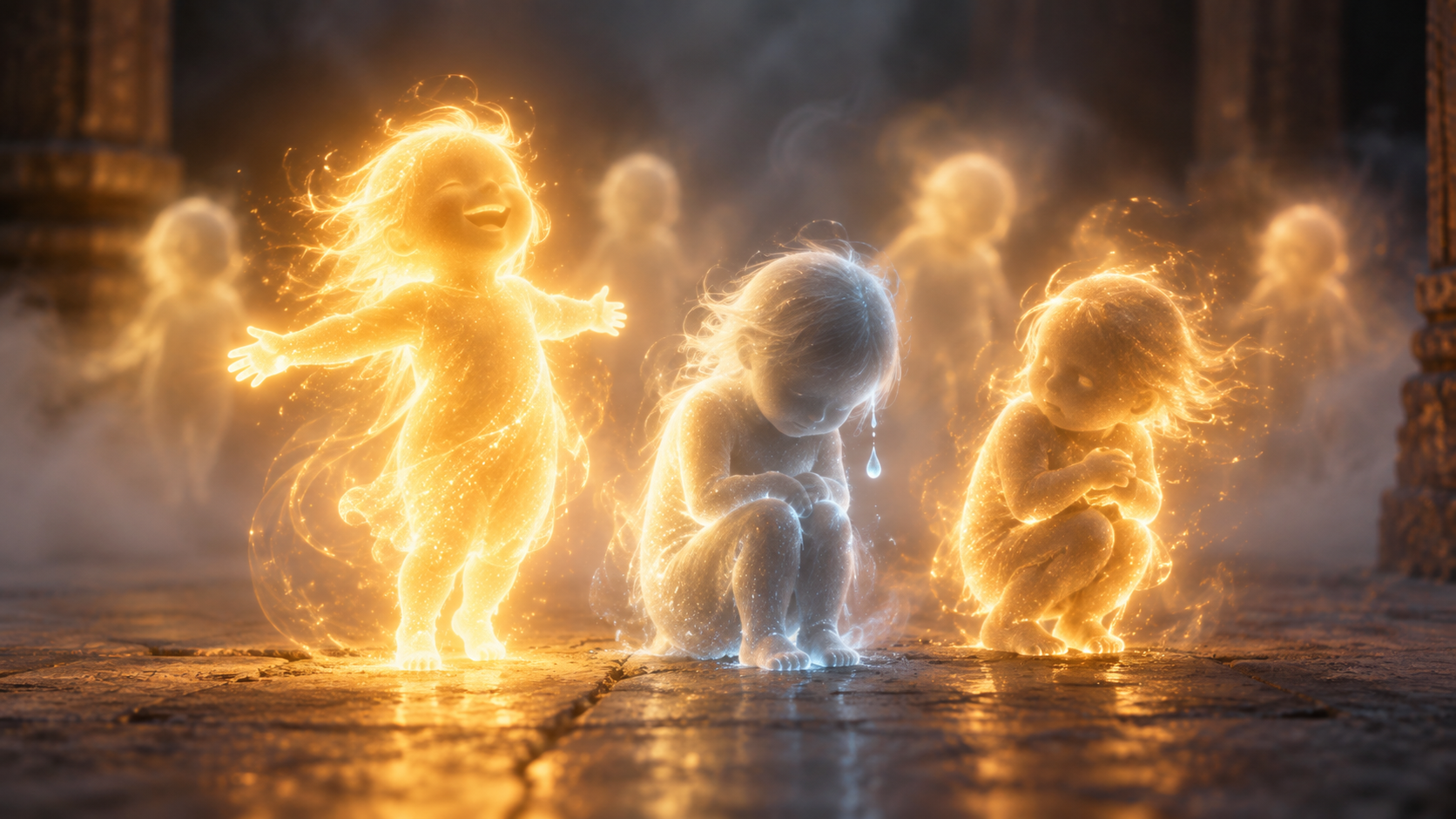
Harsha, Shoka, and Bhaya, and — in the Bhagavata Purana's own wording — more besides, left unnamed.
One more echo is worth a line rather than a section. In the same Bhagavata Purana passage, Arka's wife Vasana bears sons "headed by Tarsha" — thirst, or craving. That name lands very close to Trishna, thirst/craving, who sits in the terminal, "without wives, without posterity" generation of the wider-tradition vice line noted below. Two differently-spelled personifications of the same craving, one hanging off a virtue-tree branch and one closing out the vice line elsewhere — not a contradiction, just the same idea reappearing on both sides of the ledger, the way Bhaya already does.
The Vice Line: Seven Generations Into Ruin
Adharma's line is a different kind of structure entirely: a chain of paired figures, each pair producing the next, running seven generations deep and getting more specific — and worse — at every step. Read straight through, the names alone tell the story before any commentary is needed.
| Generation | Names | What the names mean |
|---|---|---|
| 1 | Adharma & Mitya | Unrighteousness and falsehood — the vice line's own founding pair, mirroring Dharma at the head of the other tree. |
| 2 | Dambha & Maya | Hypocrisy and deceit — unrighteousness and falsehood's first offspring are the arts of appearing otherwise. |
| 3 | Lobha & Nikriti | Greed and immorality/depravity — deceit hardens into active wrongdoing. |
| 4 | Krodha & Himsa | Wrath and violence — greed turns outward into open harm. |
| 5 | Kali & Durukti | Strife (the personified degradation associated with the current age, distinct from the goddess of the same name) and evil or abusive speech. |
| 6 | Bhaya & Mrityu | Fear and death — strife's direct consequence. |
| 7 | Naraka & Yatana | Hell and torment — the line's terminus, and the only point in either tree where the descent stops because there is nowhere further to go. |
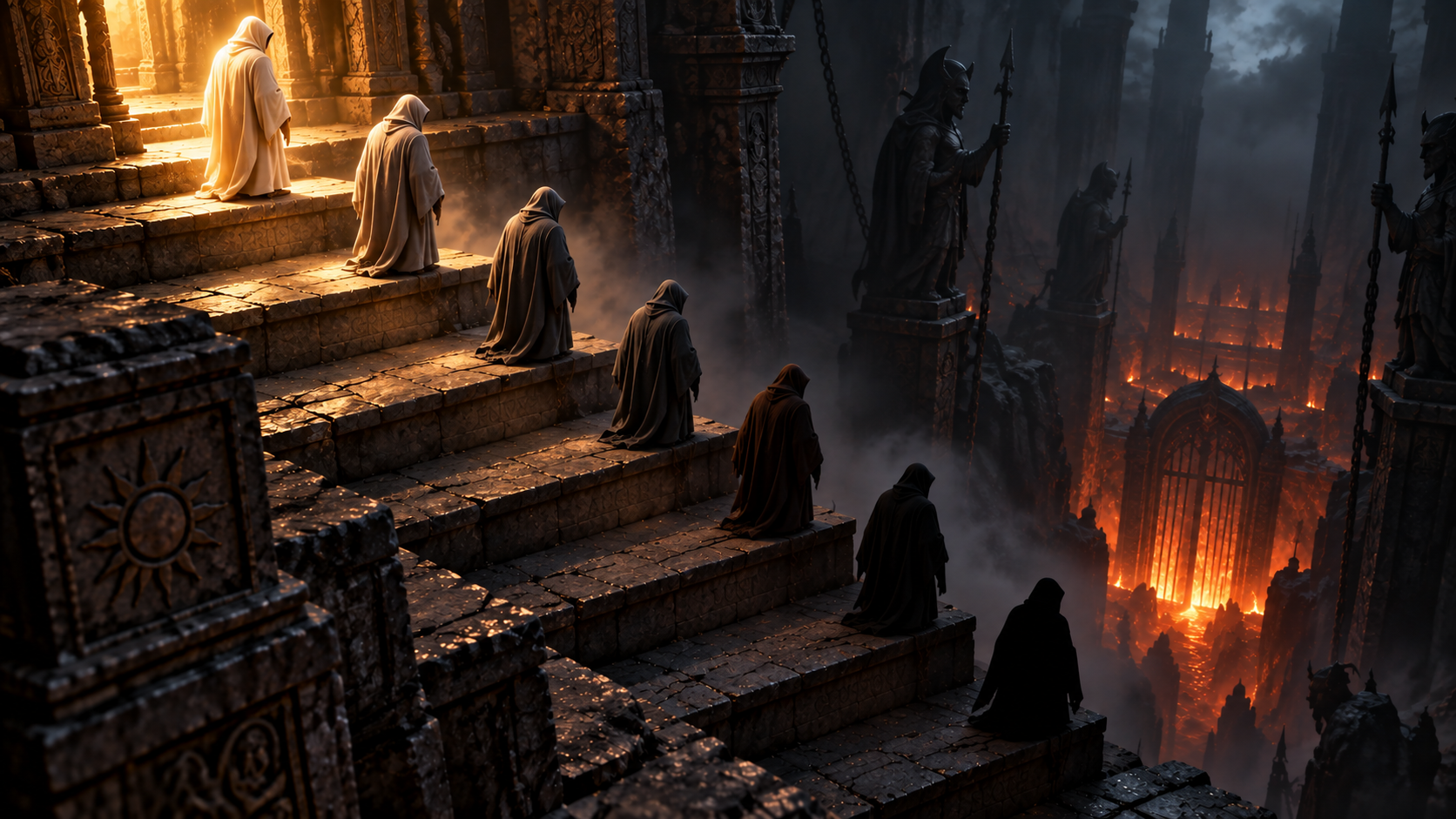
The seven generations of the vice line, each pair a step further from Adharma and a step closer to Naraka and Yatana — hell and torment.
Read this way, the vice line isn't a list of unrelated bad qualities — it's a single argument, made across seven generations, about how ruin actually develops: it starts with a foundational untruth, becomes performance and deceit, hardens into greed and depravity, turns violent, degrades into open strife and cruelty of speech, produces fear and death as its direct social consequence, and ends — literally, structurally, with nowhere left to go — in hell and the torment inflicted there. Nothing about the virtue line above offers a comparable throughline; it simply doesn't run long enough to make one.
Same Name, Two Trees: The Problem of Bhaya
Bhaya — fear, personified — appears twice in this material, and not as the same figure in two places. In the virtue line, Bhaya is one of Dhara's three children, a grandchild of Dharma. In the vice line, Bhaya is a child of Kali and Durukti, six generations down from Adharma, and the parent (with Mrityu) of the line's final pair, Naraka and Yatana.
These aren't presented here as the same figure appearing in two places by mistake, nor is one silently dropped to make the trees consistent. Genealogical material of this kind is compiled across a wide span of source texts and editions, and a name recurring under two different parentages is a normal feature of that process, not a contradiction to be resolved. What's worth noting is simply that fear is the one quality the tradition — at least as this database preserves it — refused to place on only one side of the ledger. It's a grandchild of righteousness and a great-great-great-grandchild of unrighteousness at the same time.
Where This Diverges From the Wider Tradition
The Vishnu Purana's own account of this vice-genealogy, in the widely circulated H. H. Wilson translation, runs a narrower chain than the one followed here: Adharma and Himsa (violence, paired directly with Adharma rather than appearing four generations later) produce Anrita (falsehood) and Nikriti (immorality); these produce Bhaya (fear) and Naraka (hell) as one generation, rather than as the line's sixth and seventh steps; Bhaya and Naraka's generation in turn produces Mrityu (death) and Dukha (pain); and Mrityu's own children — Vyadhi (disease), Jara (decay), Shoka (sorrow — the same name that appears as one of Dhara's three children in the virtue line above), Trishna (thirst or craving), and Krodha (wrath) — are explicitly described in that text as "without wives, and without posterity," a deliberately sterile, terminal generation.
Set beside that, the seven-generation chain followed in this database's tree is a different recension: it adds an opening pair (Adharma with Mitya, rather than Himsa), inserts an entire extra generation (Dambha and Maya, then Lobha and Nikriti, where the Wilson text moves directly from Adharma to Anrita/Nikriti), and introduces Kali and Durukti as a named couple mid-chain, where the Wilson text has no equivalent generation at all. Both versions agree on the broad shape — a long, escalating, paired genealogy running from unrighteousness toward death — and both eventually produce a Bhaya and a Naraka. They simply don't agree on how many steps it takes to get there, or in what order. This piece follows the database's own seven-generation version as its primary structure and flags the Wilson recension here as the point of comparison, rather than treating either one as the corrected version of the other.
Three Names the Tree Doesn't Fully Contain
Three figures named in or adjacent to this genealogy carry more instability than a straight family tree can show, and are worth flagging individually rather than folding silently into the chain above.
Kali, the degradation of the age
The Kali named here — strife, fifth-generation child of Dambha-and-Maya's line — is not the goddess Kali, and the tradition is generally careful to keep the two apart. In fuller tellings connected to the Kali Yuga specifically, this Kali has his own more elaborate genealogy and his own wife, Alakshmi, misfortune personified — a figure this series returns to directly in Part IV. That fuller genealogy overlaps with, but isn't identical to, the position Kali occupies in the seven-generation chain above; the two are treated here as the same figure appearing in genealogies compiled for different purposes, not as evidence that one version is wrong.
Mrityu, created twice
Mrityu — death — sits in generation six of the chain above, child of Kali and Durukti. Elsewhere in the tradition, Mrityu has a second and flatly incompatible origin: a being Brahma is said to have created separately and reluctantly, resisting the act of making death at all before finally doing so. A figure descended from strife and evil speech, and a figure Brahma made once, alone, against his own inclination, are not easily reconciled into one birth story — and this piece doesn't attempt to reconcile them. Both are simply on record.
Nirriti, waiting in Part VI
Nirriti — destruction and misfortune, closely associated with this entire family of ideas — does not appear in either tree above by name, but belongs unmistakably to the same cluster: her genealogy is itself unstable across sources (wife of Adharma in some accounts, daughter of Adharma and Himsa in others, an independent creation of Brahma in still others). She reappears later in this series in a completely different role — not as a personified quality with parents and children, but as one of the eight Dikpalas, the guardian assigned to the southwest. That's a different mechanism of personification altogether, and Part VI is where it's addressed directly.
Set side by side, these two trees don't read as a simple morality chart with a "good" branch and a "bad" branch, and they don't end the same way on purpose. The vice line is long, tightly structured, and terminal by design — seven generations that escalate deliberately and end, definitionally, at a point with nowhere further to go. The virtue line closes the opposite way: its own source names three feeling-deities and then says, in as many words, "and so on," declining to close the set at all. One tree is an argument that ruin compounds toward a fixed endpoint. The other is content to gesture at an uncountable family of feelings and leave it there. Read that way, the difference isn't that the virtue line is thinner — it's that thinness was never the point of it.
Kala, Dhruva's son and Dharma's grandson on the virtue side, is covered directly in Part II, The Judge Who Was Once the First to Die: Kala and Yama. Kali's wife Alakshmi is covered in Part IV, The Goddess and Her Shadow: Lakshmi and Alakshmi. Nirriti's second identity as a guardian of direction is covered in Part VI, Eight Gods, Eight Directions: The Dikpalas. All three cross-links are noted rather than re-explained here, since each figure is doing a different kind of work in each place.
References
Primary Sources
- Vishnu Purana, Book 1, Chapter 7 — translated by H. H. Wilson (1840), via sacred-texts.com. Source for Dharma's and Adharma's origin from Brahma's breast and back, and for the wider-tradition vice-genealogy (Adharma/Himsa → Anrita/Nikriti → Bhaya/Naraka → Mrityu/Dukha → Vyadhi, Jara, Shoka, Trishna, Krodha) used as the comparison recension above.
- Bhagavata Purana, Skandha 6, Chapter 6, verses 10–13 — for the eight Vasus under their Bhagavata names (Drona, Prana, Dhruva, Arka, Agni, Dosha, Vastu, Vibhavasu), for Drona/Dhara's wife Abhimati and sons Harsha, Shoka, Bhaya "and so on," and for Arka's wife Vasana's son Tarsha.
- Puranic Encyclopaedia (Vettam Mani) and the Mahabharata tradition — for the alternate account of Dhara's children through his wife Manohara (Dravina, Hutahavyavaha), with the Agni and Padma Puranas adding Shishira, Prana, and Ramana.
Project Sources
- This site's own genealogical database, as maintained by the project author — primary structure followed for both the virtue line (Brahma → Dharma → Dhara → Harsha, Shoka, Bhaya) and the seven-generation vice line (Brahma → Adharma, Mitya → Dambha, Maya → Lobha, Nikriti → Krodha, Himsa → Kali, Durukti → Bhaya, Mrityu → Naraka, Yatana).
Where the database's tree and the Wilson translation diverge, both are presented and neither is treated as the corrected version of the other. Kali's fuller Kaliyuga-demon genealogy and Mrityu's alternate creation story are noted as open, unreconciled threads rather than resolved into the chain above.