
I. The Plea That Reached the Trimurti
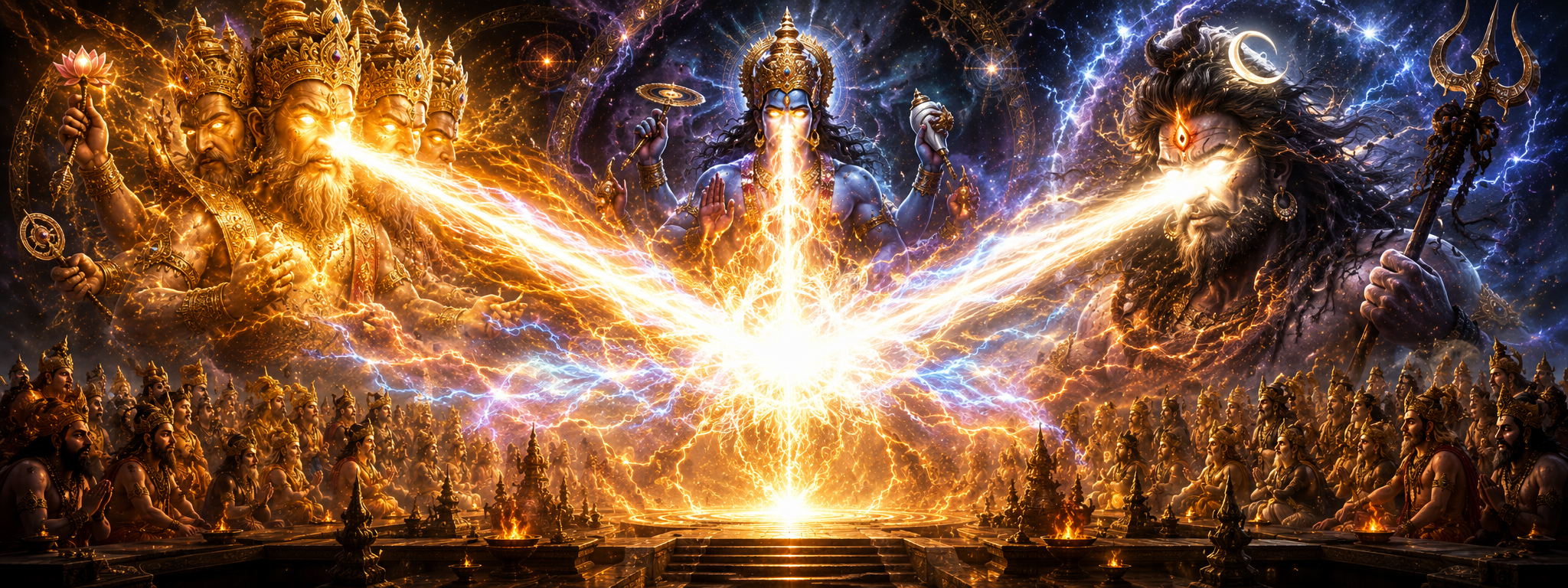
By the time the dispossessed devas reach Brahma, Vishnu, and Shiva, they have already exhausted every lesser appeal available to them. Mahishasura's conquest had not stopped at the throne of heaven; he had personally assumed the specific cosmic offices that kept the universe functioning — acting as Surya where the sun god should have shone, as Chandra where the moon should have waxed and waned, executing the duties of Varuna, Agni, Vayu, and Kubera in turn, while Indra and the rest of the deva pantheon wandered the earth as ordinary, powerless mortals. The devas' account to the Trimurti is not phrased as a request for justice; it is a structural diagnosis. As they put it, in the Devi Mahatmya's own framing: we have told you all the actions of Mahishasura and have sought your refuge — think now of how he can be killed.
II. Fury Made Visible
What happens next is one of the more startling moments of theological staging in the entire Devi Mahatmya, precisely because of how literally it treats divine emotion as raw material. Hearing the devas' account, Brahma, Vishnu, and Shiva do not confer, strategize, or delegate. Their anger simply becomes light. The text describes a single, intensely lustrous power arising directly from their three enraged faces — and then, in the same instant, a comparable radiance pouring from the bodies of every other assembled god present at the council, until the light of Indra, Agni, Yama, Varuna, Vayu, Kubera, and the rest has joined the original three into one mingled, blinding mass of pure tejas, hovering over the mountain where the gods stand.
It is from this combined light — not from a womb, not from a sheath, but from concentrated divine anger given physical form — that a single goddess begins to take shape.
III. A Body Built From the Gods' Own Faces
The Devi Mahatmya's account of this goddess's physical formation is unusually anatomical for a text this devotional: her face is said to take its shape from the light of Shiva, her arms from the light of Vishnu, her breasts from the light of Soma the moon, her waist from Indra's, her legs and thighs from Varuna's, her hips from the earth's own light, her feet from Brahma's, her fingers from the light of the sun-gods, her teeth from Prajapati's, her three eyes from the light of Agni, her eyebrows from the twin Sandhyas of dawn and dusk, and her ears from Vayu's light — every distinguishing feature of her face and body traced to a different god, so that what stands assembled on the mountainside is, quite literally, a composite portrait of the entire pantheon rather than the creation of any single deity.
A Note on Scale
The Devi Mahatmya's narration, at the height of this goddess's confrontation with Mahishasura, describes her as pervading the three worlds with her thousand arms — a figure that should be read as the text's standing hyperbole for overwhelming, cosmic scale rather than a fixed iconographic count. Temple sculpture and devotional art across India most commonly depict this composite Durga with eight or ten arms, each bearing one of the weapons described below; the "thousand arms" language belongs to a different register of the text, closer to poetry than to iconographic specification.
IV. The Gifts of the Gods
With her form assembled, each god in turn arms her — not with newly forged weapons, but with duplicates of their own signature implements, so that the goddess who rides out to meet Mahishasura carries, quite literally, the combined arsenal of the entire Hindu pantheon in her many hands.
From Shiva, Bearer of Pinaka — The Trident
The first and most iconic of the goddess's weapons: a duplicate of Shiva's own trident, drawn from the bow named Pinaka. It is this same trident — more than any other weapon she carries — that will deliver the war's final blow in Act III, driven through Mahishasura's chest in the instant he tries to half-emerge from the buffalo's body in his own true form.
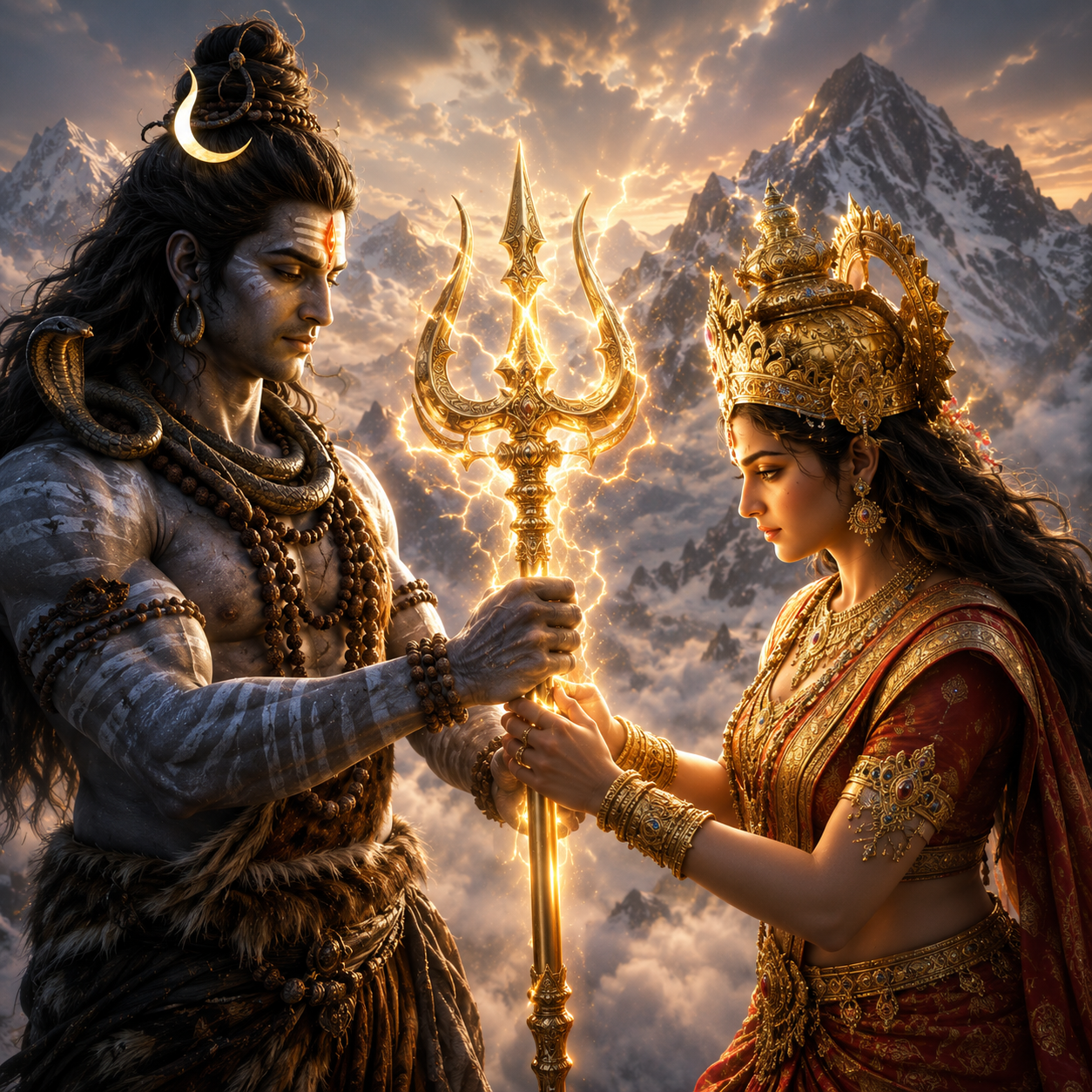
The trident from Pinaka — the weapon that ends the war.
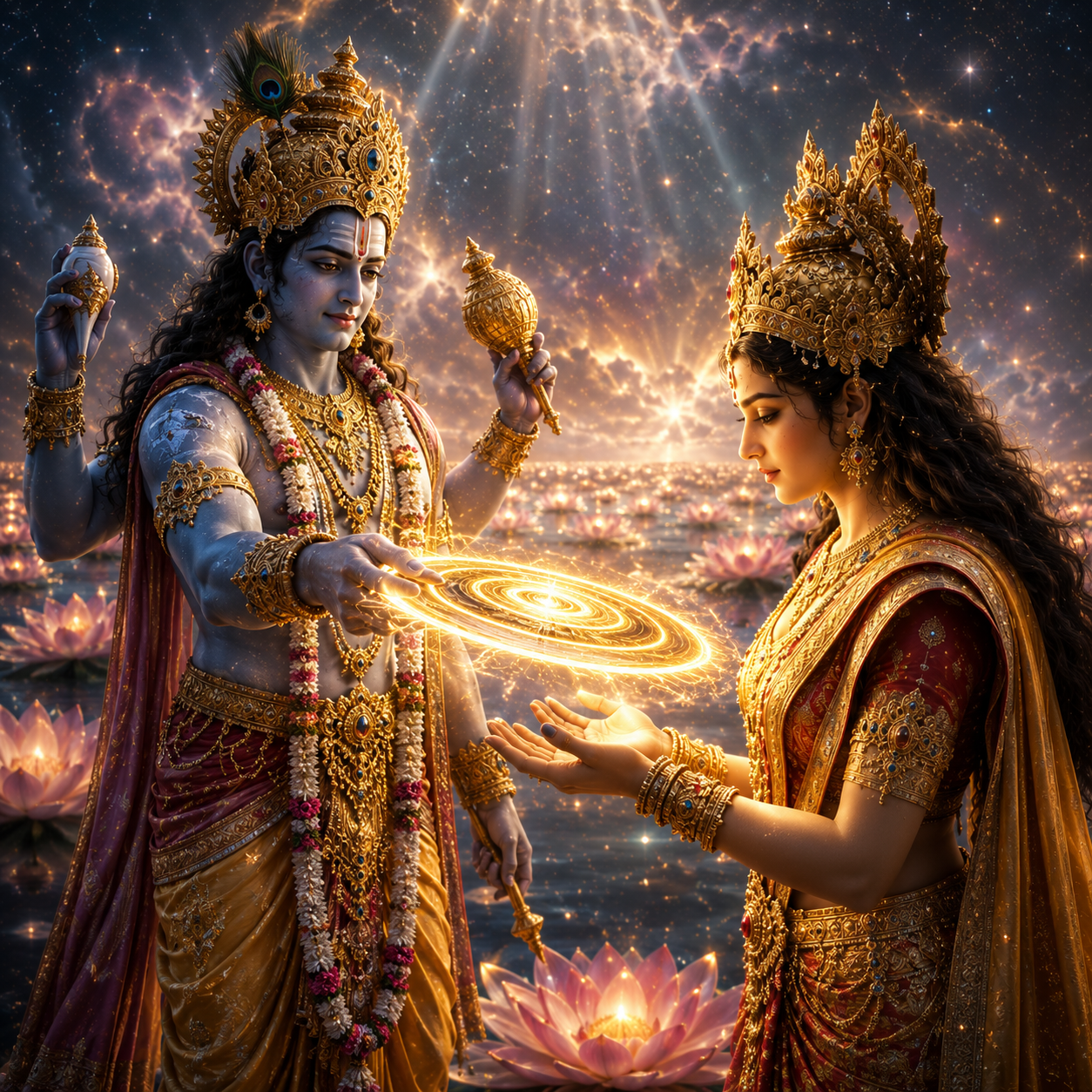
The Sudarshana discus — the head-severing weapon of the entire saga.
From Vishnu, Wielder of Sudarshana — The Discus
A duplicate of Vishnu's own discus, the same weapon that elsewhere in the Puranic corpus ends Madhu and Kaitabha's threat to creation itself. In the goddess's hand, it becomes one of the instruments that will, generation by generation across the rest of this saga, sever exactly the heads that boons have made too dangerous to leave attached.
From Indra, Lord of the Devas — The Thunderbolt and the Bell
Indra — the god whose throne and conquest set this entire war in motion — gives the goddess his own thunderbolt, the vajra, and a bell taken from his white elephant Airavata. The bell's clanging will become, in Act II, one of three distinct sounds — alongside her bowstring and her lion's roar — that together announce her presence across the battlefield before a single weapon is drawn.
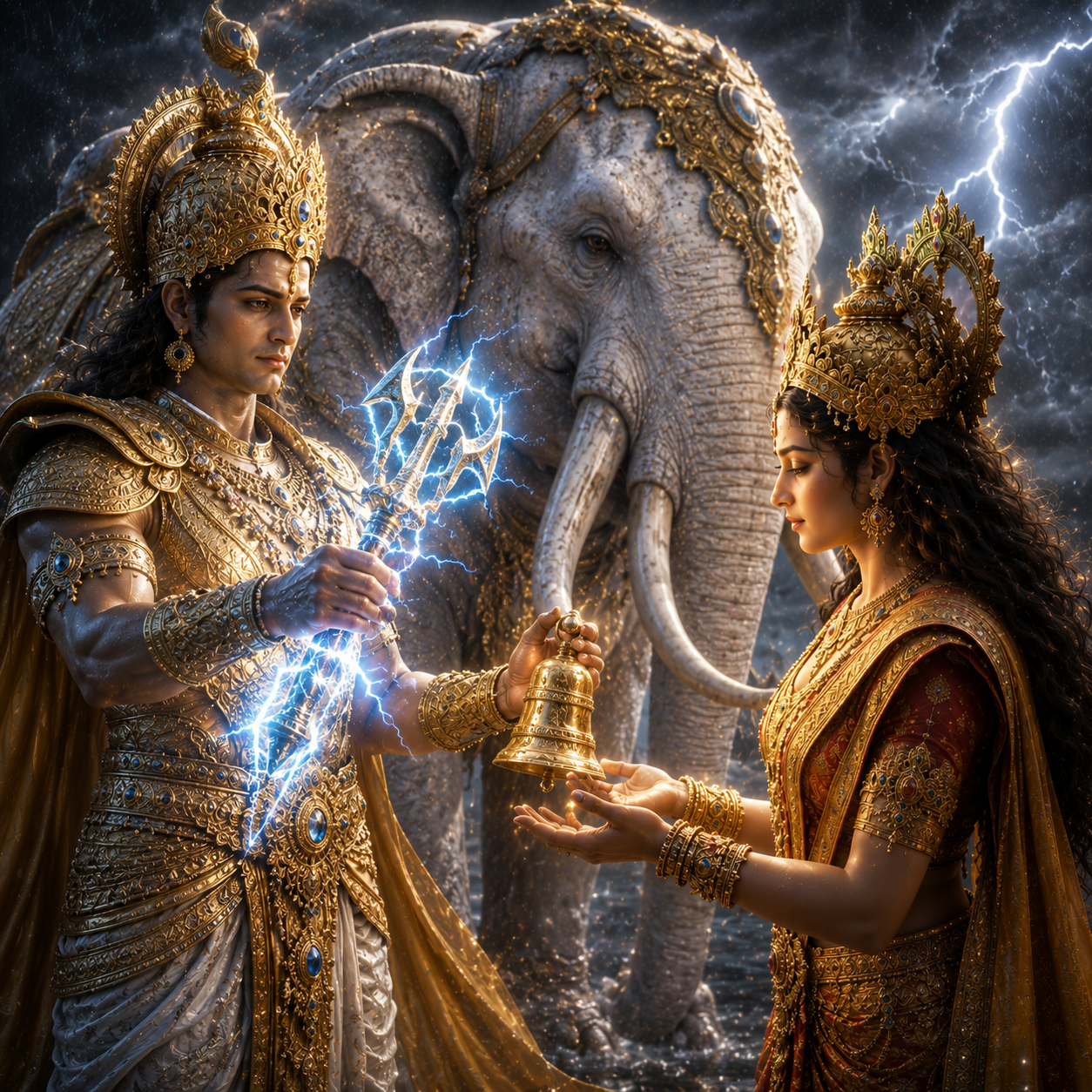
The vajra and the bell — two of the three sounds that precede her in battle.
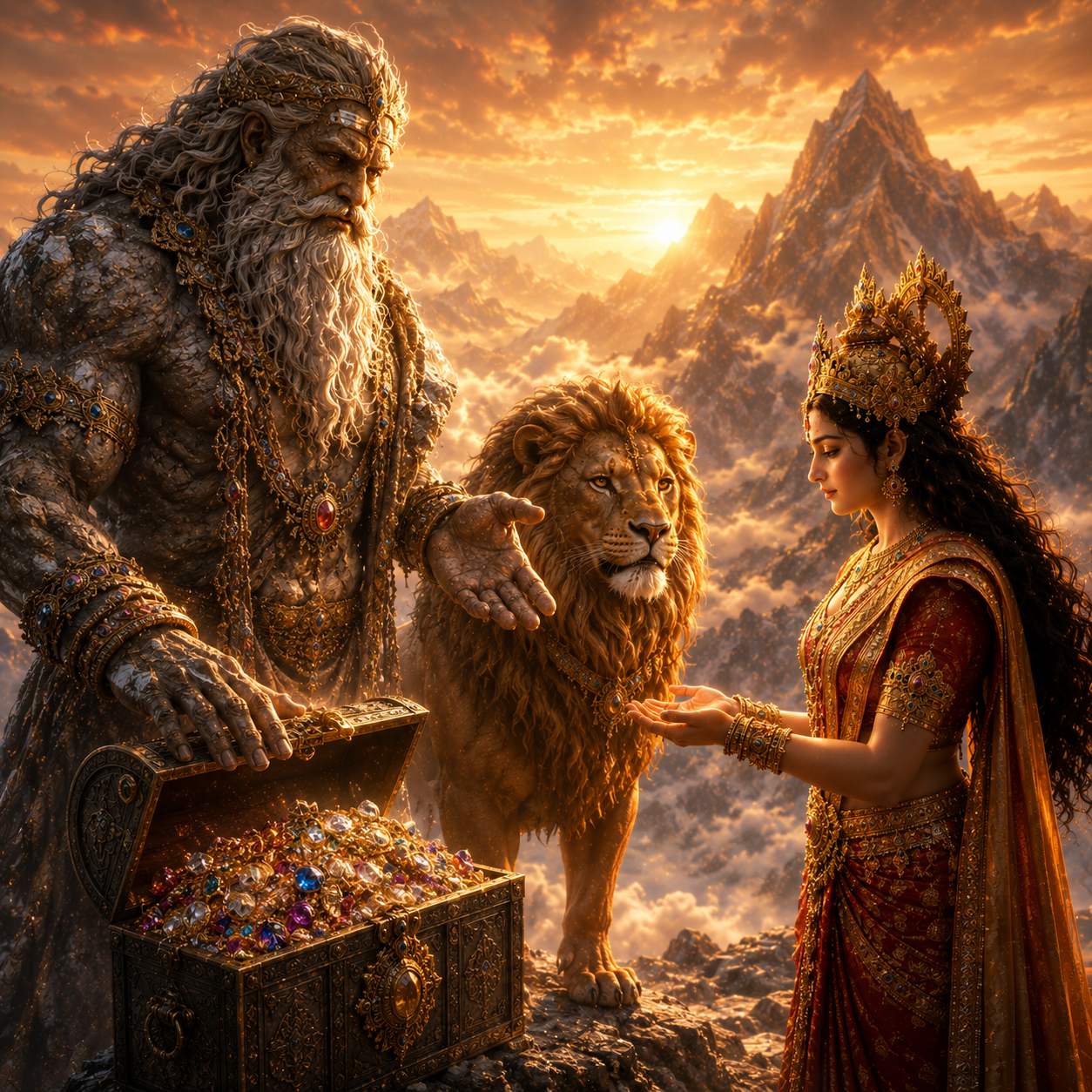
The lion — first acquired here, never absent from her image again.
From Himavat, Lord of the Mountains — The Lion and the Jewels
It is in this scene, and not in Kaushiki's later emergence in the saga's third episode, that the goddess's lion enters the story: Himavat — lord of the mountains, father of Parvati — gives her both jewels and the lion she will ride into battle against Mahishasura's entire army. This mount becomes one of the most consistent and recognizable elements of her iconography across every later episode in which a lion-riding goddess appears, even in contexts where the Devi Mahatmya itself does not repeat the story of how the lion was first acquired.
The Remaining Gifts
- Varuna — a conch and a noose
- Agni — a spear
- Vayu — a bow and a quiver of arrows
- Yama — a sword and shield
- Vishwakarma — an axe and a suit of armor
- Kubera — a drinking-vessel, kept filled, which the goddess will draw from at the height of her final duel with Mahishasura in Act III
V. The Goddess Takes the Field
Fully formed and fully armed, the goddess gives a roar — described as a lion's roar in its own right, distinct from the roar her actual lion-mount will soon add to it — loud enough to fill the space between earth and sky. The mountains tremble; the seas shudder; her footstep alone is enough to make the earth bend beneath her, and the twang of her drawn bowstring shakes the netherworlds. The sages of the three worlds bow and extol her as she advances. It is in this moment, fully assembled, armed by an entire pantheon, mounted on a mountain-god's own lion, that she turns toward the war that the rest of this saga is about to narrate in full.
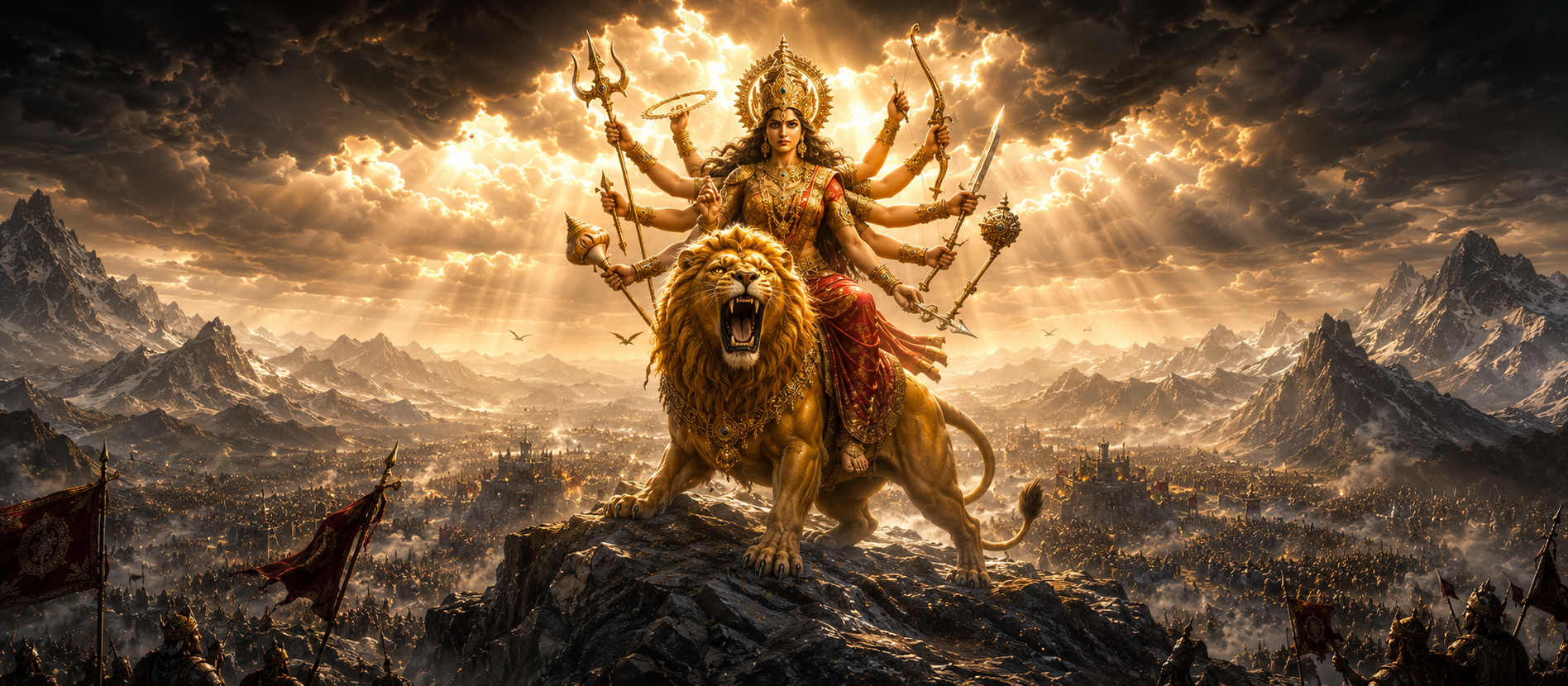
Fully assembled and fully armed, the goddess takes the field — and Mahishasura's army comes into view below.
Sources for This Act
Primary & Secondary Sources
- Markandeya Purana, Ch. 82 (Devi Mahatmya, Durga Saptashati Ch. 2, "The Manifestation of the Divine Power") — primary source: the devas' plea, the formation of the goddess from the Trimurti's combined tejas and the radiance of the lesser gods, the anatomical description of her form, and the full sequence of weapons and gifts.
- Vamana Purana and Devi Bhagavata Purana — parallel elaborations of the goddess's composite formation.
- Kinsley, David. Hindu Goddesses. University of California Press, 1986. On the theological significance of a goddess assembled from combined divine tejas rather than born of any single deity.
- Coburn, Thomas B. Devi-Mahatmya: The Crystallization of the Goddess Tradition. Motilal Banarsidass, 1984. Structural analysis of chapter 2 and its place as the text's central statement on divine composite power.