
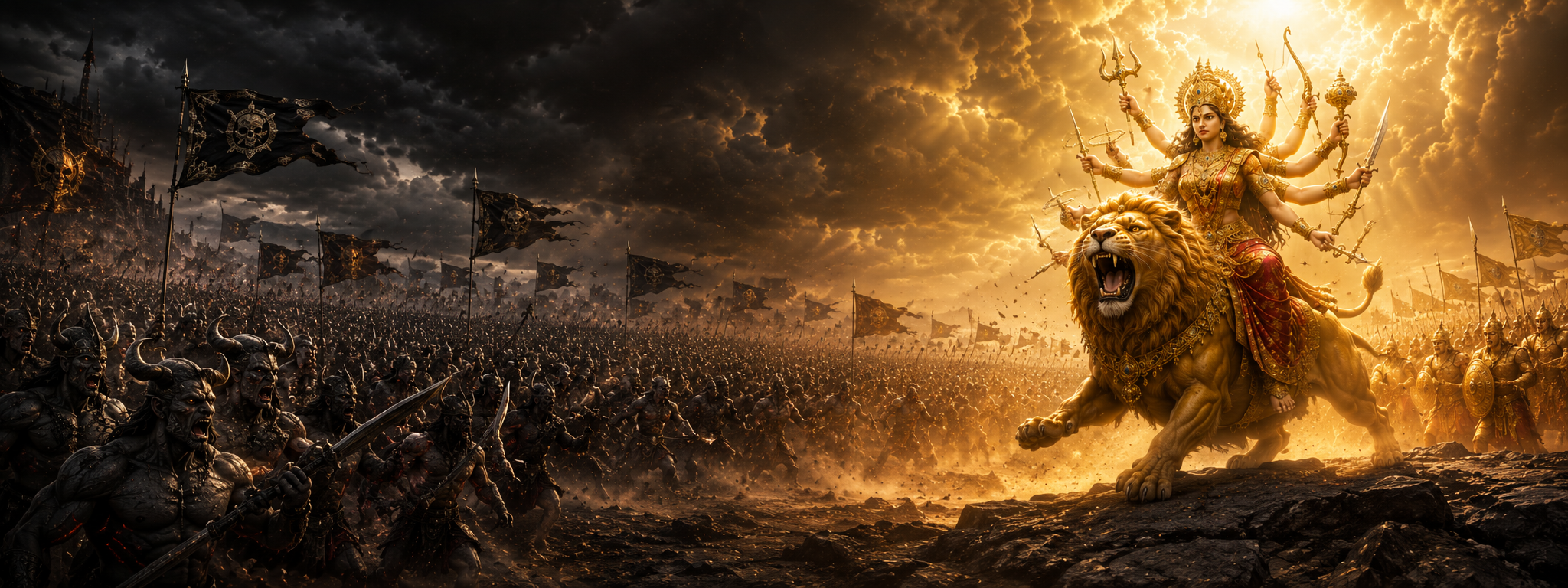
I. Three Sounds Before a Single Blow
Mahishasura's army hears the goddess before it sees her clearly: the clang of Indra's bell carried on Airavata, the deep twang of her drawn bowstring, and beneath both, the roar of the lion she rides — three distinct sounds rolling across the field together, loud enough that the text describes the combination as filling heaven, earth, and the directions between them at once. Mahishasura, watching this advance, does not retreat or parley. He orders his full army forward under the command of his most trusted officer.
II. Chikshura's Charge
Chikshura, Commander-in-Chief
Mahishasura's most senior general leads the opening charge in full force — chariots, archers, and infantry pressed forward as a single coordinated assault rather than the piecemeal, escalating campaigns this saga's third episode will later feature. Chikshura himself closes directly with the goddess, loosing volley after volley of arrows that she shatters in mid-air or simply absorbs without flinching. The duel that follows is the first genuinely sustained exchange of the entire war — sword against arrow, chariot against lion — and it ends with the goddess's own weapons finally finding their mark, breaking Chikshura's chariot and bringing down the army's commander in the war's opening engagement.
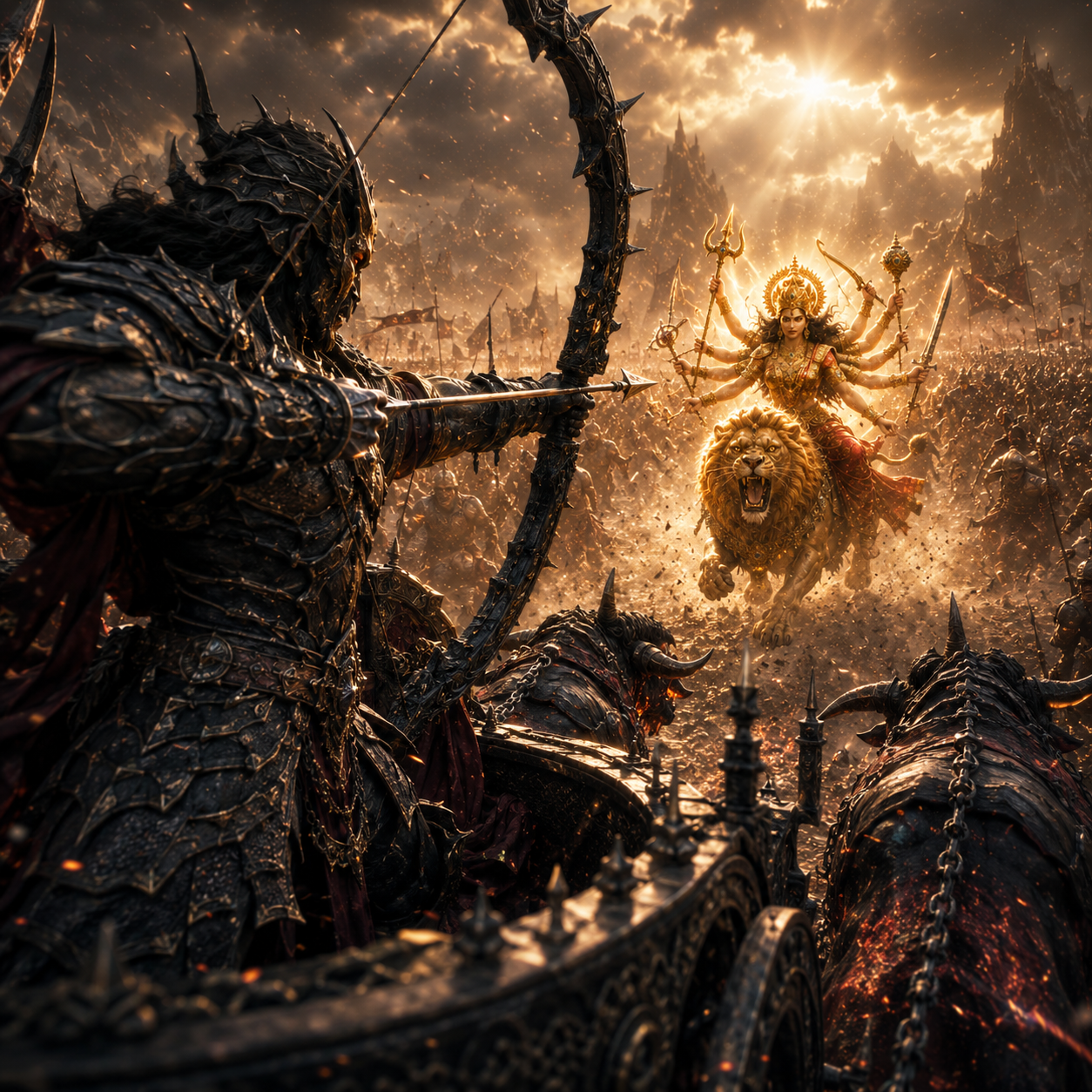
The first sustained duel of the war — and its first general to fall.
III. The Lion's First Kill
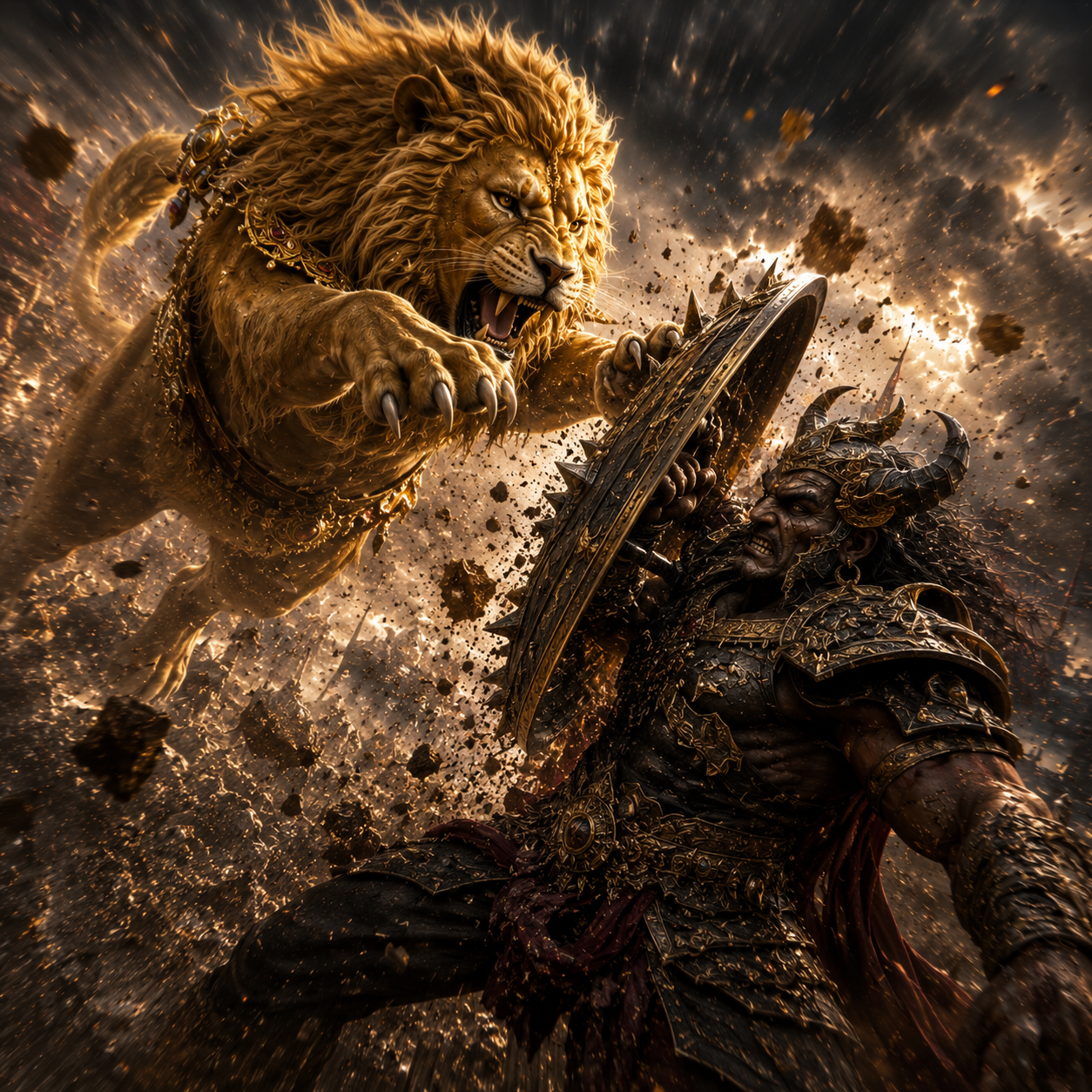
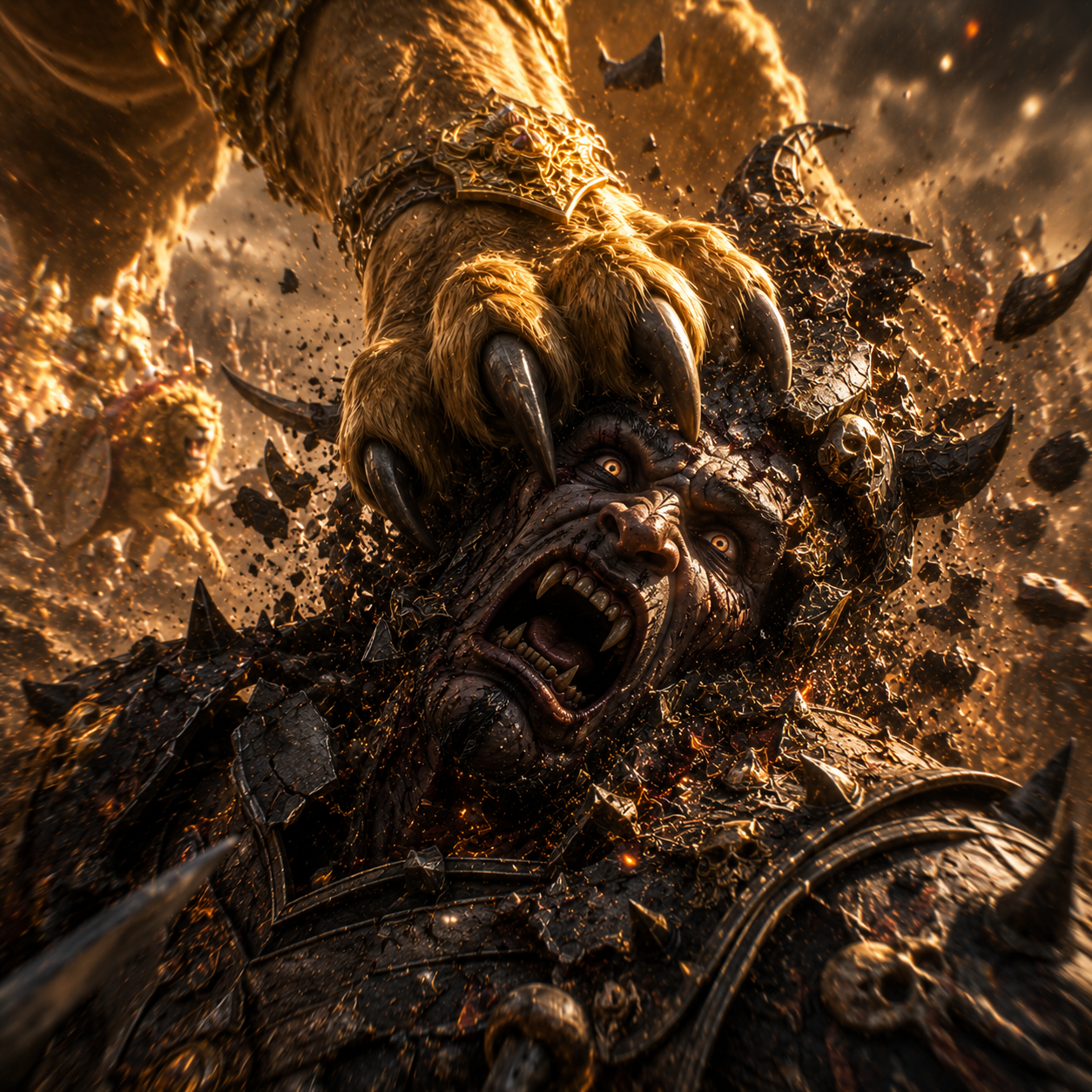
Himavat's gift proves to be a combatant in its own right.
Chamara, Killed by the Goddess's Own Mount
With Chikshura down, the general Chamara presses forward — and meets not the goddess's weapons but her lion directly. Himavat's gift, introduced in Act I as a mount, proves in this engagement to be a combatant in its own right: the lion brings Chamara down with claw and jaw before the goddess's own hands need to be raised against him, the first of several moments across this campaign where her mount fights as an independent force rather than simply carrying her into range.
IV. The Goddess's Own Army
As the battle widens beyond Chikshura and Chamara into a general engagement against the full demon host, the goddess does not face this army with her own hands alone. The text describes her producing, from the very force of her exhaled breath, vast numbers of her own armed attendants — shaktis and ganas, springing into existence fully formed and weaponed, who fall on Mahishasura's remaining forces alongside her. It is a detail worth holding onto across this entire saga: the same structural move — a single goddess answering an overwhelming army by multiplying her own forces rather than relying on combined strength alone — will recur in expanded and far more theologically weighted form when Kaushiki produces the Sapta-Matrikas against Raktabija in the saga's third episode. Here, in this earlier war, it appears in a simpler, less individuated version: a wave of nameless reinforcements rather than seven distinct, named goddesses.
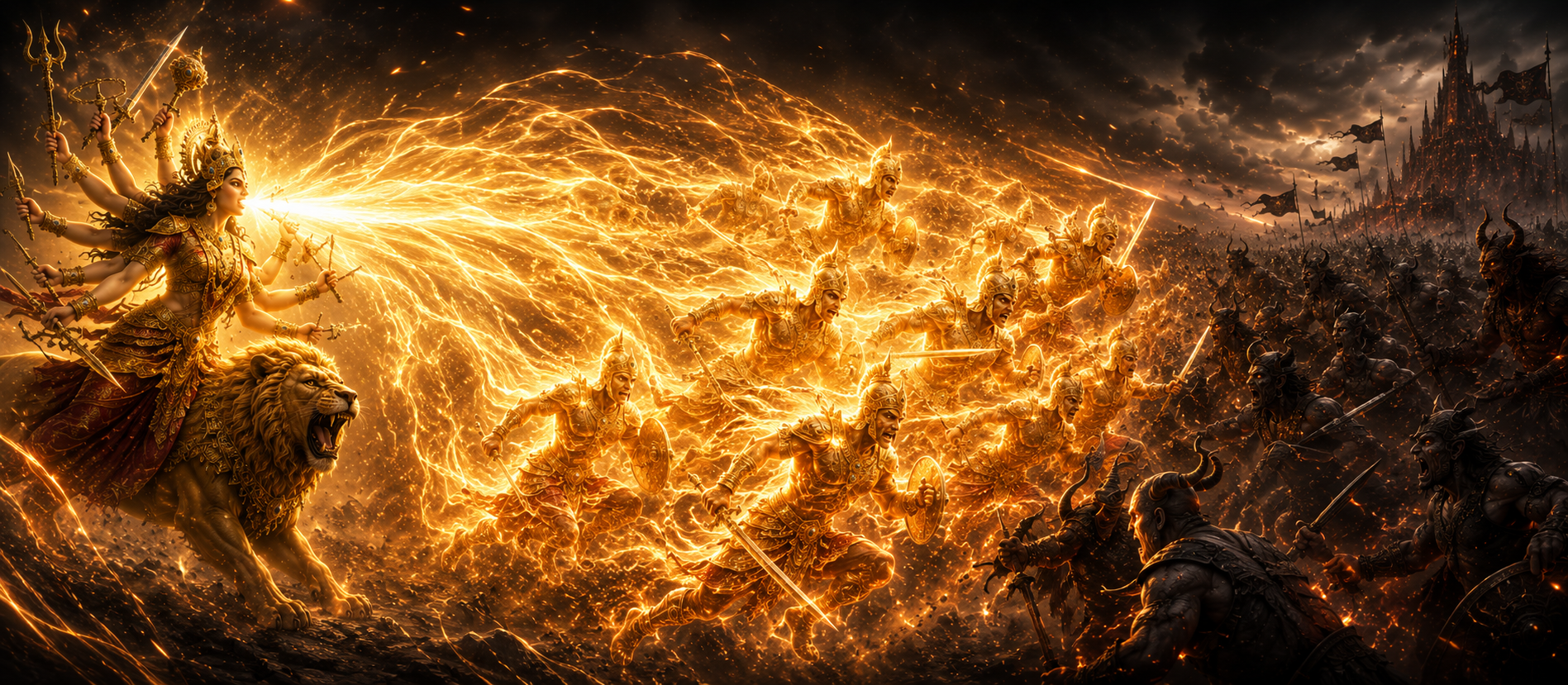
Armed attendants spring from the goddess's own breath to meet the scale of Mahishasura's remaining army.
V. The Litany of Fallen Generals
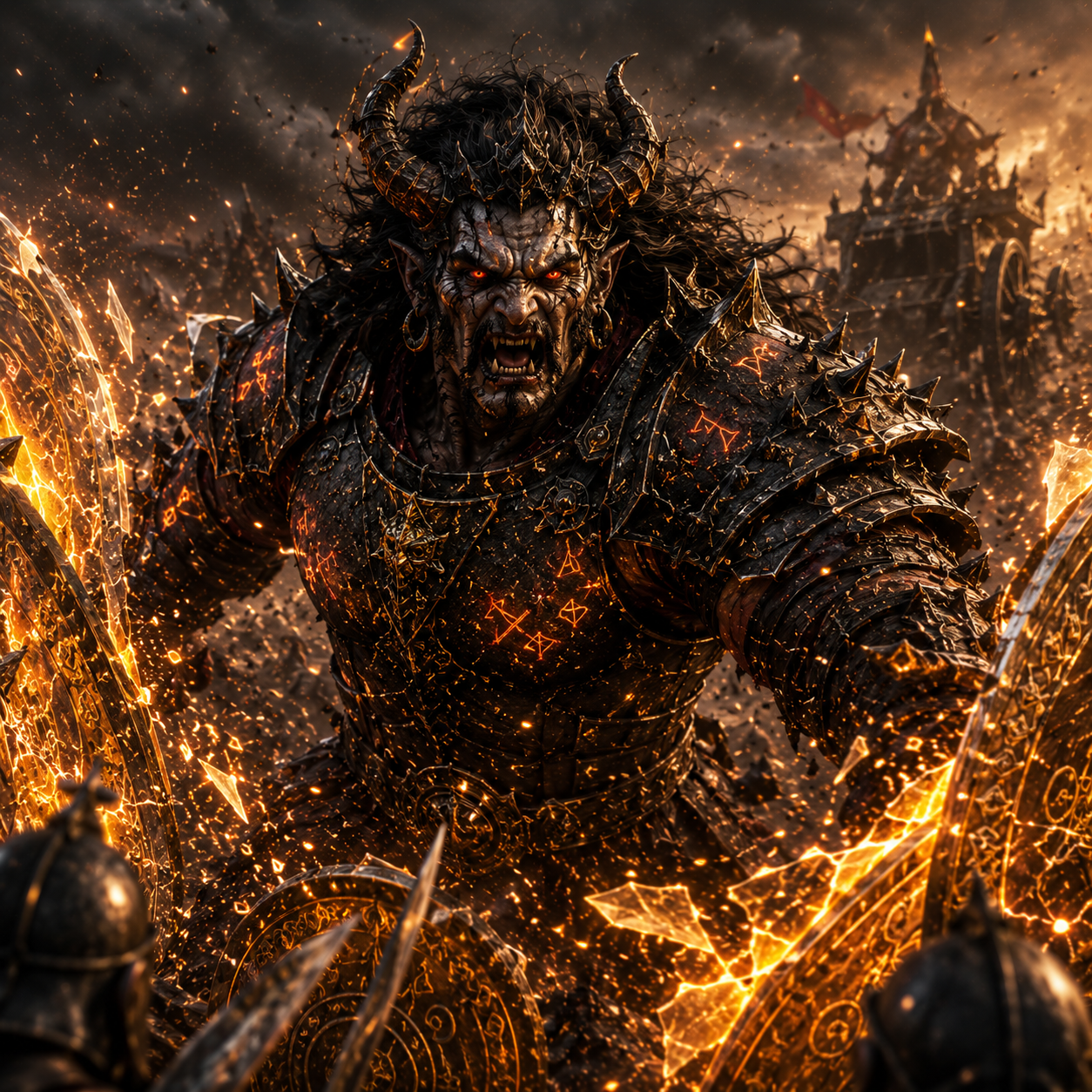
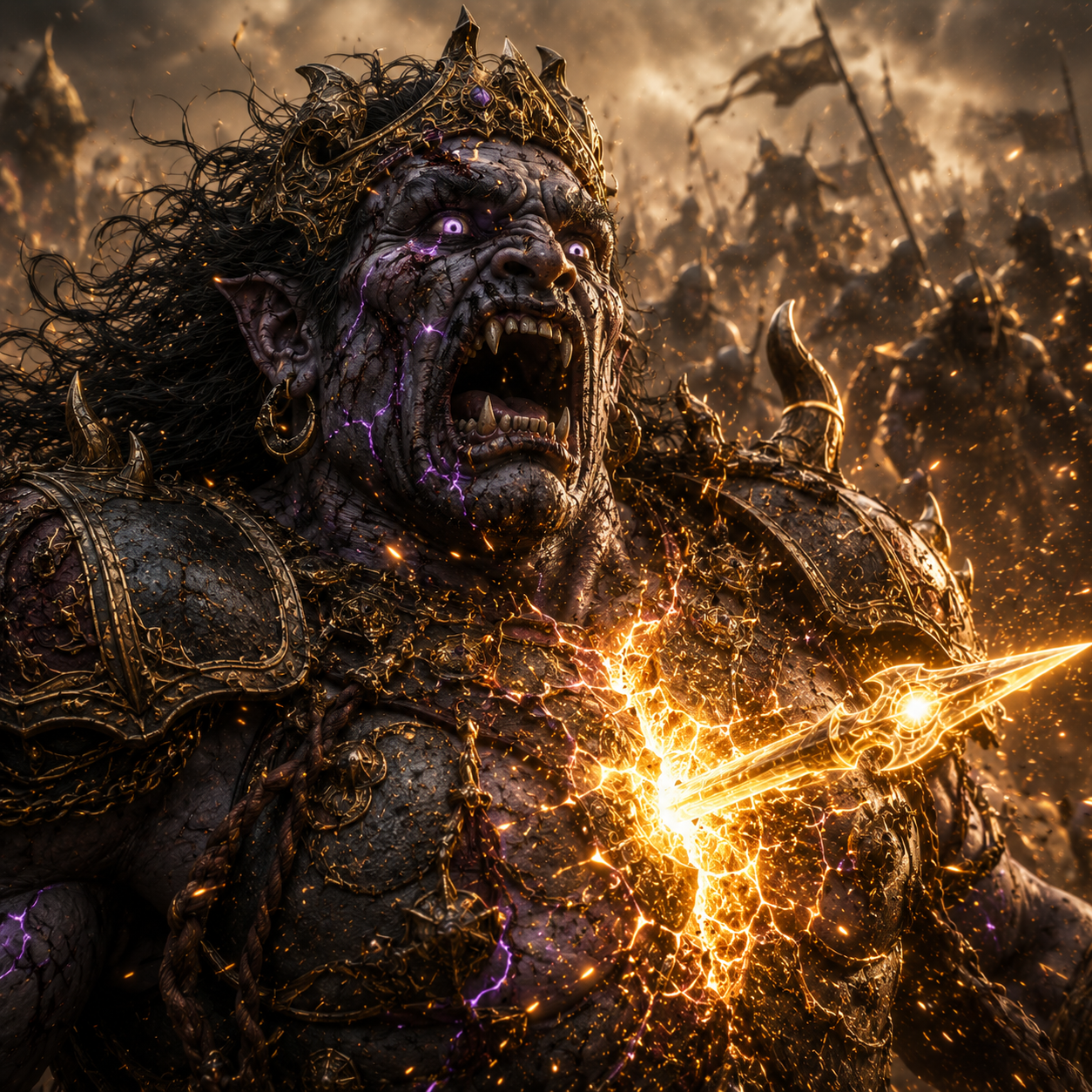
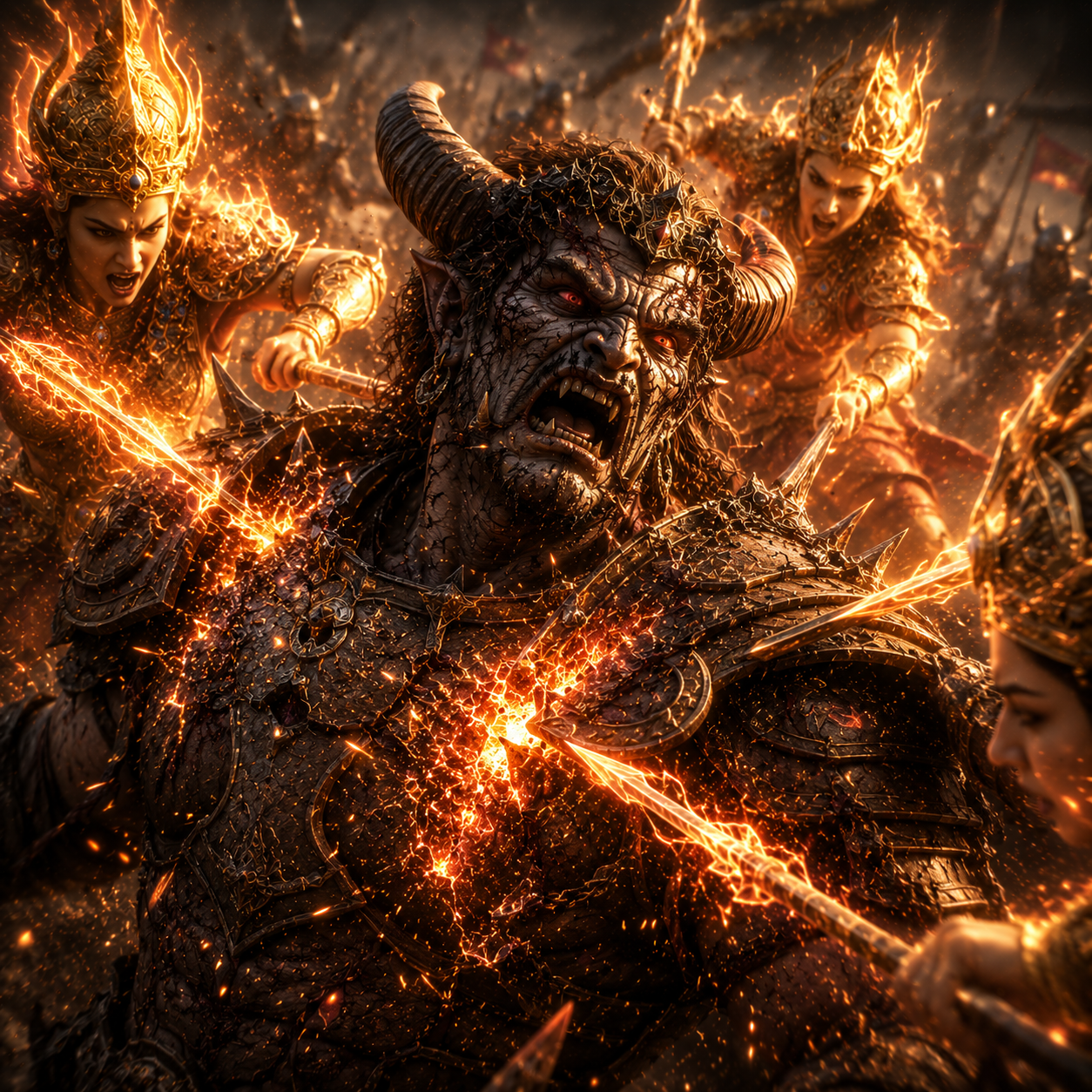
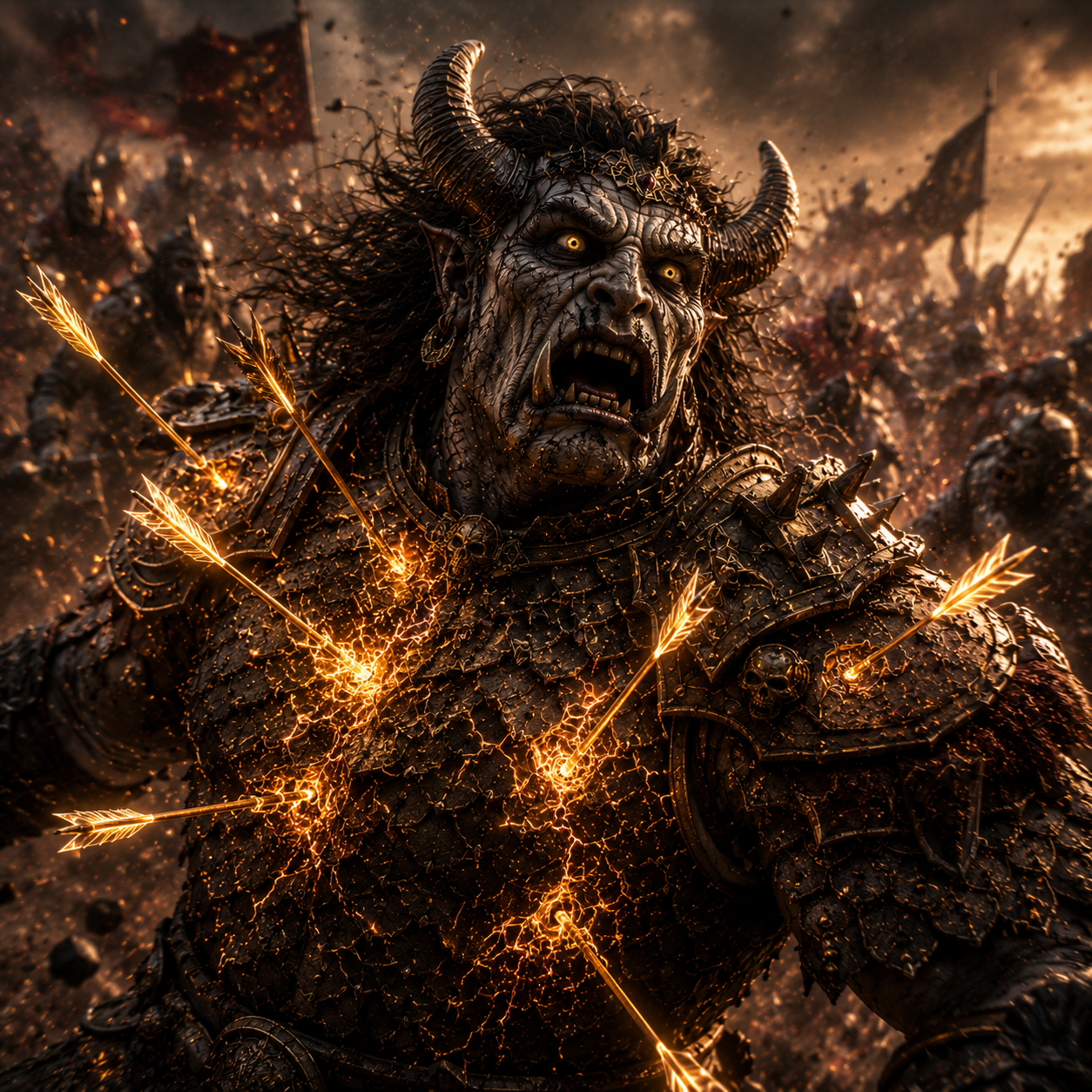
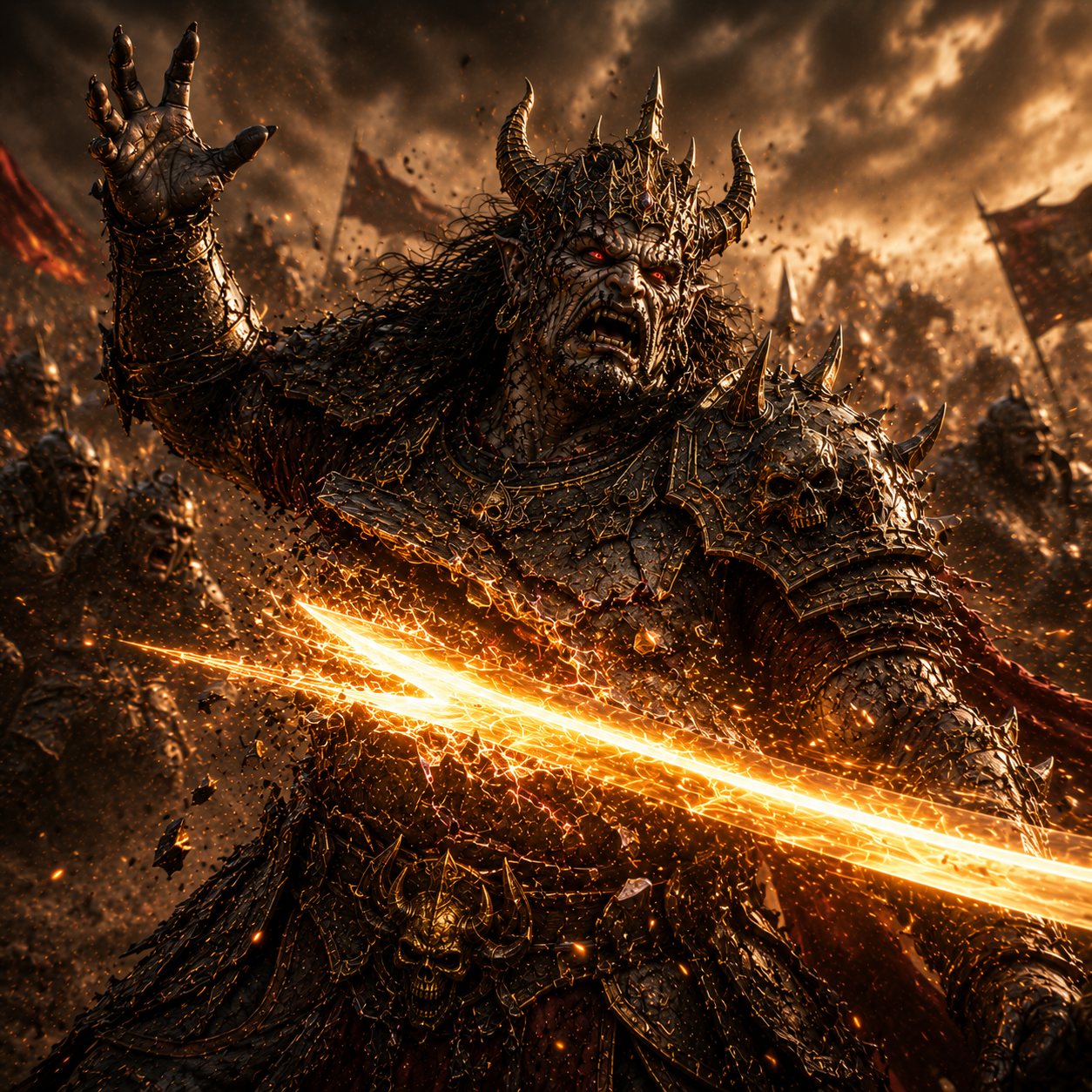
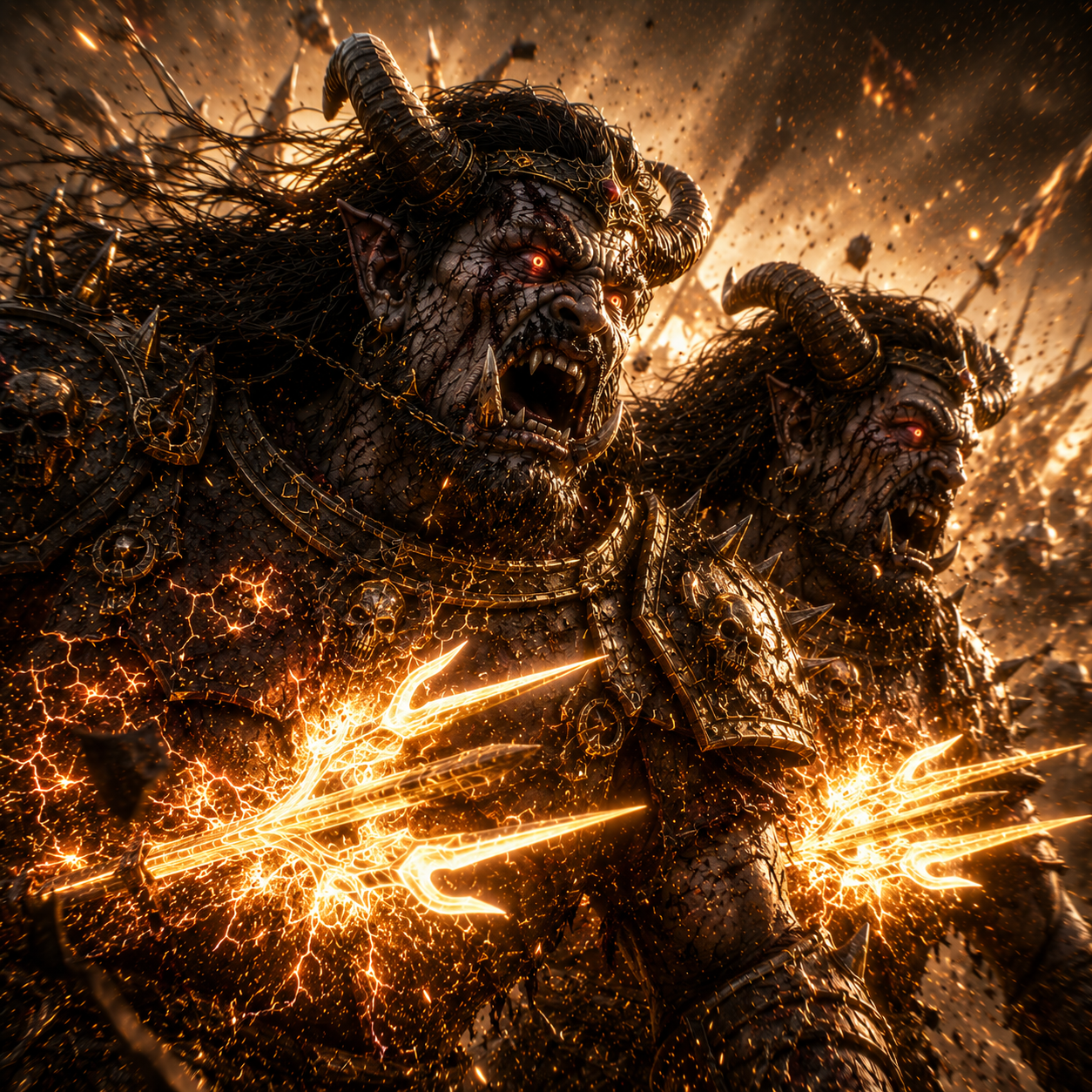
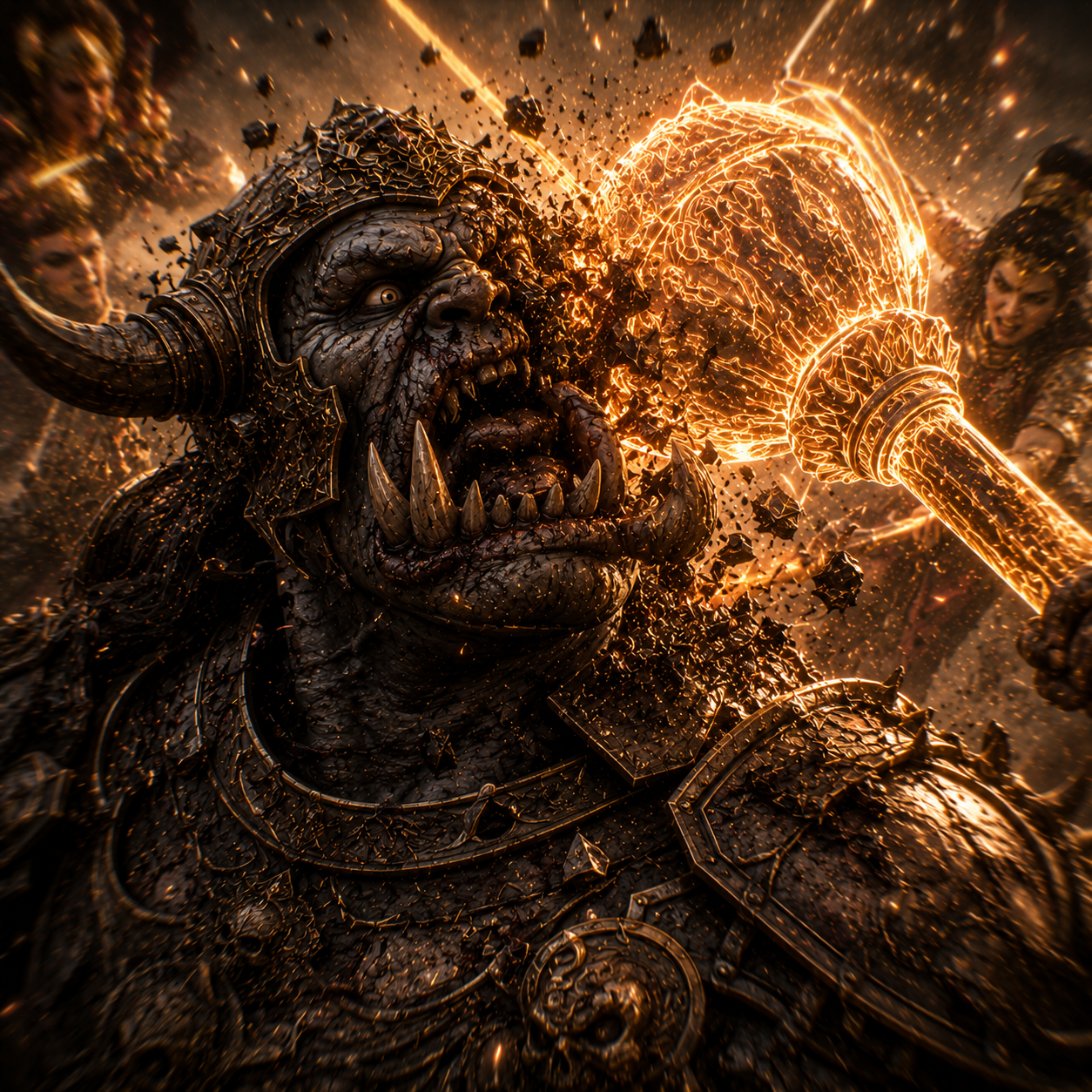
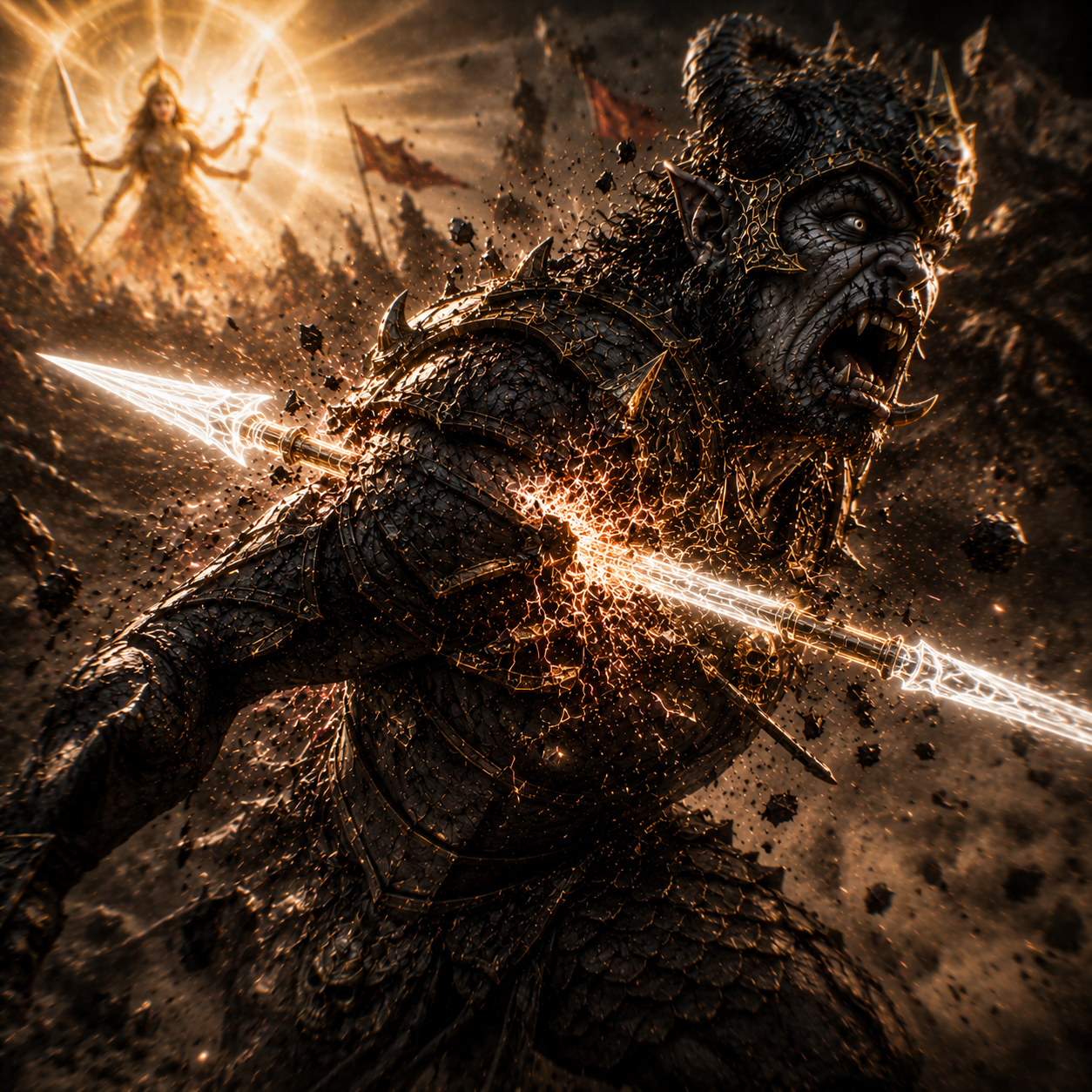
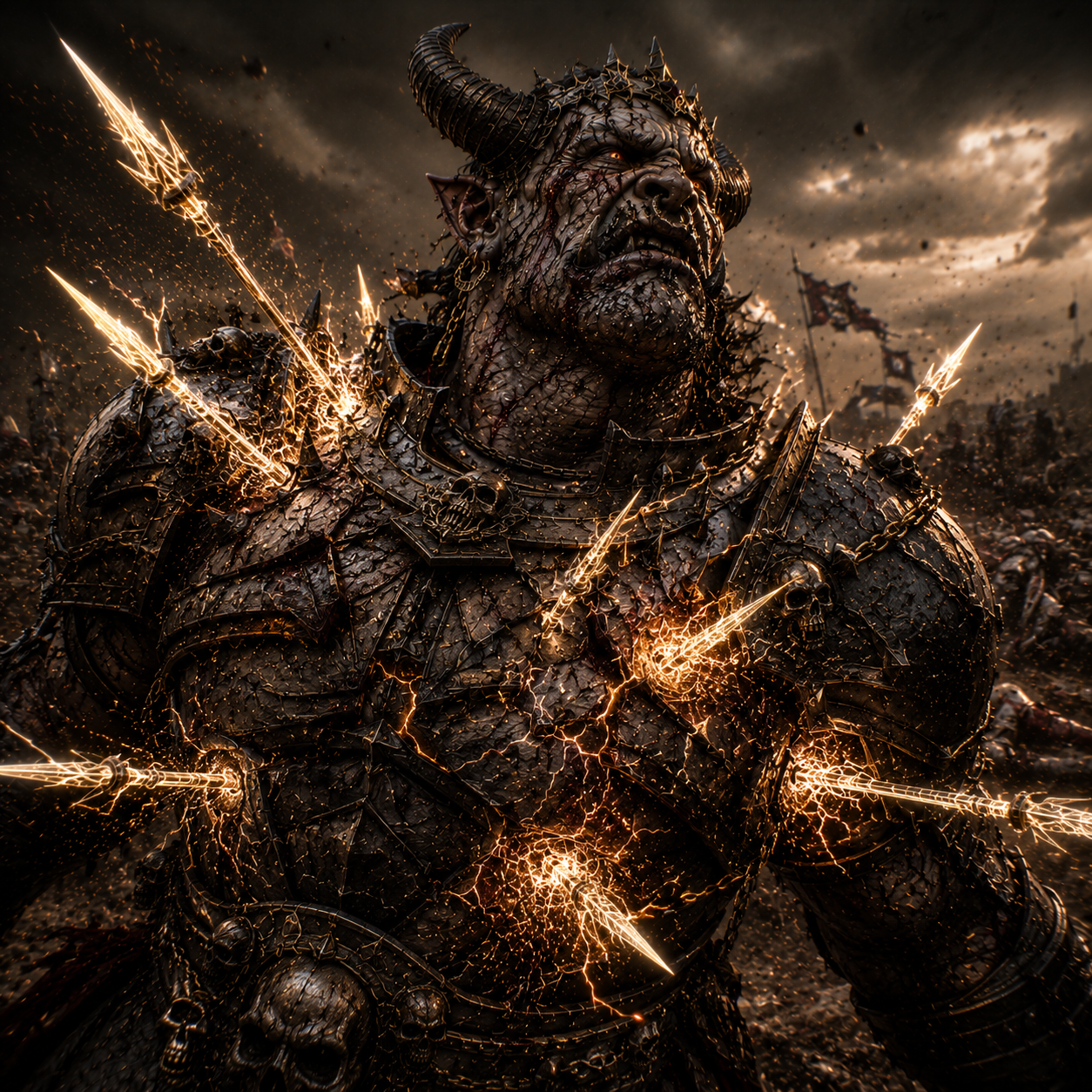
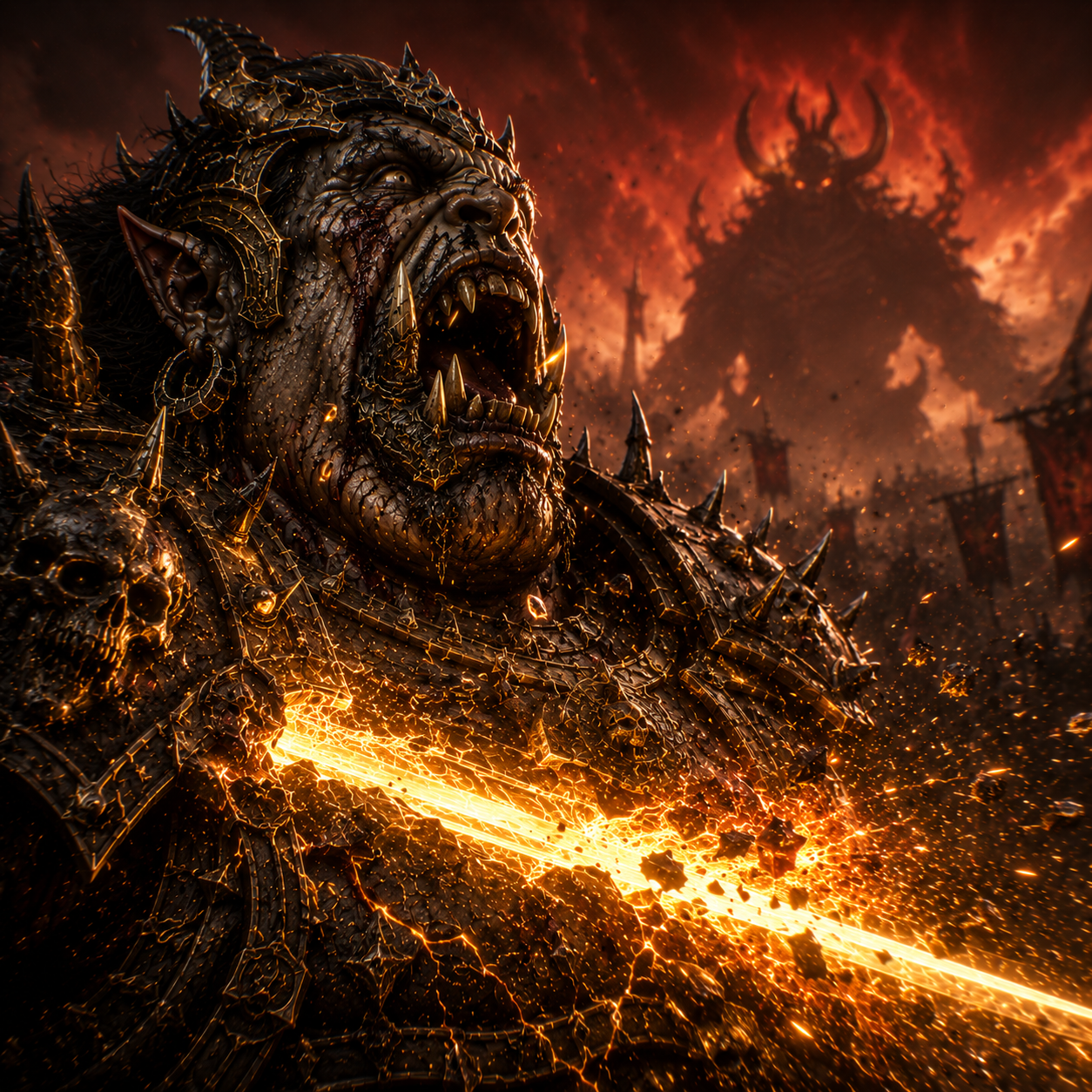
What follows is the longest sustained sequence of named demon deaths anywhere in the three episodes of the Devi Mahatmya — general after general thrown against the goddess and her forces, each one granted a name, a moment of resistance, and a specific end, before the text moves to the next. It reads less like a single climactic duel and more like the cast list of an army being struck off one by one, a deliberate structural choice that conveys the sheer scale of the force Mahishasura had assembled before any of it proves sufficient.
A Note on This Sequence
The Devi Mahatmya gives most of these secondary generals brief, often formulaic combat-deaths — a sentence or two each, compared to the extended treatment given to Chikshura, Chamara, and Mahishasura himself. The brief fate-descriptions below follow the consistent pattern the text establishes (death by the goddess's weapons, by her attendants, or by the lion) rather than claiming a uniquely distinct method is specified in the verses for every single name; where the text is genuinely terse, this chronicle does not invent dramatic specifics beyond what a reasonable, consistent battlefield reconstruction supports.
VI. The Army That Was No Longer There
By the time Durmukha falls, Mahishasura's officer corps has been entirely eliminated and the bulk of his rank-and-file army with it. What had been, at the opening of this act, a force vast enough to fill the horizon is now wreckage — chariots overturned, banners down, the field littered with the named and unnamed dead in roughly equal measure. Mahishasura, watching from wherever a demon king watches his own army's annihilation, is left with exactly one resource the war has not yet tested: himself.
He had, until this point, directed the war entirely through delegation — through Chikshura's command, through the weight of numbers, through officer after officer thrown at a single goddess in the hope that scale alone would eventually be enough. With that hope exhausted, he does something none of the brothers in this saga's later episode will manage until their own armies are equally spent: he enters the field himself, in the form that gives this war its name.
Sources for This Act
- Markandeya Purana, Ch. 83 (Devi Mahatmya, Durga Saptashati Ch. 3, opening verses, "The Slaying of Mahishasura's Army") — primary source: Chikshura's charge, Chamara's death at the lion's claws, the goddess's production of attendant shaktis, and the litany of named generals.
- Mani, Vettam. Puranic Encyclopaedia. Motilal Banarsidass, 1975. Entries on Chikshura, Chamara, and the named officers of Mahishasura's army.
- Coburn, Thomas B. Devi-Mahatmya: The Crystallization of the Goddess Tradition. Motilal Banarsidass, 1984. On the structural function of the extended general-by-general sequence and its parallel to the later Sapta-Matrika episode.
As noted above, the Devi Mahatmya's treatment of the secondary generals (Udagra through Durmukha) is brief and largely formulaic in the source text; the specific fates given to each in the gallery above are reasonable, consistent reconstructions in keeping with the text's established pattern rather than claims of verse-by-verse specificity for each individual name.