
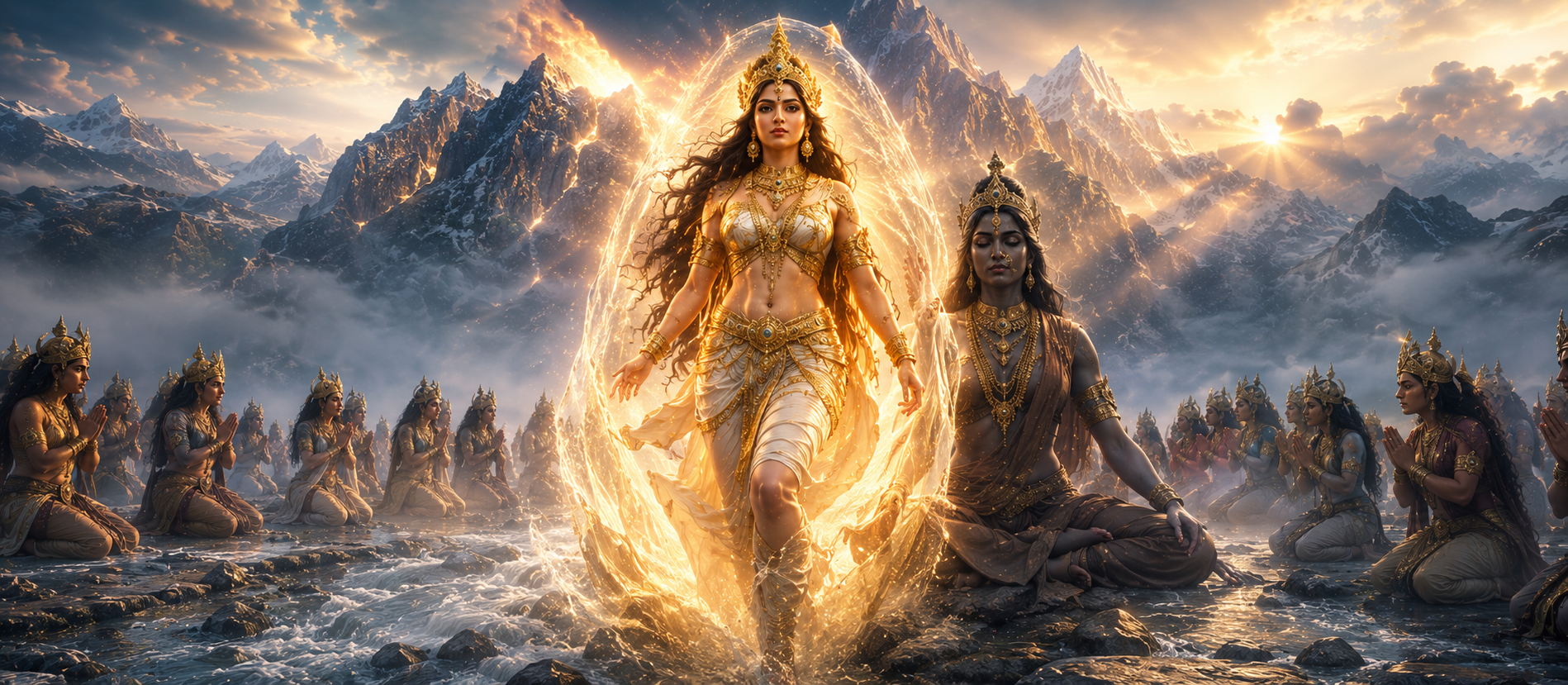
This act covers the Prologue and first movement of the Shumbha-Nishumbha war: the cosmic logic that required a new goddess, her emergence from Parvati's own body, the scouts' fateful report, and the vow that declared a war before a single blow was struck. The full Prologue — the mechanics of the conquest and the comparative context of boons with built-in loopholes — is told here in depth.
I. A World Without Gods
To understand why this war required a goddess who did not yet exist, it helps to first understand exactly how completely the gods had lost. The Devi Mahatmya does not describe Shumbha and Nishumbha's conquest of heaven as a single battle won and a throne seized. It describes a total, administrative dispossession. Indra's elephant Airavata, the wish-granting tree Parijata, the divine horse Uchchaihshravas — the very offices of Surya, Agni, Vayu, and Kubera — every function and possession of divine rule was catalogued, seized, and reassigned to the demon hierarchy. The devas were not merely defeated; they were made obsolete in their own cosmos.
This is, in the structure of the Devi Mahatmya, the third time this exact pattern has played out. Mahishasura — granted invincibility against every male being — had already driven the gods from heaven once before and was destroyed only by a goddess assembled from the gods' combined fury. Shumbha and Nishumbha's boon is more dangerous still, because of its precision: not "no man," but no being who existed at the moment the boon was sworn. A closed list with a fixed timestamp — and the gods, the asuras, and every existing form of the Goddess herself were already, irrevocably, on it.
The device of a boon that seems airtight but contains an exploitable precision is one of the most recognisable structural patterns in Puranic literature: Hiranyakashipu's protection against death "by day or night, indoors or outdoors, by god, man, or beast" is circumvented by Narasimha at twilight on a threshold. Ravana's invulnerability to gods and demons leaves him exposed to Rama, born as a man. Mahishasura's restriction to a male slayer leaves him exposed to Durga. Shumbha and Nishumbha's restriction to beings already in existence is this same device turned toward time itself rather than category — and it is precisely this temporal precision that the commentarial tradition reads as the reason Kaushiki had to be newly born to end them.
II. The Hymn That Summoned a Goddess
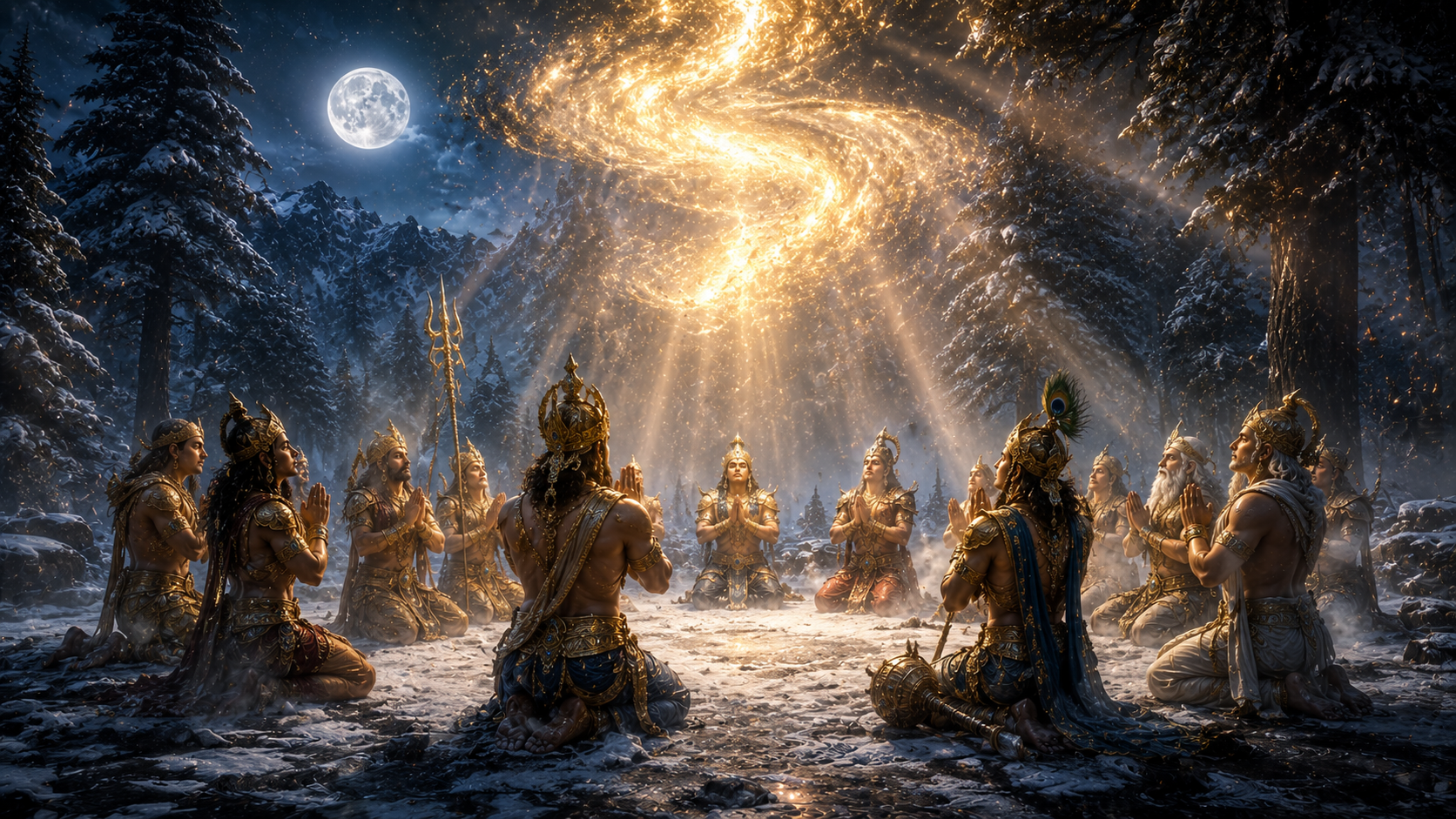
The Aparajita Stuti rises from the Himalayan foothills — a prayer cast wide enough to call forth whatever the crisis demanded.
The invocation the gods raised — preserved as the Aparajita Stuti, the "Hymn to the Unconquered One" — is addressed not to any single goddess-form already known to them, but to the unmanifest, formless Shakti underlying every form the Goddess might take. It is a prayer cast wide enough to call forth whatever was needed, without specifying what that would be — because the gods themselves had no way of knowing that what was needed did not yet exist.
It was into the middle of this hymn that Parvati, daughter of the mountain-king Himavat and his wife Mena, happened to arrive at the river to bathe. Hearing the gods singing nearby, she asked the simple, almost domestic question that triggers everything that follows: to whom are you singing? And in answer, before any of the gods could speak, something in Parvati's own body answered for her.
III. The Mechanism of Emergence
Kaushiki — She Who Came Forth from the Sheath
From Parvati's kosha — her sheath, the outer covering of her physical form — a second goddess stepped bodily into the world: golden-complexioned, fully formed, radiant, armed with nothing yet but her own presence. She announced herself as the very one the gods' hymn sought. The text gives her the name that records this precise mechanism of birth: Kaushiki, "she who came forth from the sheath."
In the same instant, the form of Parvati that remained darkened in complexion, taking the name Kalika — a goddess whose fuller role in the war belongs to Act III, when she will emerge a second time, in a far fiercer form, from Kaushiki's own brow.
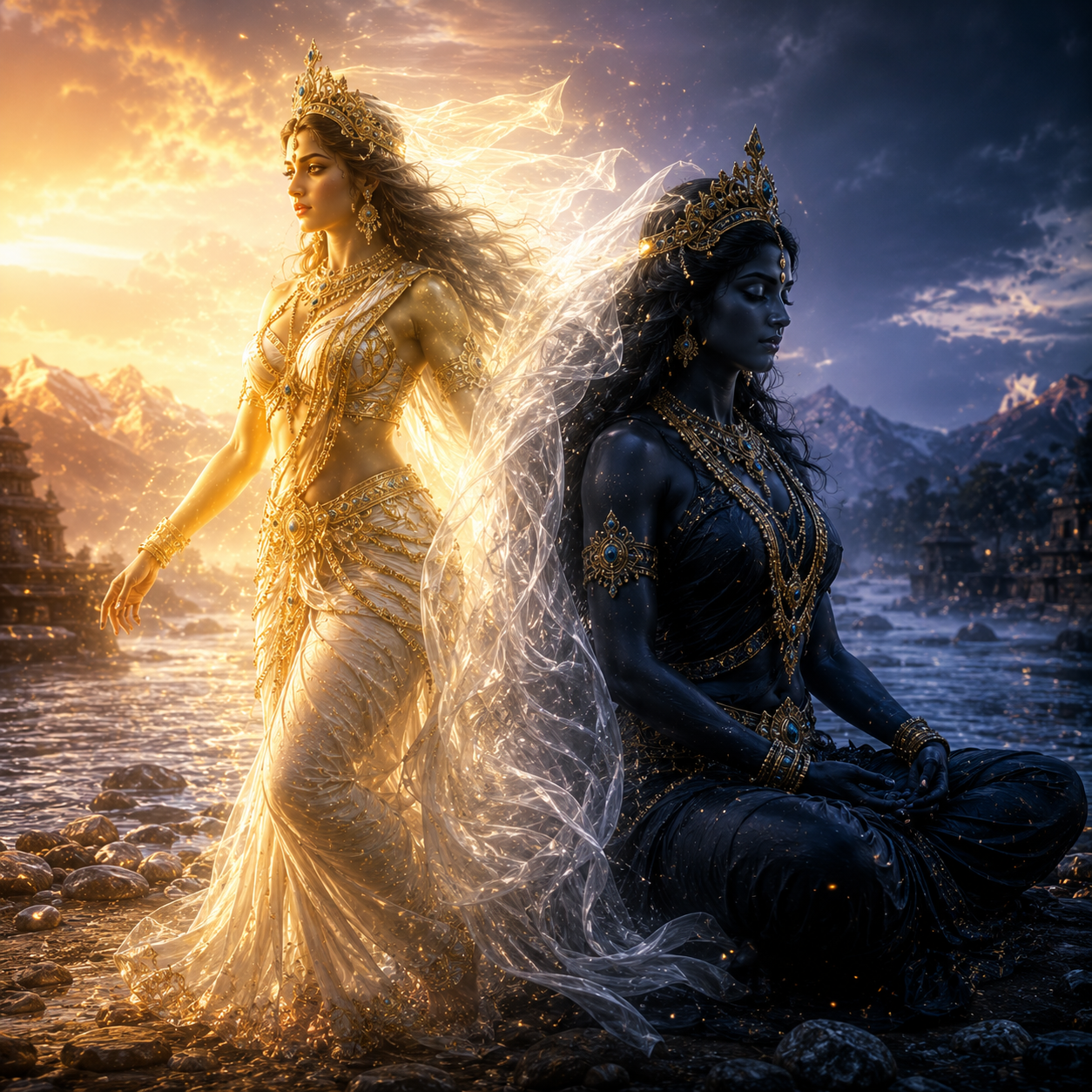
The instant of division: Kaushiki steps forth in gold; the form that remains darkens into Kalika.
The Devi Mahatmya's own verses do not pause to explain why the goddess who had already destroyed Mahishasura could not simply return to finish this new threat. That explanatory logic — that Shumbha and Nishumbha's boon protected them specifically against beings already in existence at the time it was sworn — belongs to the commentarial layer that grew up around the text. The Mahatmya simply shows us a new emergence and lets the war that follows make the case for why it had to happen this way.
IV. The Scouts on the Mountain
Word of the new goddess reached the demon court by the most mundane possible channel available to this kind of cosmic drama: two minor demons, Chanda and Munda, happened to be passing through the Himalayan foothills on Shumbha's business and simply saw her — seated, smiling gently, on a golden mountain peak, her lion beside her. They did not recognise a threat. They recognised the single most beautiful being either of them had ever seen, and reported her existence to Shumbha in exactly the terms the brothers used for everything else of value they encountered: as an asset not yet acquired.
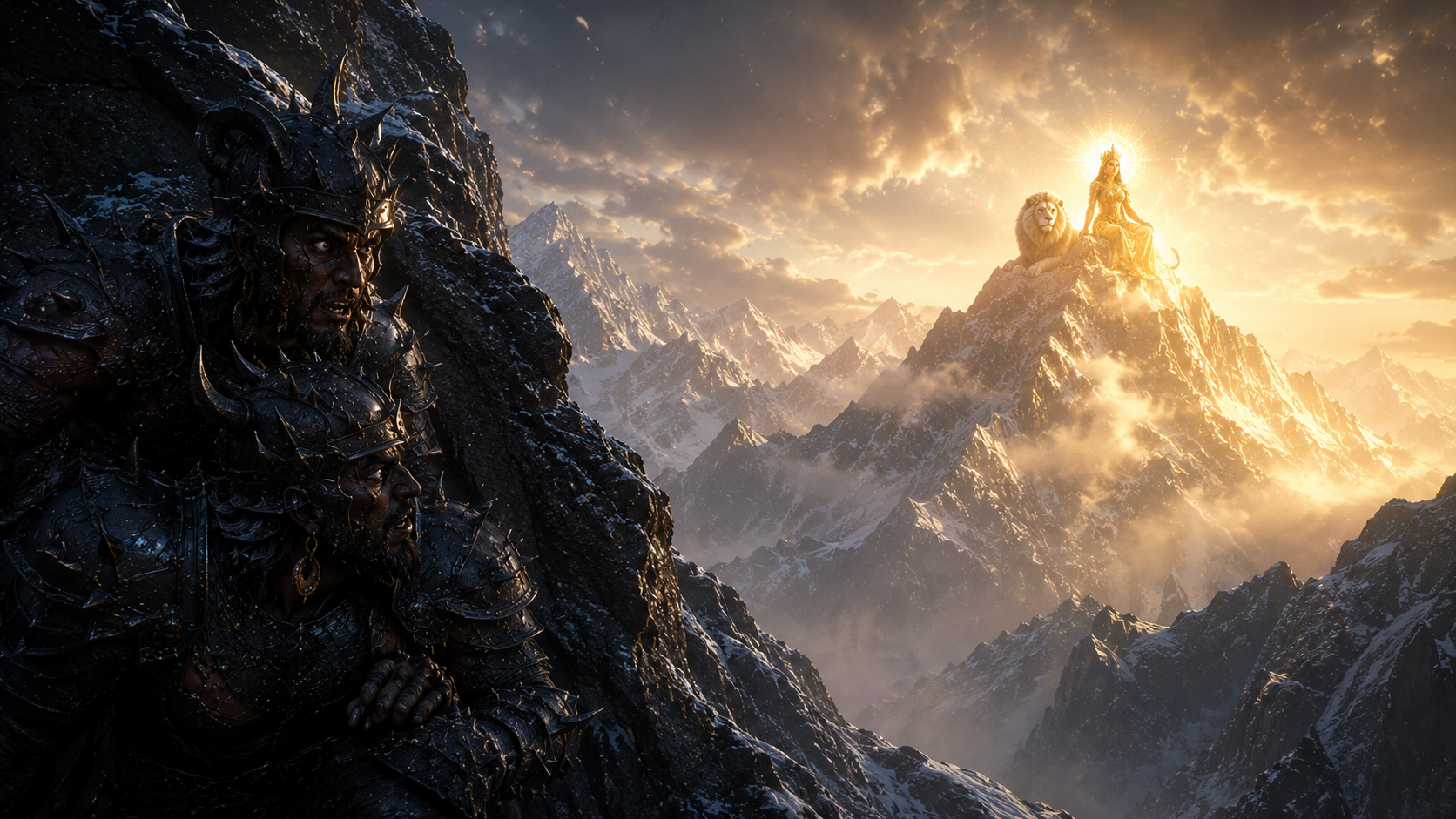
Chanda and Munda mistake a warning sign for an asset — and set the entire war in motion with their report.
V. Sugriva's Embassy and the Vow That Declared War
Shumbha's response was a proposal, not a declaration of war — at least not yet. He dispatched his messenger Sugriva (a demon envoy unconnected to the later monkey-king of the Ramayana) to the mountain, with an offer phrased as generosity: Shumbha possessed every treasure in the three worlds; she had only to come to him and she would want for nothing ever again.
Kaushiki's answer is the hinge on which the entire war turns. She does not refuse the proposal outright. She instead confesses to a vow taken out of her own pride, before this conversation ever began: that she would marry only the one being capable of meeting her in battle and defeating her outright.
"I made, out of my own pride, a foolish vow: that I would wed only the one who could conquer me in battle and break that pride. Whichever of you can do this — let him come and take me."
— Kaushiki's reply to Sugriva, Devi Mahatmya ch. 5 (paraphrased)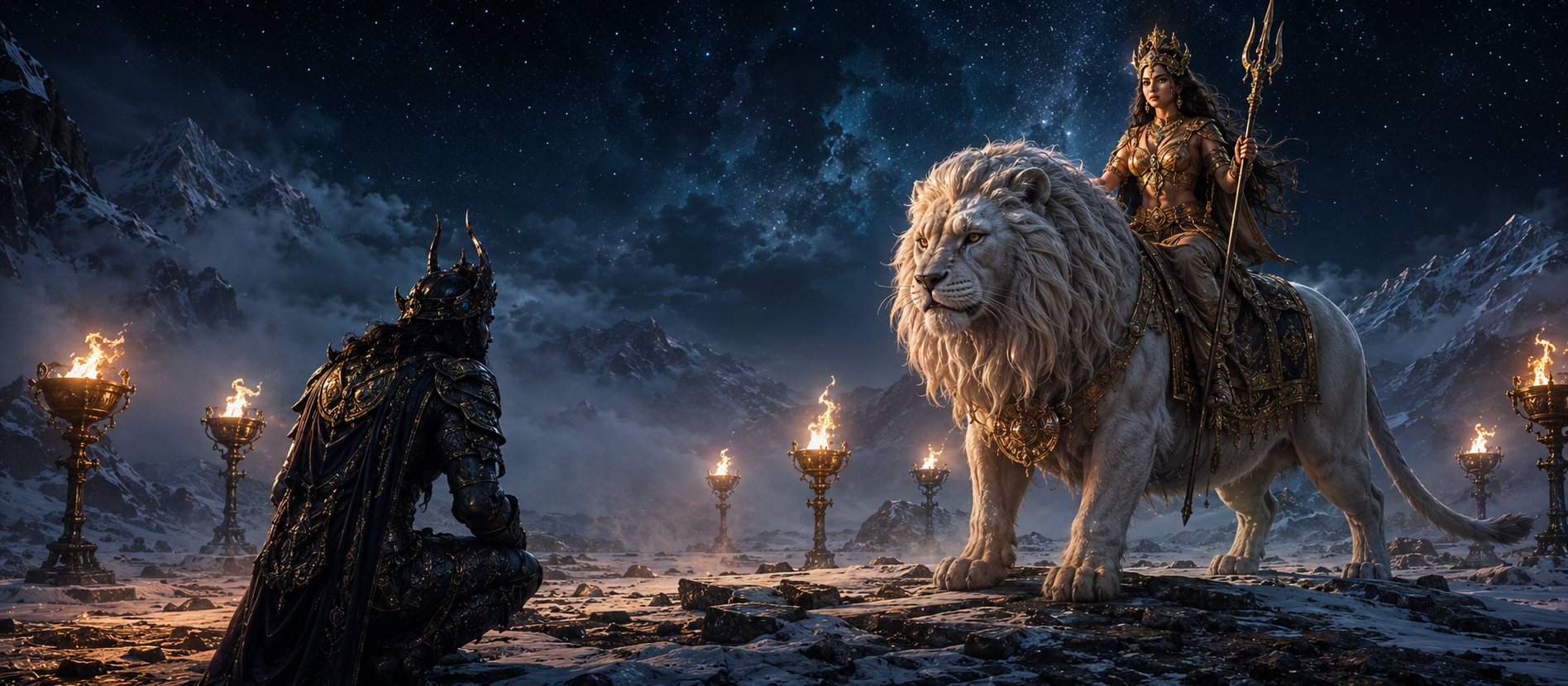
A declaration of war wearing the costume of a marriage condition — and the demon court accepted it without hesitation.
It is, in effect, a declaration of war wearing the costume of a marriage condition — and Shumbha and Nishumbha, who had never yet met an opponent they could not eventually overwhelm by sheer numbers, accepted it without a moment's hesitation. That miscalculation is the engine of everything that follows across the next five Acts.
VI. The Court's First Miscalculation
Sugriva returned with Kaushiki's answer, and the court's reaction tells us almost everything about how this war will be lost. Shumbha did not hear a battle-tested condition; he heard a technicality. A vow taken "out of foolish pride" by a single woman, however beautiful, was not a serious military problem — it was an inconvenience to be cleared by whichever general happened to be standing nearest the door. He did not go himself. He did not send his brother. He sent Dhumralochana, with an army, on what the demon court clearly understood to be an errand rather than a campaign. It would be the first of four campaigns, each larger and more carefully considered than the last, and each ending in a defeat the demon court somehow failed to read as evidence about what they were actually facing.
Sources for This Act
Primary Sources
- Markandeya Purana, ch. 81–85 (Devi Mahatmya, Durga Saptashati ch. 5) — the gods' invocation, Parvati's arrival, Kaushiki's emergence from the kosha, the naming of Kalika, the Chanda-Munda report, and the Sugriva embassy and vow.
- Devi Bhagavata Purana, Book 5, ch. 21 — the brothers' austerities at Pushkara and the terms of the boon.
Secondary Sources
- Coburn, Thomas B. Devi-Mahatmya: The Crystallization of the Goddess Tradition. Motilal Banarsidass, 1984 — structural analysis of the third episode's opening and the theology of the kosha-emergence.
- Kinsley, David. Hindu Goddesses. University of California Press, 1986 — on Kaushiki's relationship to Parvati and the sattva/tamas reading of the Kaushiki-Kalika division.