
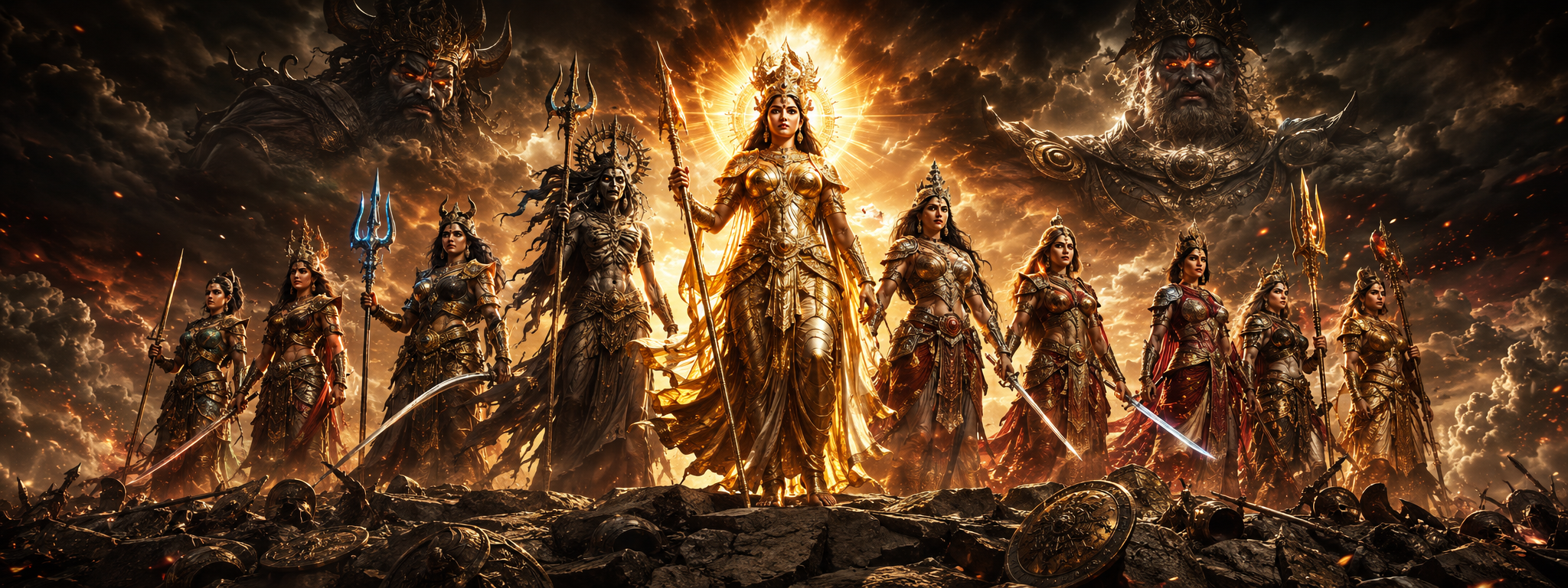
This is the complete chronicle of the third and longest episode of the Devi Mahatmya — the sixth-century Sanskrit text forming chapters 81 through 93 of the Markandeya Purana, recited across India as the Durga Saptashati or Chandi Path. Of the text's three battle-episodes, this one is the most structurally elaborate: a war fought in four escalating campaigns, by a goddess who did not exist until the war required her, against two demon brothers who had made themselves — by the precise letter of a cosmic boon — unkillable.
What follows is organized as a saga in eight movements: a Prologue setting the world in crisis, six Acts of escalating war, an Aftermath tracing what the victory left behind, and a full bibliography. Each Act is summarized here and expanded into its own full chronicle, researched across the Devi Mahatmya and its supporting Puranic literature — the Devi Bhagavata, the Vamana Purana, the Skanda Purana, the Varaha Purana, and the Harivamsha — with variant traditions flagged rather than silently merged into the base narrative.
The spine of this entire saga is the Devi Mahatmya itself (Markandeya Purana, chs. 81–93 / Durga Saptashati chs. 5–13). Material drawn from other Puranas is marked inline as variant or supplementary, in keeping with the project's standing distinction between canonical Mahapurana narrative and later devotional elaboration.
Dramatis Personae
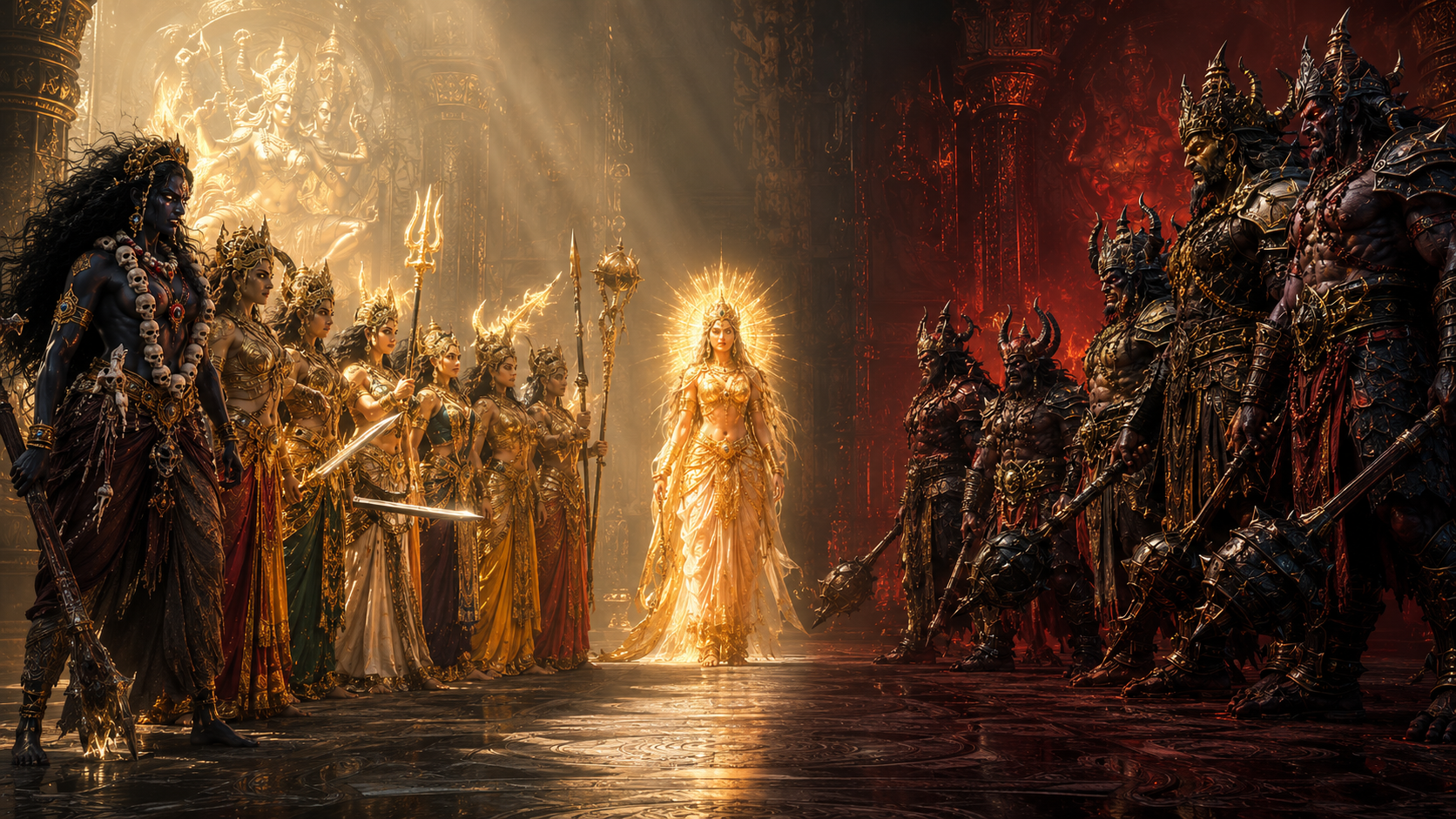
The principal figures of the war: divine and demonic.
| Figure | Role in the War |
|---|---|
| Kaushiki (Ambika, Chandika) | The goddess born from Parvati's kosha to fight a war no prior goddess could legally win |
| Parvati / Kalika | The mountain goddess from whose body Kaushiki emerges; the darkened remainder becomes Kalika |
| Shumbha | Elder Daitya king; conqueror of heaven, the war's final antagonist; allegorically, ahamkara |
| Nishumbha | Younger brother and co-conqueror; allegorically, mamatva — possessive attachment |
| Dhumralochana | First general, "smoke-eyed"; destroyed by a single breath |
| Chanda & Munda | The scouts who started the war with a beauty report; beheaded by Kali in Act III |
| Kali (Chamunda) | Born from Kaushiki's furrowed brow; slayer of Chanda, Munda, and Raktabija's blood |
| Raktabija | The "blood-seed" demon whose every wound multiplied his army — the war's central crisis |
| The Seven Matrikas | Brahmani, Maheshvari, Kaumari, Vaishnavi, Varahi, Aindri, Narasimhi — projections of Kaushiki's own power |
| The Devas | Indra and the dispossessed gods whose invocation begins the entire war |
Prologue — The Conquest of Heaven
Every war in this literature begins with a boon, and this one begins with the most consequential boon any demon ever extracted from Brahma. Shumbha and Nishumbha — Daityas, sons of Kashyapa Prajapati — undertook severe austerities for ten thousand years at Pushkara to win a guarantee of near-total invincibility: no male being, divine or otherwise, would ever be able to kill them.
Armed with that guarantee, the brothers marched on heaven and took it. Indra's forces broke. The gods were not merely defeated — they were catalogued, their portfolios redistributed: Airavata, the Parijata tree, Uchchaihshravas, the offices of Surya, Agni, Vayu, and Kubera — all seized and reassigned to the demon hierarchy. Stripped of rank, office, and shelter, the defeated devas withdrew to the Himalayas and raised the hymn of invocation that would, almost as a side effect, call into being a goddess who did not yet exist.
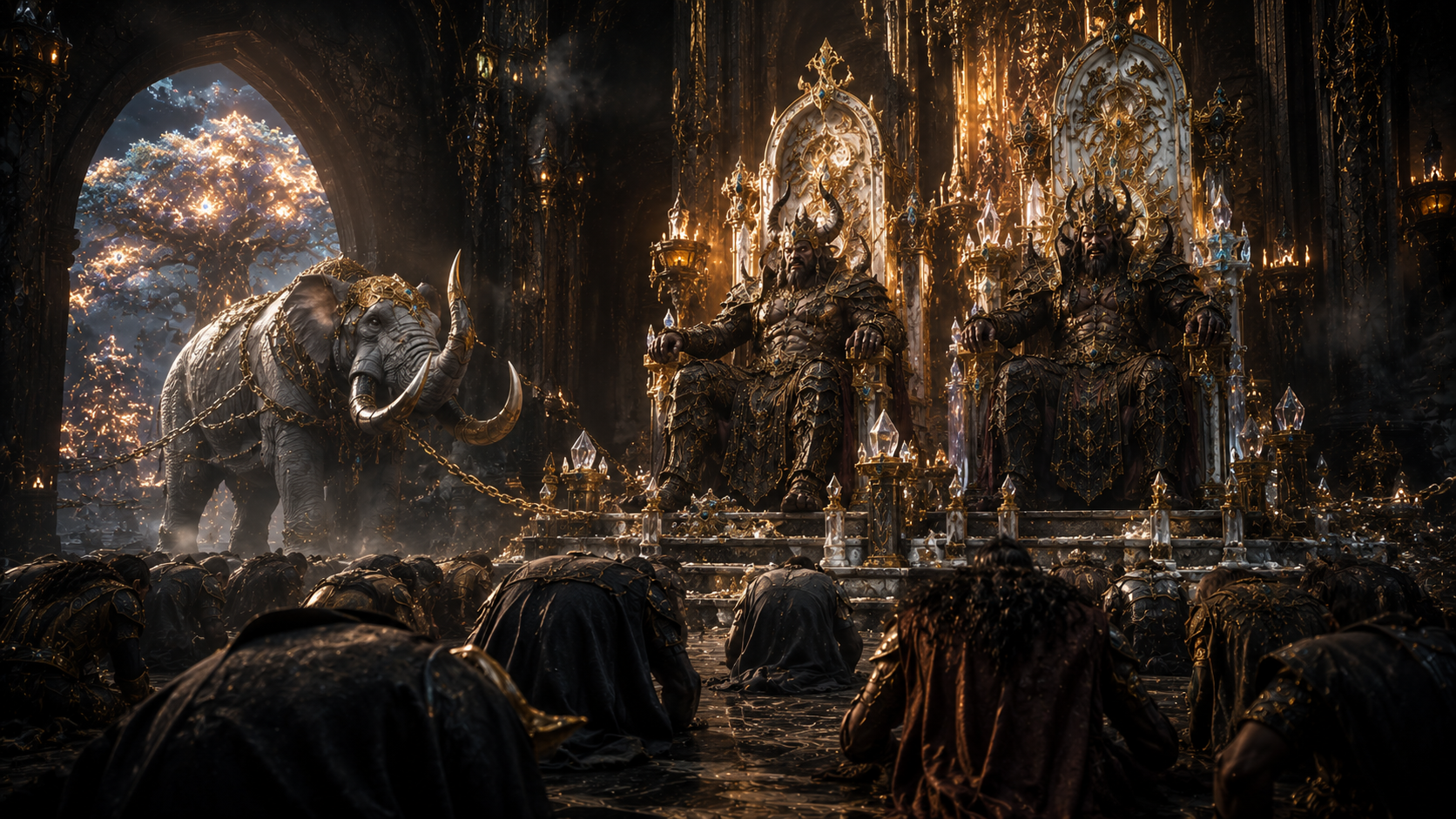
Heaven sacked: the gods' emblems, offices, and divine animals all catalogued and seized by the demon brothers.
The Devi Mahatmya names Kashyapa as the demons' father. The Devi Bhagavata Purana (Book 5, ch. 21) places the brothers' austerities specifically at Pushkara across ten thousand years. The structural logic of the boon — protection from all beings existing at the moment it was sworn — is explained in commentarial tradition rather than the Mahatmya's own verses, but has been the standard exegetical reading since at least the medieval period.
The Six Acts
Each act below is summarized here and told in full in its own chronicle.
The Sheath Opens
On the banks of the Jahnavi, Parvati's own kosha opens and a second goddess steps out fully formed — golden, radiant, and crucially, born after the demons' boon was sworn. The remaining Parvati darkens into Kalika. Word of the new goddess's beauty reaches the demon court, a marriage proposal is sent and refused, and Kaushiki's vow declares the war before a single blow is struck.
Read the full chronicle of Act I →Dhumralochana's Army
Shumbha's opening move is contempt made into strategy: a single general and an army sent to drag the goddess to the demon court by force. It is the shortest engagement of the entire war — a single exhalation of breath reduces Dhumralochana to ash; her lion destroys what remains of his army. The demon court learns exactly the wrong lesson.
Read the full chronicle of Act II →Chanda, Munda, and the Birth of Kali
The goddess's own fury produces a second goddess from her brow — gaunt, garlanded in skulls, unstoppable. Chanda and Munda, the very scouts who first reported Kaushiki's beauty, fall to the goddess they helped summon into the war, and Kali earns the name that will outlast her: Chamunda.
Read the full chronicle of Act III →Raktabija and the Seven Mothers
The war's central crisis: a demon who multiplies with every wound, threatening to overwhelm the field with his own blood. To meet him, Kaushiki produces her most famous instruments of war — the seven Matrikas — and devises the only strategy that can neutralize a self-replicating enemy rather than feed him.
Read the full chronicle of Act IV →The Fall of Nishumbha
The younger brother finally enters the field in person, in a duel that strips away weapon after weapon — arrows, sword, spear, mace, trident — until the goddess's blade ends it. Even in death, Nishumbha holds one final terrible surprise: a second being rising from the wound itself, dispatched just as instantly.
Read the full chronicle of Act V →The Final Duel
Shumbha's accusation — that the goddess fights only with borrowed strength — receives the single most quoted answer in the entire Devi Mahatmya, as Kaushiki withdraws every emanated goddess back into her own body and faces him utterly alone. The duel rises off the ground entirely, and ends the war above the clouds.
Read the full chronicle of Act VI →Aftermath — What the Victory Left Behind
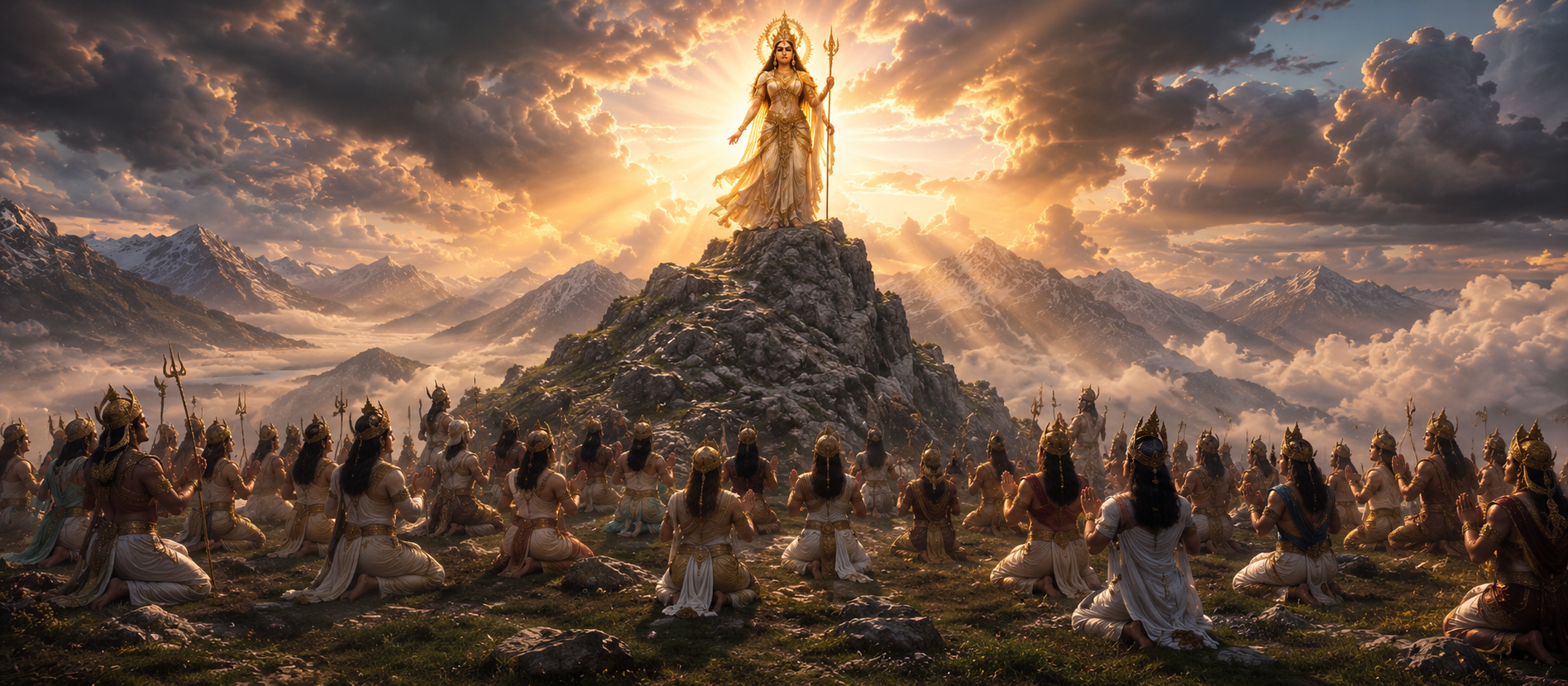
Calm returns: the devas offer the Narayani Stuti as the storms of the war subside and heaven is restored.
The Narayani Stuti
With Shumbha dead, the universe settles at once into stillness — the portentous storm-clouds of the war dispersing, rivers resuming their courses, the sky clearing. Indra and the gods offer the fourth and final great hymn of the Devi Mahatmya: the Narayani Stuti of chapter 11. Kaushiki is addressed here as Katyayani, praised as the substratum of the earth, the embodiment of all three gunas, the intelligence seated in every heart, the one in whom liberation and worldly enjoyment alike originate.
A Promise of Return
The hymn's close contains the saga's most startling turn: the Devi tells the assembled gods that Shumbha and Nishumbha will be born again in a future age, and that she herself will incarnate to destroy them once more — born this time from the womb of Yashoda, dwelling thereafter on the Vindhya mountains. This is the textual seed of the goddess's identification with Vindhyavasini, she who dwells in the Vindhyas — connected by regional tradition to the shrine at Vindhyachal in present-day Uttar Pradesh.
Why This War Needed This Goddess
The structural logic rests on a single asymmetry: Shumbha and Nishumbha's boon protected them against every being who existed at the moment it was granted — which included every prior form of the Goddess herself. The war therefore required a goddess born after the boon: one whose weapons (the Matrikas, Kali) were projections rather than independent allies, so that the unmasking before Shumbha in Act VI would carry its full theological weight. The newest, most narrowly defined goddess in the entire tradition turns out, on the field, to contain every form that came before her.
Complete Bibliography
Primary Sources
- Markandeya Purana, chapters 81–93 (Devi Mahatmya / Durga Saptashati, chapters 5–13) — primary source for the entire saga.
- Devi Bhagavata Purana, Book 5 (ch. 21) and Book 6 — variant origin of Shumbha and Nishumbha; expanded ten-goddess company in the Raktabija episode.
- Vamana Purana, chapters 56–57 — Matrikas' bodily emergence points; the Andhakasura blood-drinking parallel.
- Varaha Purana, chapter 27 — Andhakasura parallel and the eight-Matrika tradition (with Yogeshvari).
- Skanda Purana (Vindhya Khanda) — elaboration of the Vindhyavasini cult.
- Harivamsha, Vishnu Parva — the infant-goddess-substituted-for-Krishna episode and Vindhyavasini.
Secondary Sources
- Coburn, Thomas B. Devi-Mahatmya: The Crystallization of the Goddess Tradition. Motilal Banarsidass, 1984.
- Coburn, Thomas B. Encountering the Goddess. SUNY Press, 1991.
- Kinsley, David. Hindu Goddesses. University of California Press, 1986.
- Kinsley, David. The Sword and the Flute. University of California Press, 1975.
- Mani, Vettam. Puranic Encyclopaedia. Motilal Banarsidass, 1975.
Variant material from the Devi Bhagavata, Vamana, Varaha, and Skanda Puranas is flagged inline throughout the saga as supplementary to, rather than fused silently with, the Devi Mahatmya's own account.