
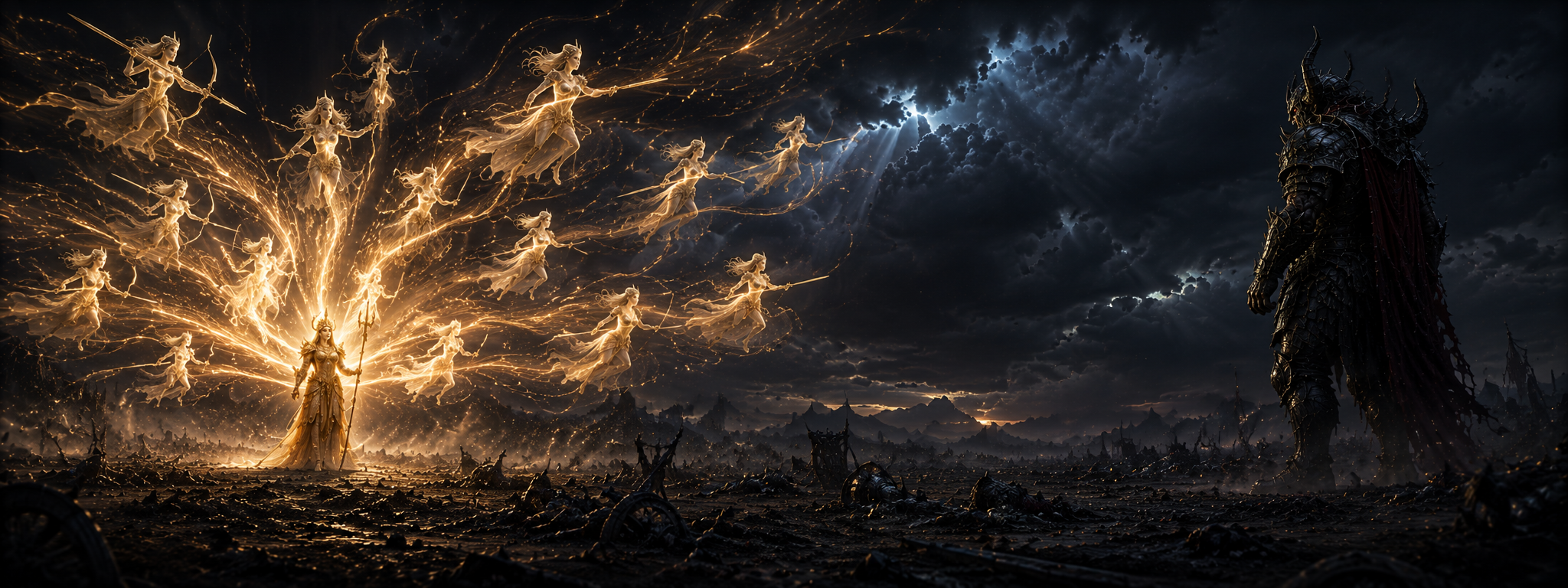
The war's final movement is also its most theologically dense. Shumbha enters the field with an accusation rather than a battle-plan — and the goddess's answer to it is the single most quoted verse in the entire Devi Mahatmya. The duel that follows rises off the ground entirely, and ends the war above the clouds.
I. The Accusation
Shumbha had now watched his brother fall. He had watched every general he sent destroyed, every army annihilated, every boon-dependent defense neutralized. When he finally stepped onto the field in person, what came out of him first was not a battle-cry but an accusation — and it is one of the shrewdest accusations available to someone in his position.
You do not fight alone, he told the goddess. You have borrowed the strength of every goddess who has fought alongside you. You have been empowered by others' might. The pride you display is not genuinely yours — it is the accumulated force of every ally who has stood behind you, and without them you would be no threat to anyone.
It is, structurally, the demon king's only remaining move: not to attack the goddess's power, which he has just watched destroy everything he valued, but to attack its authenticity. The challenge is theological before it is physical. And the goddess's answer to it is the moment on which the entire war's meaning pivots.
II. The Answer — The Most Quoted Verse
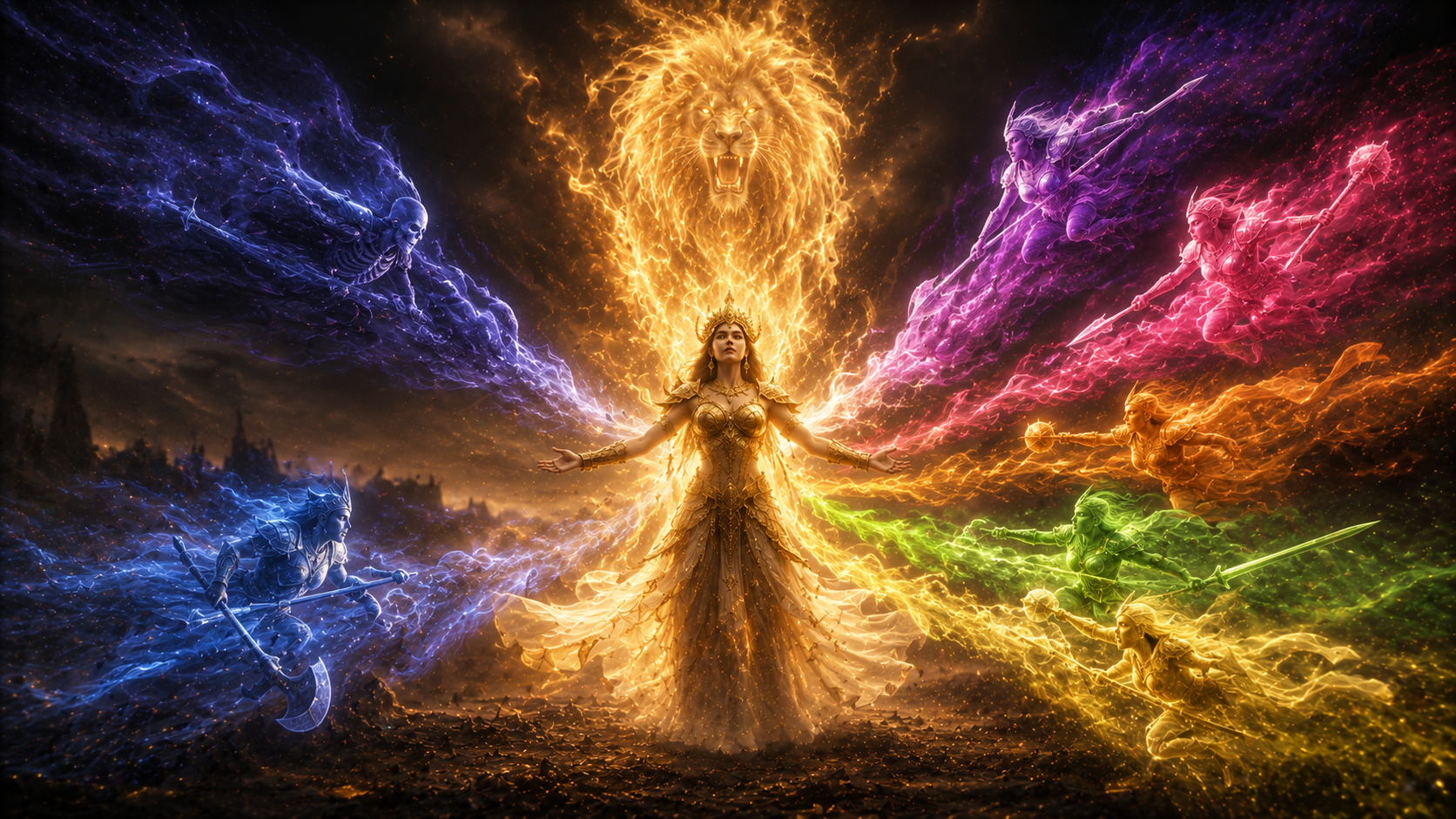
The goddess withdraws every emanated form back into her own body until she stands utterly alone — the single most theologically charged moment in the Devi Mahatmya.
"I alone exist in this world. What second being is there, other than me? O wicked one, behold these my powers withdrawing into my own self."
— Kaushiki to Shumbha, Devi Mahatmya ch. 10 (Coburn trans.)In answer to Shumbha's accusation, Kaushiki does something no commentator has ever found easy to describe in purely military terms. She withdraws every emanated goddess — Kali, all seven Matrikas — back into her own body. Not as a tactical retreat, not as a regrouping, but as a demonstration. She is not collecting allies; she is recalling projections. Everything that had been deployed as a separate figure was always, the withdrawal shows, her own power wearing a distinct face for a specific purpose. The Matrikas did not come from elsewhere; they came from her. Kali did not arrive from outside; she erupted from within. When she reabsorbs them, she is not diminished — she is simply the same singular being she always was, without the tactical distribution that the war had made useful.
And having made this demonstration visibly, she turns back to Shumbha and says, in the verse that has been quoted, painted, chanted, and set to music more than any other single line in the Devi Mahatmya's entire text: I alone exist here. Who is there a second being besides me?
III. The Final Duel — Rising Off the Ground
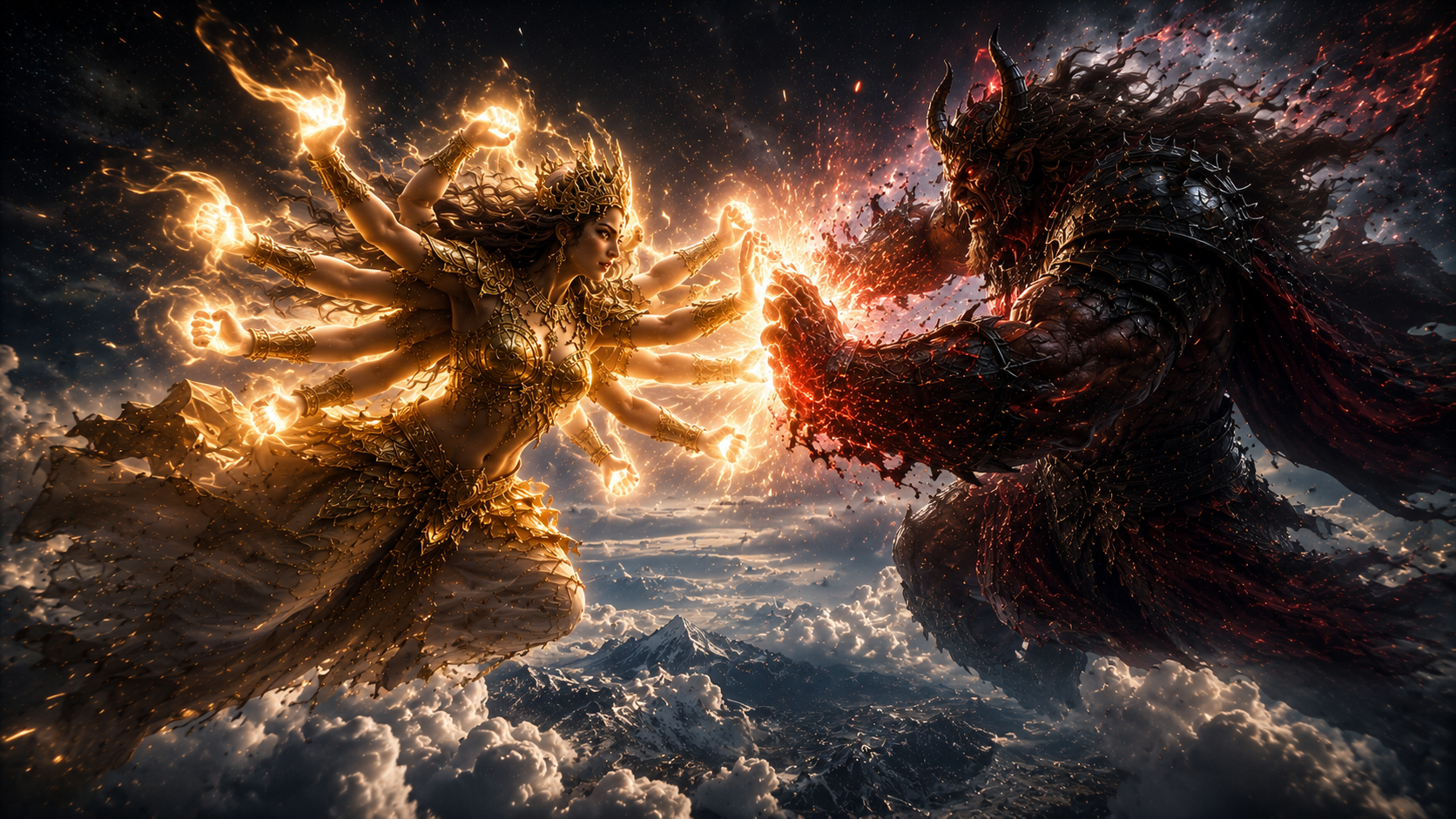
The final duel between Kaushiki and Shumbha rises off the ground entirely — fought in the sky above the clouds.
The combat that follows is the only fight in the entire war that leaves the ground. Shumbha, who had been held in reserve through every campaign, turns out to be a genuinely formidable opponent in a way that none of his generals — not even Nishumbha, not even Raktabija — had fully prepared the war to demonstrate. The duel between Kaushiki and Shumbha rises off the surface of the earth entirely as both combatants ascend into the sky, weapons and countermoves and divine energy building between them, the fight conducted above the cloud-line with the mountain range visible below and the space between earth and heaven as the battlefield.
The Devi Mahatmya's description of this aerial phase is shorter than one might expect given its dramatic staging — the text was never primarily a battle-chronicle, and the momentum here is toward the verse already spoken rather than toward the physical contest — but the elevation itself carries meaning: this is the last fight, fought at the highest possible remove from the earth that has been the war's stage, and its ending brings the entire arc downward and to rest.
IV. Shumbha's Death and the End of the War
The Decisive Blow
The Devi Mahatmya describes Kaushiki transfixing Shumbha with her spear (in some translations, her trident) at the culminating moment of the aerial duel. As the weapon drives home, the text describes a burst of brilliance from Shumbha's body — as though the demon's form itself recognizes, in the moment of its dissolution, what it has been fighting and what has destroyed it — before he falls from the sky toward the earth.
His fall marks not just the end of a battle but the end of the war's entire narrative arc: the first campaign opened with a goddess who had not existed when the boon was sworn; the last campaign ends with the only being the boon could never have protected him against having been the one to kill him. The logic of the boon, extended to its necessary conclusion, arrives exactly here.
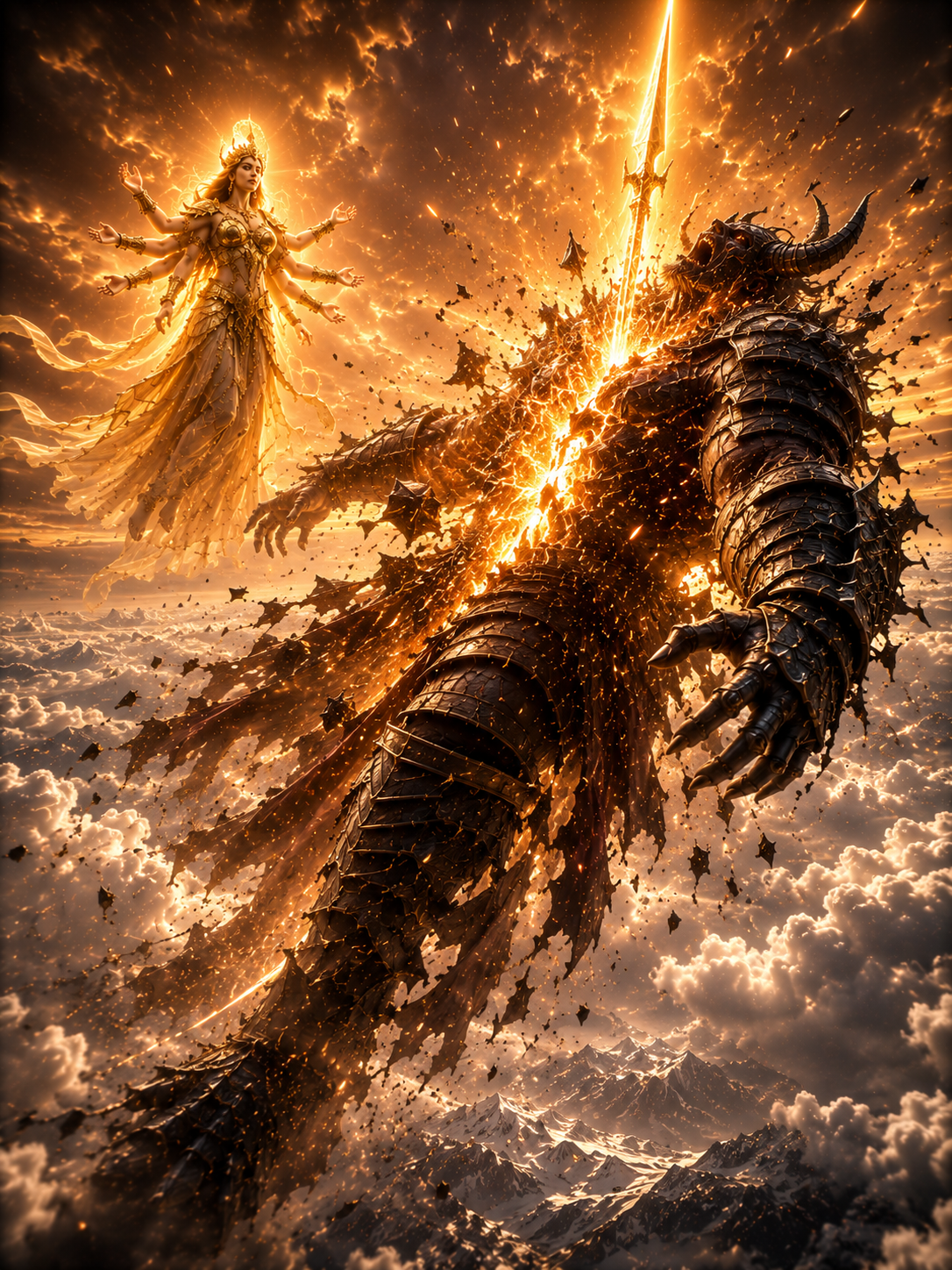
Shumbha falls from the sky — the war's arc closed, the boon's logic completed.
V. The Peace That Followed
With Shumbha dead and his body fallen to the earth, the war's atmospheric effects — the ominous portents that had gathered through all six acts — dissolved instantly. The skies cleared. The rivers resumed their courses. Celestial music sounded without a source. Indra and the gods, restored to the offices they had lost in the conflict's opening movement, offered the Narayani Stuti — the war's closing hymn — before the goddess who had fought it for them. The hymn praises her as the substratum of the earth, the intelligence in every heart, the one from whom all liberation and all worldly prosperity flow. It is the Devi Mahatmya's final and most comprehensive theological statement about what the war, across all three episodes, has been demonstrating.
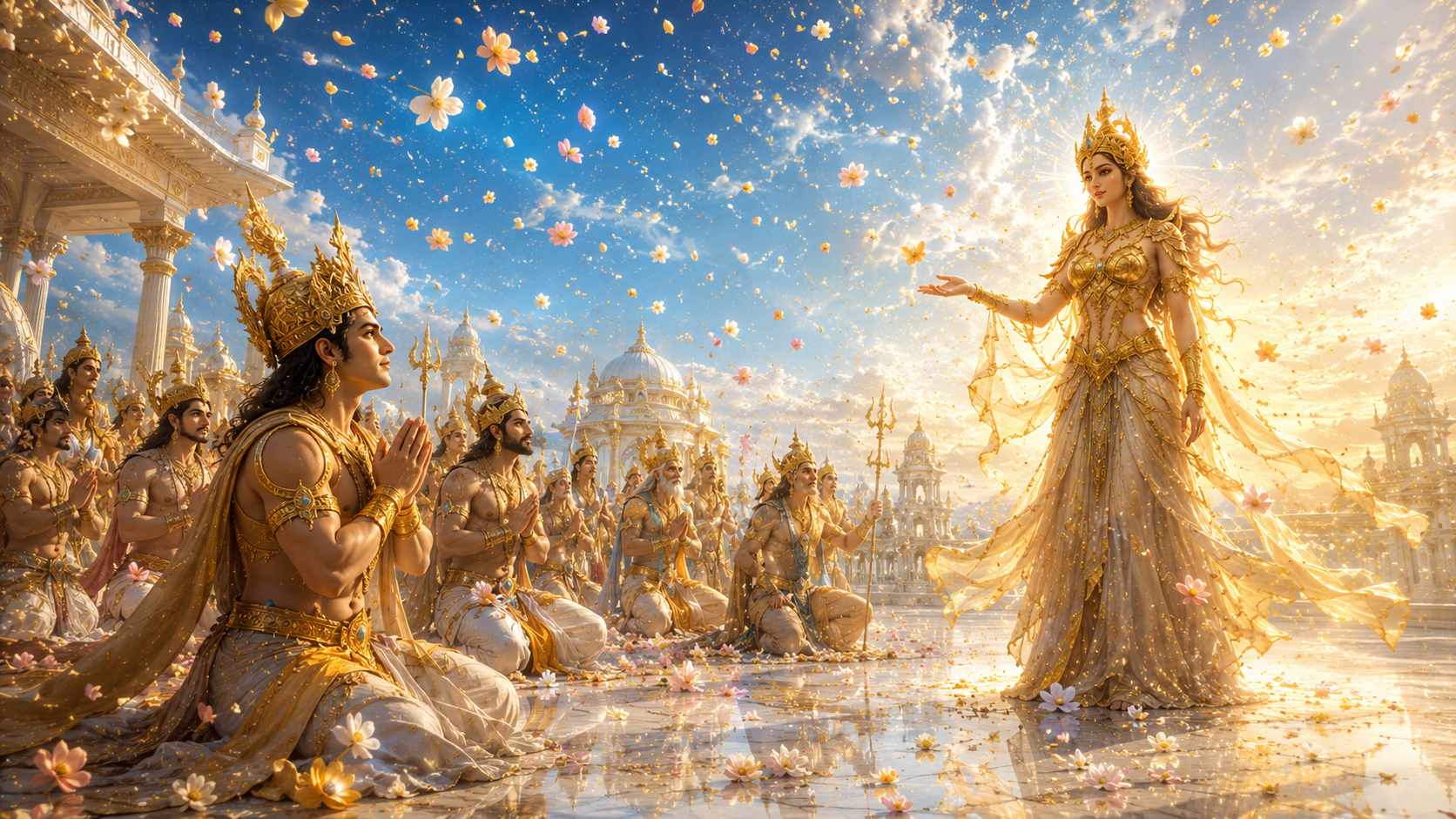
Indra and the gods offer the Narayani Stuti — the Devi Mahatmya's most comprehensive statement of who the goddess is and what the war has proven.
VI. The Promise of Return
Before she withdraws from the gods' sight, Kaushiki makes the war's most unexpected statement — and the one with the longest afterlife in devotional tradition. She tells Indra and the assembled devas that Shumbha and Nishumbha will be born again in a future age, and that she herself will incarnate once more to destroy them — born this time from the womb of Yashoda, in the household of the cowherd Nanda, and dwelling thereafter on the Vindhya mountains as Vindhyavasini.
This promise connects the Devi Mahatmya's third and final episode to the Harivamsha's account of the infant goddess substituted for the newborn Krishna on the night of his birth — the same goddess who slipped from Kamsa's hands, rose into the sky, and named herself before vanishing. The goddess who began as Kaushiki, fighting a war no prior goddess could legally fight, ends as Vindhyavasini, dwelling in the hills and waiting for the next cycle to begin. The wars of the Devi Mahatmya are over. The worship that grew from them has never stopped.
Sources for This Act
Primary Sources
- Markandeya Purana, chs. 90–93 (Devi Mahatmya, Durga Saptashati chs. 10–13) — Shumbha's accusation, the reabsorption verse, the aerial duel, Shumbha's death, the Narayani Stuti, and the promise of return as Vindhyavasini.
- Harivamsha, Vishnu Parva — the infant-goddess-substituted-for-Krishna episode and the Vindhyavasini connection.
- Skanda Purana (Vindhya Khanda) — elaboration of the Vindhyavasini cult and its connection to the Kaushiki-Ambika identity.
Secondary Sources
- Coburn, Thomas B. Encountering the Goddess. SUNY Press, 1991 — translation and analysis of the reabsorption verse and the Narayani Stuti.
- Coburn, Thomas B. Devi-Mahatmya: The Crystallization of the Goddess Tradition. Motilal Banarsidass, 1984 — structural analysis of chapters 10–13 as the war's theological climax.
- Kinsley, David. Hindu Goddesses. University of California Press, 1986 — on Kaushiki's identification with Vindhyavasini and the regional shrine tradition.
- Mani, Vettam. Puranic Encyclopaedia. Motilal Banarsidass, 1975 — entries on Shumbha, Vindhyavasini, and the Narayani Stuti.