
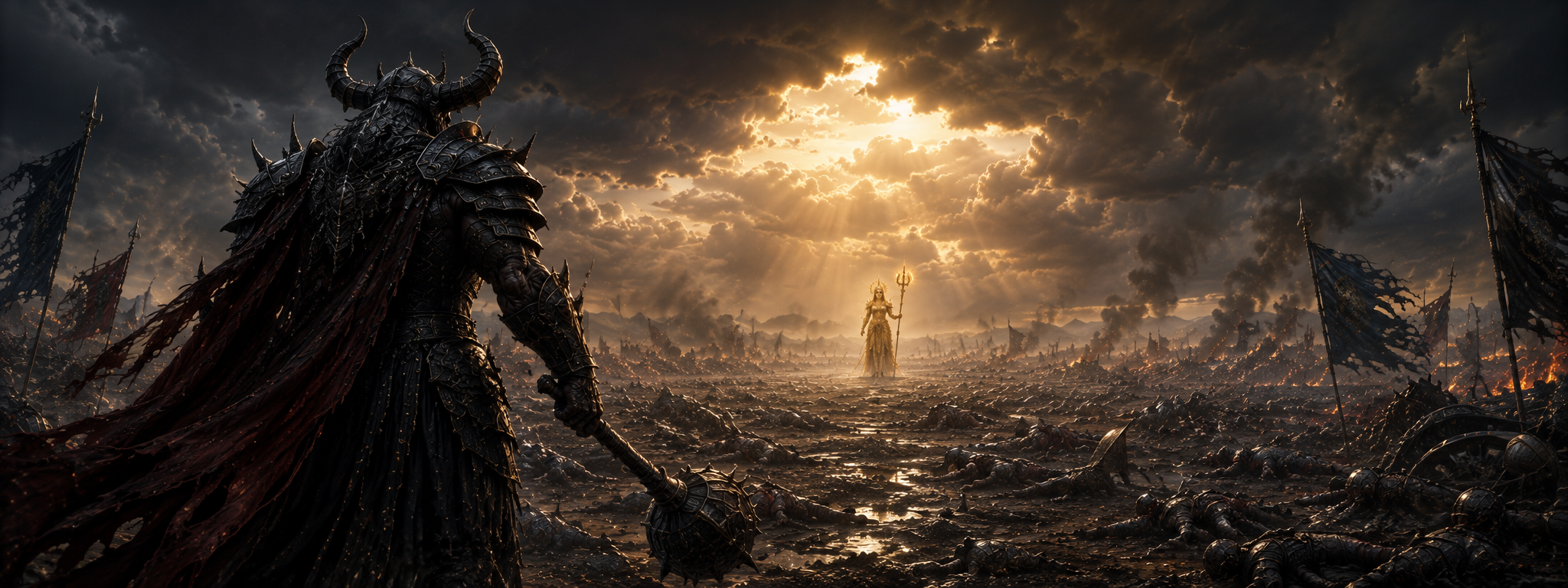
Three campaigns, three generals, three total defeats. For the first time in the war, one of the two kings who began it takes the field in person. Nishumbha's duel with Kaushiki is the war's first genuinely even contest — and it holds one final, terrible surprise even in the moment of apparent victory.
I. The First King to Fight
Dhumralochana reduced to ash by a breath. Chanda and Munda beheaded by a goddess torn from Kaushiki's own fury. Raktabija, whose every wound should have multiplied his army into something unstoppable, destroyed instead by a tongue that simply refused to let his boon function. By the time word of Raktabija's death reaches the demon court, there is no general left whose deployment would not read, even to Shumbha, as an admission that the problem has outgrown delegation entirely.
It is at this point, for the first time in the war, that one of the two kings who began it takes the field in person. Nishumbha — the younger brother, co-ruler of the conquered heavens — descends from his chariot onto a battlefield still littered with the wreckage of everything sent before him, and faces the goddess directly.
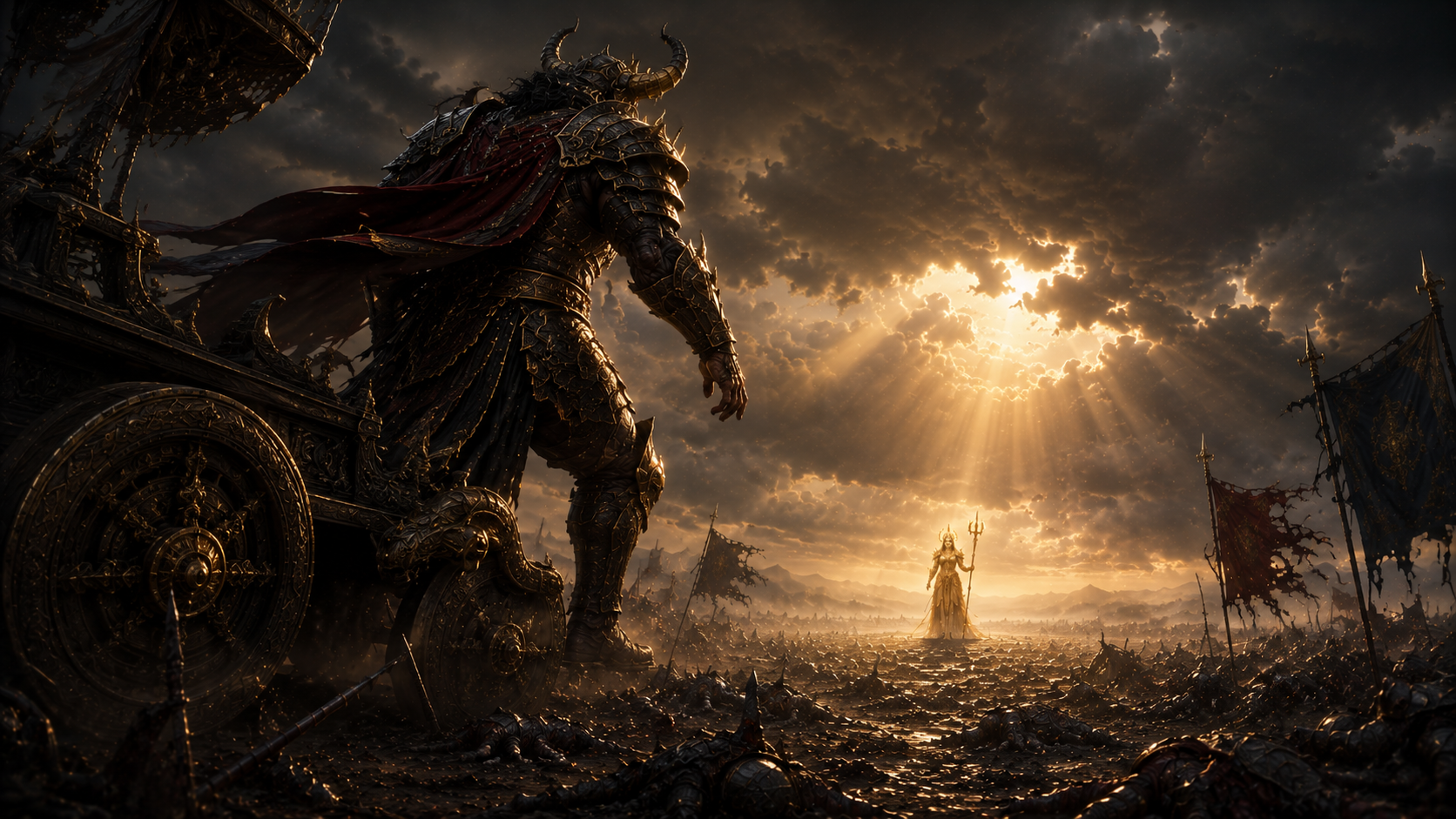
Nishumbha descends onto a field that has already swallowed three armies — and steps into it himself.
II. A Duel of Escalating Weapons
What follows is, by the standards of the campaigns that preceded it, a genuinely even contest — the first engagement in the entire war where the text lingers on an extended exchange of arms rather than resolving the matter in a single decisive stroke. Nishumbha was a king who had personally helped conquer the three worlds, and he fought like one. The Devi Mahatmya describes the duel as a sequence of escalating weapons, each side answering the other's strike with something heavier, until the engagement had run through nearly every implement of war available to a Puranic combatant.
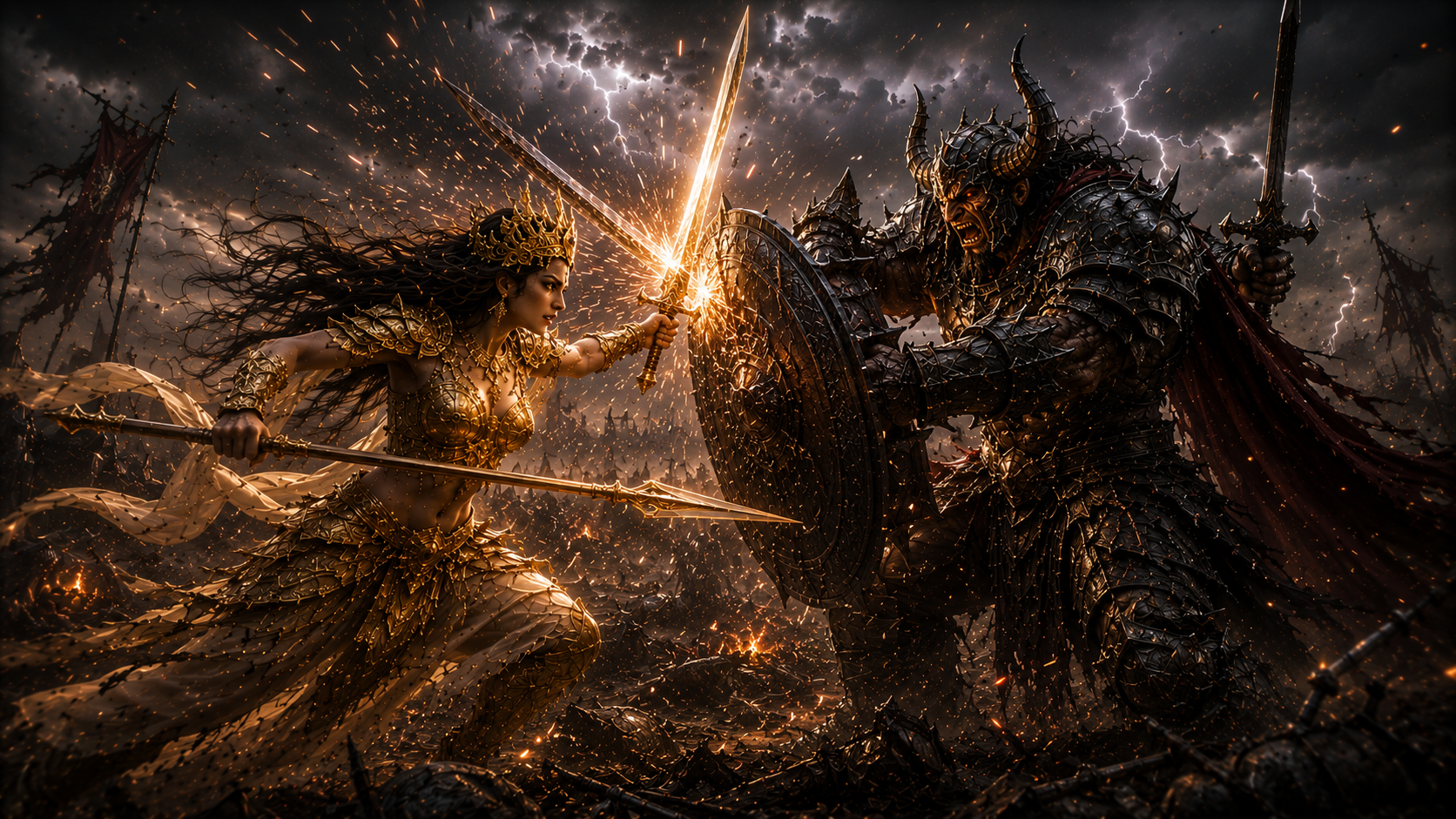
The duel escalates through arrow, sword, spear, and mace — the war's first genuinely even exchange of arms.
- Arrows — the opening exchange: a volley met with a volley, neither side gaining clear advantage
- Sword and shield — closing the distance, Nishumbha pressed with blade-work the goddess matched stroke for stroke
- Spear and javelin — thrown and parried, several shattering on contact with divine armour on both sides
- Mace and club — heavier weapons brought to bear as the duel intensified, each blow shaking the ground beneath them
- The trident — Kaushiki's final answer, driven through Nishumbha's chest in the engagement's decisive blow
The precise sequence and number of weapons exchanged varies slightly across translations and retellings of this chapter — the Devi Mahatmya's Sanskrit is compressed at points, and different translators reconstruct the duel's order slightly differently. What remains constant across every version is the structure: an escalating exchange of arms, ending in the trident, the goddess's signature weapon throughout the Devi Mahatmya, driven home.
III. The Being That Emerged From the Wound
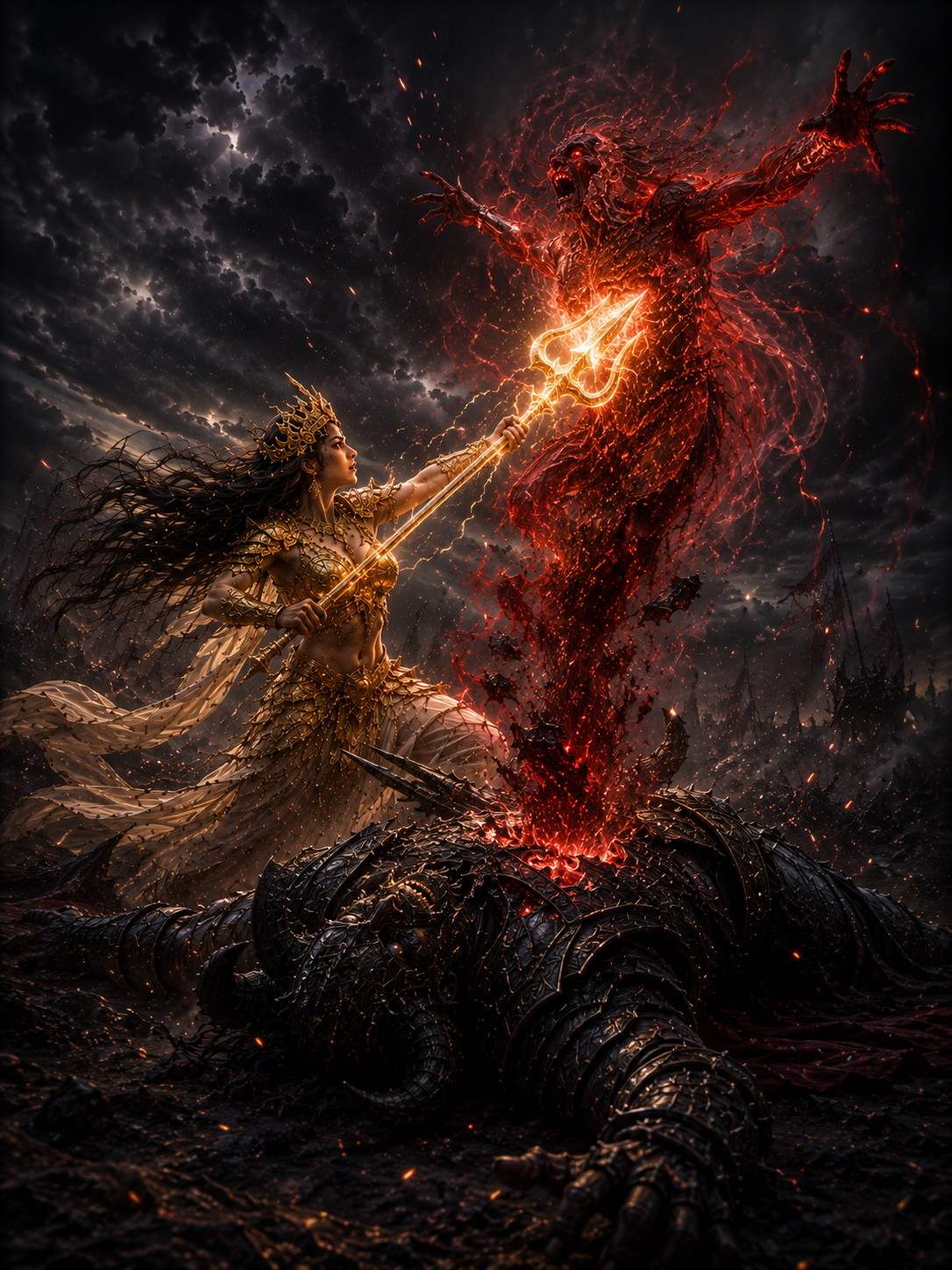
A second threat rises from Nishumbha's wound the instant he falls — and is ended just as instantly.
What happens in the instant after the trident strikes home is one of the strangest and least-discussed beats in the entire Devi Mahatmya, and it deserves to be told in full rather than smoothed over. As Nishumbha fell, struck through the chest, a second being is described as emerging directly from the wound in his body — a figure of great strength and ferocity, identified in the text as a manifestation of Nishumbha's own essential power or selfhood, separate enough from the dying king's physical body to rise and continue the fight on its own.
Kaushiki met this emergent figure with no pause for surprise, and dispatched it as decisively as she had dispatched Nishumbha himself moments before — a coda to the duel rather than a separate engagement.
Devotional commentary on this episode has sometimes read Nishumbha allegorically as a personification of mamatva — "my-ness," the deep, persistent sense of possessive attachment to one's body, identity, and belongings, in contrast to Shumbha's reading (taken up in Act VI) as ahamkara, the ego-principle itself. Under this reading, the being that emerges from Nishumbha's wound and must be separately destroyed becomes a fitting symbol: attachment does not die cleanly even when its source is struck down; it produces a final residue that must be confronted in its own right. This allegorical layer belongs to the commentarial tradition rather than to the Devi Mahatmya's own explicit narration.
IV. One Brother Remains
With Nishumbha dead and his final, emergent surprise destroyed alongside him, the war has now consumed every general Shumbha sent, every army he raised, and — for the first time — one of the two kings who started this conflict. Of the two brothers who divided the conquered heavens between them and sent a marriage proposal up a mountain as though it were a formality, only Shumbha now remains.
He had watched the goddess destroy a general with her breath, watched a second goddess tear free from her own fury and behead two more, watched a boon that should have made an army unstoppable fail because she simply denied it the ground it needed to work, and now watched his own brother fall in a duel he had personally chosen to fight. What Shumbha says next, stepping onto the field himself, is not a battle plan. It is an accusation — and the goddess's answer to it is the single most important verse in the entire Devi Mahatmya.
Sources for This Act
Primary Sources
- Markandeya Purana, ch. 89 (Devi Mahatmya, Durga Saptashati ch. 9, "The Slaying of Nishumbha") — Nishumbha's personal entry into the war, the escalating weapon-exchange, his death by trident, and the emergent being destroyed in the same instant.
Secondary Sources
- Coburn, Thomas B. Devi-Mahatmya: The Crystallization of the Goddess Tradition. Motilal Banarsidass, 1984 — structural notes on chapter 9 as the war's penultimate engagement.
- Mani, Vettam. Puranic Encyclopaedia. Motilal Banarsidass, 1975 — entry on Nishumbha.
The allegorical reading of Nishumbha as mamatva is drawn from widely circulated Devi Mahatmya devotional commentaries; it is noted here as interpretive rather than textual.