
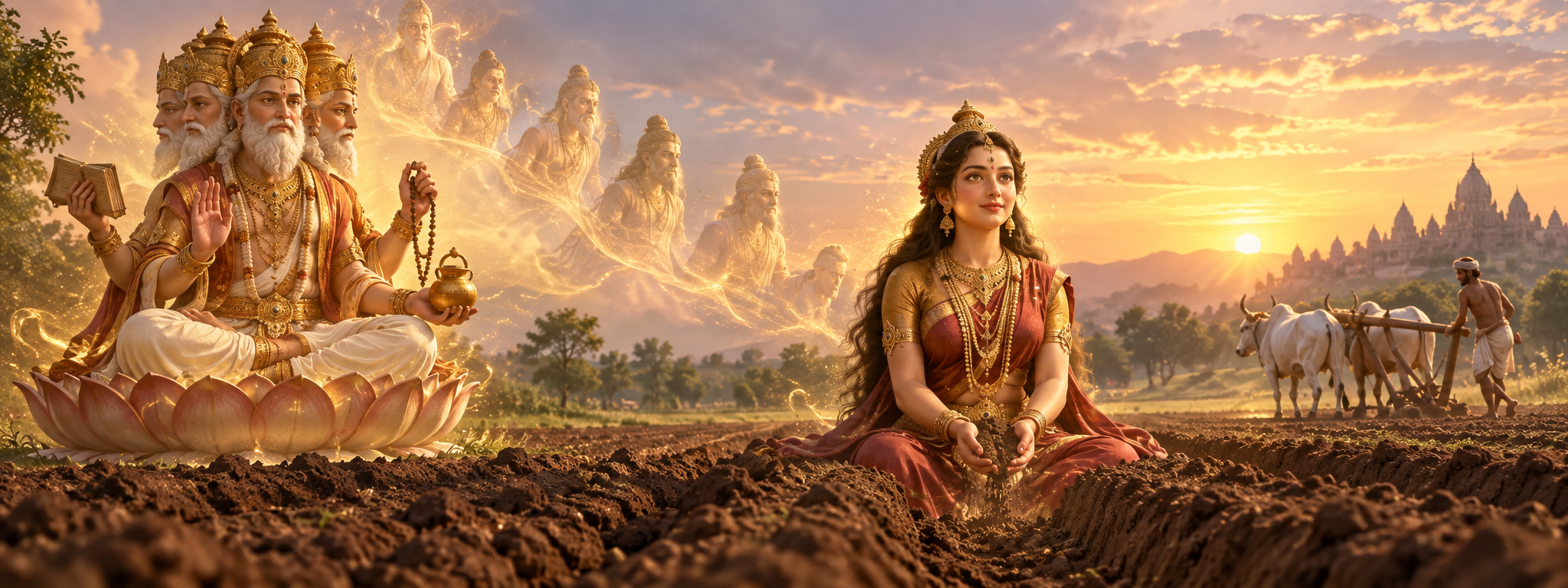
"Ayonija" — not born of a womb — covers more ground than it first appears to. This opening part of the series takes five cases: a creation that skips the female principle altogether, a birth that skips the male one, a conception that involves two fathers and no mother in either sense, a pair of births that skip both parents at once, and a construction that skips the entire category of parentage. None of the five figures here has an ordinary birth to compare against; each is, in its own way, the tradition's answer to the question of what a "first" birth looks like.
The five are grouped for the shared absence, not for any relationship between them. Nothing here implies the Manasaputras, Sita, Ayyappa, Dhrishtadyumna/Draupadi, and Tilottama exist in the same genealogical space — only that each is missing a parent-category other figures in this series are missing for entirely different reasons.
The Manasaputras: Sons Willed Into Being
At the start of creation, the Vishnu Purana describes Brahma producing a set of sons not by union with a wife but by an act of will alone — mind-born, manasa-putra. No mother is involved in any sense; the sons proceed directly from Brahma's intention, in the same register as his production of Dharma from his breast and Adharma from his back, covered in this project's Personifications series. The difference here is that nothing is drawn from any part of the body at all — the sons are simply thought into existence.
The commonly cited group are the great sages who go on to become Prajapatis in their own right — among them Marichi, Atri, Angiras, Pulastya, Pulaha, Kratu, Vasishtha, and Bhrigu — each of whom fathers further lineages that run through the rest of Puranic genealogy. Their mind-born status is a starting condition, not a permanent one: unlike the other two figures in this Part, they go on to marry, father children, and enter ordinary genealogical life immediately afterward.
Puranic sources do not agree on a single roster of mind-born sons, and more importantly, they don't agree on whether every group carrying the name belongs to the same creative act. The sage-Prajapatis named above are consistently mind-born by will, and consistently go on to marry and generate lineages.
A separate, smaller group — the four Kumaras (Sanaka, Sanandana, Sanatana, and Sanatkumara) — is also described as mind-born, but is treated in most Puranic tellings as a distinct and earlier creative act, and their defining trait is the opposite of the sage-Prajapatis': they refuse Brahma's instruction to procreate and remain eternal celibate ascetics, five-year-old boys in perpetuity. Some later texts fold the Kumaras into the same list as the Prajapatis; this project keeps them as two separate mind-born acts rather than one group, since the sources' own account of what each group does next doesn't support treating them as interchangeable.
Sita: Risen From a Furrow
The Valmiki Ramayana's Bala Kanda gives Sita an origin with no mother and, in the plain sense, no father either: King Janaka of Mithila, ploughing the ground as part of preparation for a yajna, finds an infant girl lying in the furrow his plough has just cut. He raises her as his own and names her accordingly — Sita, meaning "furrow," the term for the very groove she was found in. In this account she is ayonija in the most literal sense available in the tradition: born from the earth itself, with Janaka her father only by the act of finding and raising her, not by any biological claim.
This makes her origin structurally distinct from the two other figures in this Part. The Manasaputras skip the mother; Sita's furrow-birth skips the father in the ordinary sense while substituting the earth itself as the originating body — closer, in mechanism, to an earth-goddess emergence than to a willed creation.
The furrow-birth is the version this project treats as primary, since it is Valmiki's own account and the one carried into the overwhelming majority of retellings. A separate strand — most developed in the later Adbhuta Ramayana and picked up in some regional and Jain Ramayana traditions — identifies Sita as the daughter of Ravana and Mandodari, abandoned at birth after a prophecy that she would cause his death, and buried where Janaka later finds her while ploughing. The two accounts do not simply differ in detail; they differ in whether Sita's furrow-discovery is the birth itself or the recovery of an already-born child. This project keeps the Valmiki account as the one this piece follows, and flags the Adbhuta Ramayana strand as a genuinely separate tradition rather than a variant detail within the same story.
Ayyappa: A Child of Two Fathers
Ayyappa's origin sits outside the pan-Indian eighteen Mahapuranas proper — his fullest textual treatment comes from Kerala's regional Sthala Puranas and temple tradition (the material collected under the name Bhutanatha Purana), rather than from the Vishnu Purana or Bhagavata Purana lineage this series otherwise draws on. Flagged as such, the story: during the Samudra Manthan, after the Amrita has been produced, Vishnu takes the form of the enchantress Mohini to recover the nectar from the asuras. Shiva, beholding Mohini's form, is overcome, and their union produces a son — Hariharaputra, "the son of Hari and Hara," carrying both names as a single compound because both deities, in this account, are his parents.
What makes this a distinct mechanism from either of the other two figures in this Part is that no mother is involved at any point — Mohini is Vishnu himself in another form, not a separate maternal figure — while two distinct paternal origins are. It is, in effect, the inverse problem to the Manasaputras': not one parent short, but one parent-category entirely substituted by a second father.
Dhrishtadyumna and Draupadi: Born From Fire
King Drupada of Panchala, seeking revenge against his former friend Drona, engages the priests Yaja and Upayaja to perform a sacrifice specifically to obtain a son capable of killing him. From the sacrificial fire itself rises a young man already grown, clad in armor and bearing weapons: Dhrishtadyumna. The fire yields a second figure as well, unasked for in most tellings — a young woman of great beauty, also fully grown, who steps from the altar alongside him: Draupadi, also called Yajnaseni, "she of the sacrifice," and Panchali. Neither has a mother in any sense; both are agni-born, arriving from the fire already adult, in the same register as the mind-born and earth-born figures elsewhere in this Part, but with the fire itself standing in for both parents at once.
Tilottama: Assembled, Not Born
Where every other figure in this Part still has some originating cause — a will, an earth, a fire, a pair of fathers — Tilottama has none at all. At Brahma's command, the divine architect Vishwakarma constructs her deliberately: gathering the single most beautiful element of everything that exists across the three worlds, along with every flawless gem, and assembling her from these collected fragments, each said to be as fine as a grain of sesame — the source of her name. She is built specifically to be irresistible to the asura brothers Sunda and Upasunda, who cannot be killed by anyone but each other, in order to set them against one another over her — which is exactly what follows, and exactly what destroys them.
Tilottama has no father, no mother, no womb, and no birth-event in any sense the rest of this Part still shares. She is not created by anyone's will alone, as the Manasaputras are, but physically constructed piece by piece by a craftsman working with material, the way an artisan builds an object rather than the way any of this Part's other figures come into being.
Set side by side, the five cases in this Part resist being treated as points on a single spectrum. The Manasaputras remove the mother and keep the father's will as the sole originating cause. Sita removes the father in the biological sense and substitutes the earth. Ayyappa removes the mother category altogether and doubles the father instead. Dhrishtadyumna and Draupadi remove both parents at once, substituting the sacrificial fire for either. Tilottama removes the entire category of parentage and substitutes deliberate construction by a craftsman working with material. Nothing here suggests the tradition was working from one template and varying it — each solves a different problem: how creation begins at all, how a foundling enters a royal genealogy, how two deities' union can still register as a single birth, how a yajna can deliver exactly the weapon a king asked for, fully formed, and how a weapon with no divine or ritual origin at all can still be built to exact specification.
Brahma's parallel production of Dharma and Adharma from his own body — a related but distinct mechanism from the will-alone birth of the Manasaputras — is covered in this project's Personifications series, Part I, Two Trees, One Root: Dharma and Adharma. Mohini's role in the Samudra Manthan, and the fuller churning sequence her appearance belongs to, is covered later in this series in Part IV, The Samudra Manthan Births. Vishwakarma's craftsmanship recurs across Puranic literature in other constructed objects and beings; Tilottama is the clearest instance of it applied to a person rather than a weapon or palace.
References
Primary Sources
- Vishnu Purana, Book 1, Chapters 7 and 10 — translated by H. H. Wilson (1840), via sacred-texts.com. Source for Brahma's mind-born creation of the sage-Prajapatis and, separately, the four Kumaras.
- Valmiki Ramayana, Bala Kanda, Sarga 66 — for Janaka's discovery of Sita in the ploughed furrow and the origin of her name.
- Adbhuta Ramayana, attributed to Valmiki (later, distinct text) — for the alternate account of Sita as Ravana and Mandodari's abandoned daughter, treated here as a separate tradition rather than a variant detail.
- Kerala Sthala Purana tradition and temple literature collected as the Bhutanatha Purana — for Ayyappa's birth from Shiva and Mohini during the aftermath of the Samudra Manthan. Noted as regional/temple tradition rather than a Mahapurana source.
- Mahabharata, Adi Parva — for the account of Drupada's sacrifice and the fire-births of Dhrishtadyumna and Draupadi.
- Mahabharata, Adi Parva (the Sunda-Upasunda narrative) — for Vishwakarma's construction of Tilottama at Brahma's command and her role in the deaths of Sunda and Upasunda.
Where a figure's textual basis sits outside the primary Mahapurana sources this project otherwise draws on — as with Ayyappa — that is noted explicitly rather than presented on equal footing with Vishnu Purana or Valmiki Ramayana material.