
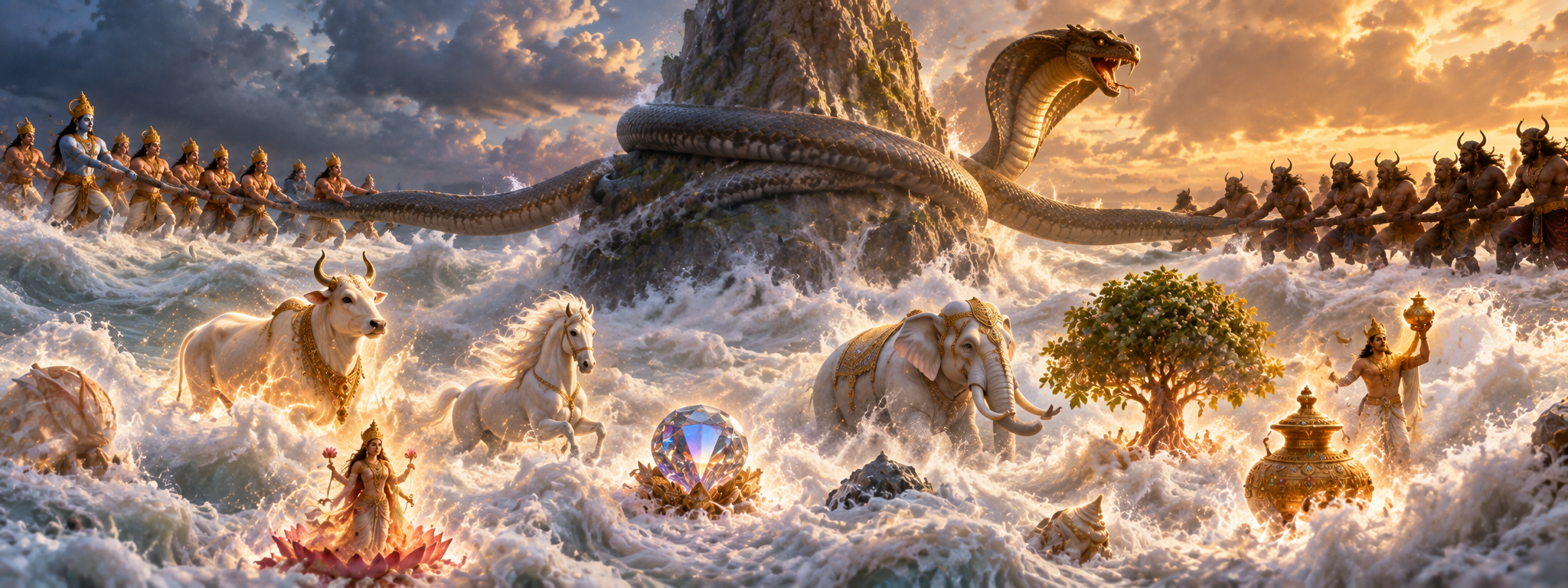
Every mechanism covered so far in this series — mind-birth, vessel-birth, animal-incubation — still involves some originating body, however unconventional. The Samudra Manthan produces beings with no such body at all. Devas and asuras churn the ocean of milk together, using Mount Mandara as a churning-rod and the serpent Vasuki as the cord, in pursuit of Amrita, the nectar of immortality. What the churning yields along the way, before the nectar itself appears, is a sequence of gods, animals, and objects that simply emerge — no conception, no gestation, no parent to name.
This is the purest form of ayonija in the entire series: not a birth with an unusual cause, but the complete absence of a birth-event as such. Several of these emergents already have full treatments elsewhere in this project; rather than duplicate that material, this piece covers the churning as a single sequence and points outward where a fuller account already exists.
The Full Churning Sequence
| Emergent | What It Becomes | Coverage |
|---|---|---|
| Kamadhenu (Surabhi) | The wish-fulfilling cow, claimed by the sages present at the churning | Covered below |
| Varuni (Sura) | Goddess of wine and intoxication, taken up by the asuras | Covered below |
| Parijata | The celestial flowering tree, carried off to Indra's heaven | Covered below |
| The Apsaras | A troop of celestial nymphs, claimed by no single deity | Covered below |
| Chandra (Soma) | The moon, gathered up by Shiva and worn on his crown | Personifications, Part II |
| Uchchaihshravas | The divine seven-headed white horse | Covered below |
| Kaustubha | A radiant gem, claimed by Vishnu and worn on his chest | Covered below |
| Airavata | The divine white elephant, claimed by Indra | Covered below |
| Halahala (Kalakuta) | A poison potent enough to destroy all three worlds | Covered below |
| Dhanvantari | Physician to the gods, emerging bearing the pot of Amrita | Covered below |
| Lakshmi | Goddess of fortune, who chooses Vishnu as consort | Personifications, Part IV |
| Alakshmi (Jyeshtha) | Lakshmi's elder, unwanted counterpart, emerging first | Personifications, Part IV |
| Amrita | The nectar of immortality, the churning's stated purpose and its final yield | Covered below |
The New Creations
Kamadhenu (Surabhi) rises early in the churning as a wish-fulfilling cow, capable of granting whatever is asked of her. She is claimed by the assembled sages rather than by any single deity, and later tradition makes her the mother of all cattle and, in some genealogical listings, the source from which several other cows of Puranic significance descend.
Varuni, alternately named Sura, emerges as the goddess and personification of wine and intoxication. In the Vishnu Purana's telling, the devas decline to accept her, and the asuras take her instead — a detail later tradition treats as an early marker of the asuras' character rather than an incidental preference, since it is one of the few moments in the churning where the two sides visibly diverge in what they want from the ocean's yield.
The celestial tree Parijata emerges fully grown and fragrant, and is carried off to adorn Indra's heaven, Amaravati — later becoming the object of a dispute in Krishna's own story, when he brings a cutting of it down to earth for Satyabhama, a separate episode this project does not cover here.
A troop of apsaras emerges from the foam as well, distinguished from the older, Kashyapa-descended apsaras of Vedic tradition by having no parent at all — they are claimed by neither devas nor asuras and become, in effect, a free-floating class of celestial women available to either side, and to the heavens generally, from that point on.
The divine horse Uchchaihshravas, seven-headed and pure white, emerges and is claimed by the asura king Bali in some tellings and by Indra in others — a minor point of variance this project does not attempt to resolve, since neither account carries clearly greater textual weight. The gem Kaustubha emerges next and is taken by Vishnu, who wears it on his chest from that point onward as one of his defining attributes. The elephant Airavata, white and multi-tusked, emerges and becomes Indra's mount, later fathering a line of elephants that recur throughout Puranic and epic literature whenever a particularly noble elephant needs a pedigree.
Before any of the treasures proper, the churning also produces Halahala (also called Kalakuta) — a poison so virulent that its release threatens to destroy all three worlds before anything else can be recovered from the ocean. Shiva swallows it to save creation, and it lodges in his throat rather than passing further, turning his throat blue and giving him the epithet Nilakantha, "the blue-throated one." This project treats Halahala's emergence as belonging on the same list as the other churning-yields, even though what it produces is a threat rather than a treasure — the mechanism of appearance is identical.
Late in the sequence, the physician-god Dhanvantari rises from the ocean bearing the pot of Amrita itself. He is credited in later tradition as the originator of Ayurveda, and his appearance — fully formed, holding a vessel of nectar he did not need to be given — marks the shift in the churning from producing incidental treasures to producing the thing the entire enterprise was undertaken for.
The nectar itself, Amrita, is the churning's final yield and its explicit purpose from the outset. Its appearance triggers the conflict between devas and asuras over who will drink it — the dispute Vishnu resolves by taking the form of Mohini to recover it for the devas alone, the same Mohini whose later union with Shiva produces Ayyappa, covered in Part I of this series.
The Vishnu Purana's own account, followed above, does not settle on a fixed count, and later tradition compresses the churning's yield into a conventional list of "fourteen ratnas" that varies by source — some versions add Vishnu's conch (Panchajanya), his bow (Sharanga), or the goddess Alakshmi as a separate, numbered item rather than treating her as bound up with Lakshmi's own emergence. The order of appearance likewise shifts between tellings, particularly around where Halahala falls relative to the treasures proper. This piece follows the Vishnu Purana's own sequence where it is explicit and does not attempt to reconcile it against the later fourteen-ratna convention, which this project treats as a later systematization rather than an equally primary account.
Nothing in this Part fits the pattern of the rest of the series. Every other mechanism covered so far involves a diversion, a substitution, or an unconventional medium standing in for a womb — something happens to a birth to make it unusual. The Samudra Manthan produces beings for whom the question of birth simply doesn't arise: they are not conceived, diverted, incubated, or willed into existence by any single act of intention. They appear because the ocean, churned, yields them, and the tradition treats that appearance as sufficient explanation in itself.
Chandra's churning-origin, alongside his separate Atri-born tradition, is treated fully in this project's Personifications series, Part II, The Sky's Family: Surya, Chandra, and the Stars. Lakshmi's emergence and her relationship to Alakshmi are covered in Personifications, Part IV, The Goddess and Her Shadow: Lakshmi and Alakshmi. Mohini's appearance in the Amrita dispute, and her union with Shiva that produces Ayyappa, are covered in this series' own Part I, Born Without Womb, Born Without a Mother.
References
Primary Sources
- Vishnu Purana, Book 1, Chapter 9 — translated by H. H. Wilson (1840), via sacred-texts.com. Primary source for the churning sequence and its yields, followed here for order and count.
- Bhagavata Purana, Book 8, Chapters 6–9 — for the fuller narrative of the churning, Mohini's appearance, and the devas-asuras conflict over Amrita.
- Mahabharata, Adi Parva — for supplementary detail on Uchchaihshravas and the churning's role in later genealogical claims about noble horses and elephants.
The later "fourteen ratnas" convention, which adds items not explicit in the Vishnu Purana's own account, is treated as a systematization rather than a primary source and is not used here to override the Purana's own sequence.