
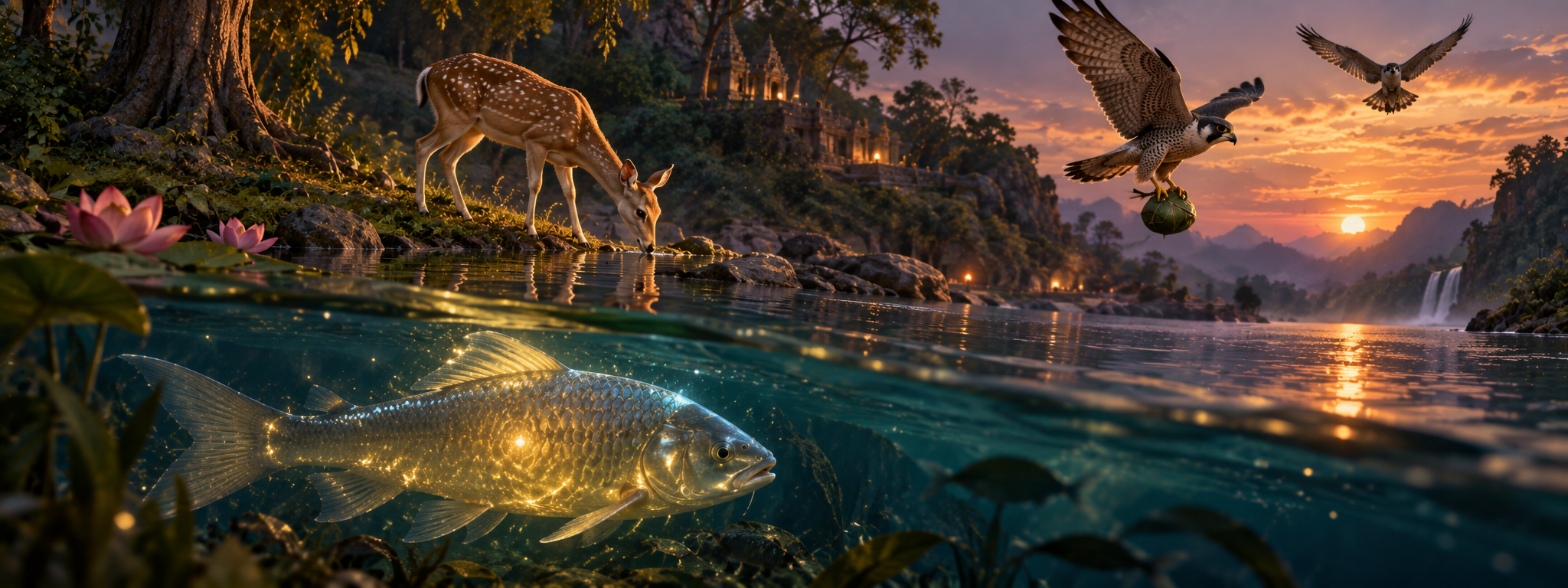
This Part gathers four births that share a narrower mechanism than the vessel-births of Part II: not an object standing in for a womb, but something living or elemental, an animal, a river, a fire, that receives a stray substance it was never meant to carry. In three of the four cases the carrier is an animal and the substance is diverted by accident before it can reach its intended end; the fourth, Kartikeya's, extends the mechanism to a chain of divine and elemental carriers.
The first case here is also this project's clearest genealogical hinge: the same birth that produces Satyavati, Vyasa's mother from Part II, happens by exactly this mechanism — which makes this Part, in effect, a step backward in time from where Part II left off.
Vasu Uparichara, Adrika, and Satyavati
King Vasu Uparichara of Chedi, occupied with forest observances away from his capital, is overcome with desire for his wife Girika upon seeing a pair of deer mating — an unfortunate piece of timing, since Girika has just entered her fertile period back at the palace. Rather than let the moment pass to no purpose, Vasu discharges his seed, seals it in a leaf, and dispatches it toward Girika by a hawk he sends flying ahead of him.
Mid-flight, a second bird of prey attacks the hawk, mistaking the leaf-packet for meat. In the struggle, the packet falls into the Yamuna, where it is swallowed by a fish — who is, unknown to anyone at the time, the apsara Adrika, living under a curse in fish-form. She conceives from the swallowed seed, and when a fisherman later catches and cuts her open, he finds twins: a boy, who becomes king Matsya and founds the Matsya line, and a girl, Matsyagandha — "fish-scented" — raised by the fisherman as his own daughter. Adrika, freed from her curse by the act of giving birth, returns to her apsara form and departs.
Matsyagandha grows up ferrying travellers across the Yamuna, and it is in that capacity that she encounters the sage Parashara — the meeting that produces Vyasa, covered in Part II, and that later, once she is purified of her fish-scent and given the name Satyavati, leads to her marriage to King Shantanu and her place as great-grandmother of the entire Kuru line.
The Mahabharata's Adi Parva names the bird carrying Vasu's seed a shyena — a hawk or falcon, a bird of prey, which fits the episode that follows: it is attacked mid-flight by another raptor competing for what looks like meat. This piece follows the Sanskrit text's own term.
Makardhwaja: Hanuman's Unknowing Son
This account sits outside Valmiki's Ramayana; it belongs to later tradition — prominently the Ananda Ramayana and various regional retellings, especially in Bengal and South India — rather than the earliest textual layer this project treats as primary. While Hanuman is flying over the ocean, a drop of his sweat falls into the water and is swallowed by a makara, a crocodile-like sea creature. The makara conceives, and from her is born a son who is half-vanara and half-makara in form, named Makardhwaja after the creature that carried him.
Hanuman himself learns of the son's existence only much later — in the Ahiravana-Mahiravana episode, Makardhwaja is found guarding the gates of Patala, raised there entirely without his father's knowledge, and the two are reconciled only once Hanuman recognizes what the drop of sweat, years earlier, had produced without his awareness.
Rishyasringa: Born of a Doe
The sage Vibhandaka, engaged in tapas at a forest pool, is startled by the sight of the apsara Urvashi and discharges seed into the water. A doe drinking from the same pool swallows the water along with the seed, conceives, and gives birth to a son who is entirely human in form except for a single small horn on his forehead — from which he takes his name, Rishyasringa, "the one with a deer's horn." Raised by his father in total isolation from women and from ordinary society, he grows into a sage of unmatched purity, precisely because he has never been exposed to anything that might compromise it.
His purity becomes the very thing the kingdom of Anga needs to end a prolonged drought, and he is later brought — not without some engineering on the part of the king's counsellors, since he has never seen a woman and must be lured out of the forest — to officiate the yajna that ends the drought and, in some tellings, to marry the princess Shanta. His largest role in this project's own material, however, comes later still: it is Rishyasringa who officiates King Dasharatha's Putrakameshti yajna, the ritual whose consecrated payasam produces Dasharatha's four sons, covered in Part V.
Kartikeya: A Seed Too Fierce for Any Body
The gods need a commander who can destroy the asura Taraka, and only a son of Shiva can be born to do it. But when Shiva's seed is released, it proves too potent for anyone who receives it to hold. Agni takes it first and cannot bear its heat; he passes it to the river Ganga, who cannot hold it either and leaves it in a thicket of reeds at Sharavana, where the child forms and grows. The six Krittikas, the women of the Pleiades, find the infant and nurse him, and from them he takes the name Kartikeya.
Where every other case in this Part runs on an accident, this one runs on refusal: the seed is not intercepted on its way somewhere else, but rejected by each carrier in turn, passing through fire, a river, a reed-bed, and a group of foster mothers because none of them can keep it. The reed-thicket that finally receives him recalls the reed-clump that produces Kripa and Kripi in Part II.
Kartikeya's birth is told in more than one form. One account has the seed divide into six sparks that grow into six infants, whom Parvati later joins into a single six-headed boy, a fusion of the kind covered in Part VI. The Mahabharata's Vana Parva, in a separate telling, makes him the son of Agni and Svaha, a version built on a deception that belongs to this project's Children of Deception material rather than here. This piece follows the seed-relay account, which is the one that carries the mechanism of this Part, and cross-links the rest.
Each case here involves a substance that was never meant to end up where it did — Vasu's seed is diverted mid-delivery by an attack, Hanuman's sweat is lost incidentally in flight, and Vibhandaka's seed is carried off in water he had no way of controlling. The animal in each case is not a chosen vessel the way a pot or a reed-clump is in Part II; it is simply whatever happens to be present when the substance goes astray, which makes this mechanism the most accidental of any covered so far in the series. Kartikeya's case differs in one respect: the seed is not diverted by accident but rejected by every carrier that receives it, the same foreign-womb logic reached by refusal rather than interception.
Satyavati's onward union with Parashara, and the birth of Vyasa that follows from it, are covered in Part II, Vessel- and Medium-Born — this Part's opening account is the direct genealogical prequel to that one. Rishyasringa's role as officiating sage for Dasharatha's Putrakameshti yajna is covered ahead, in Part V, Nature and Multiplicity by Ritual Food.
References
Primary Sources
- Mahabharata, Adi Parva — for the account of Vasu Uparichara, Girika, the diverted seed, Adrika's fish-form, and the births of Matsya and Satyavati.
- Mahabharata, Vana Parva, and Valmiki Ramayana, Bala Kanda — for the birth of Rishyasringa from Vibhandaka's seed and the doe, and his later role in ending the Anga drought.
- Ananda Ramayana and regional Ramayana retellings (notably Bengali and South Indian tradition) — for the birth of Makardhwaja and his reconciliation with Hanuman during the Ahiravana-Mahiravana episode. Noted as later, regional tradition rather than Valmiki's own text.
- Valmiki Ramayana, Bala Kanda; Mahabharata, Vana Parva; and Skanda Purana — for Kartikeya's birth from Shiva's seed through Agni, Ganga, the Sharavana reeds, and the Krittikas, and for the competing six-headed and Agni-Svaha accounts.
The bird carrying Vasu's seed is given here as the Sanskrit text's own shyena (hawk/falcon), since that is the term used in the primary source.