
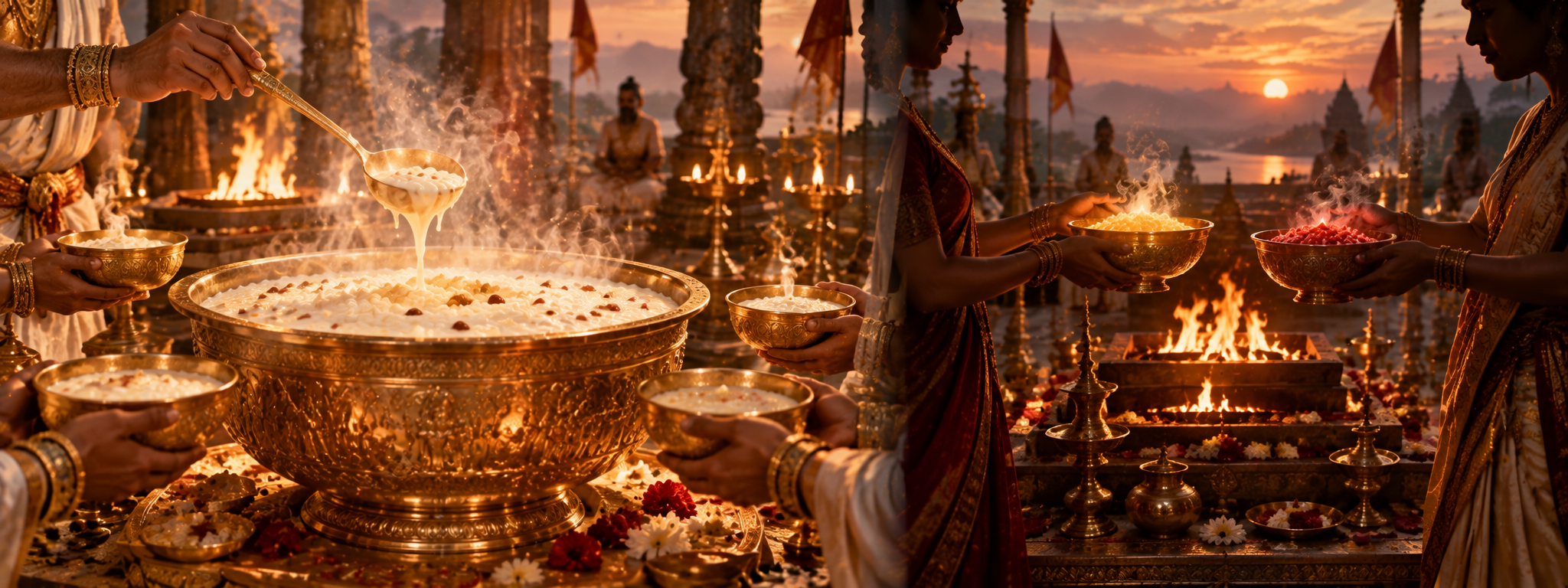
The cases in this Part share a mechanism distinct from anything covered so far: a sage, king, or craftsman-god performs a ritual — a payasam, a charu, consecrated water, a yajna for a son, a sacrificial invocation — carrying a specific intent for what it will produce, and that intent is disturbed before the ritual reaches its intended outcome, or produces an entirely unintended one instead. Unlike the vessel-births of Part II, conception here still happens inside a living body; what's unusual is that the ritual determining the child's nature, number, bearer, sex, or ultimate fate goes astray first.
Dasharatha's Four Sons
King Dasharatha of Ayodhya, without an heir, undertakes the Putrakameshti yajna, officiated by the sage Rishyasringa — whose own unusual birth from a doe is covered in Part III of this series. From the sacrificial fire, Agni himself rises bearing a vessel of divine payasam and instructs Dasharatha to distribute it among his queens. Dasharatha gives half to Kausalya and half of the remainder to Kaikeyi. Sumitra, his third queen, receives no direct portion of her own — instead, Kausalya and Kaikeyi each give her half of what they were given.
The arithmetic decides what follows: because Sumitra ends up with two separate half-shares rather than one whole share, she conceives twins. Kausalya's portion produces Rama; Kaikeyi's produces Bharata; Sumitra's doubled portion produces Lakshmana and Shatrughna together. Nothing supernatural governs the twinning itself — it follows directly from the fact that Sumitra alone received two portions rather than one, making this the series' one case where multiplicity results from simple division of a substance rather than from any other mechanism.
Valmiki's Bala Kanda is consistent on the outcome — Sumitra receiving two half-shares and bearing twins — but regional and later retellings do not always agree on the precise fractions each queen receives, some assigning Kausalya and Kaikeyi different proportions before the remainder passes to Sumitra. This piece follows the sequence given above as the version most consistently repeated across major tellings, without treating the exact fractional accounting as settled beyond the central fact of Sumitra's doubled share.
Jamadagni and Vishwamitra: The Swapped Charus
The sage Richika, son of Bhrigu, marries Satyavati, daughter of King Gadhi — a distinct figure from the Satyavati of Parts II and III, sharing only the name, worth flagging given how easily the two could be conflated. Wanting a worthy line of descendants, Richika prepares two consecrated charus: one infused with brahminical essence, intended for his wife Satyavati, so that her son would be a peaceful sage; and one infused with kshatriya essence, intended for Satyavati's mother, Gadhi's queen, so that her son would be a mighty warrior-king able to continue the royal line.
The two charus are exchanged before either woman consumes them — accounts differ on whether Gadhi's queen deliberately swaps them, wanting greater power for her own son, or whether the exchange happens by accident and Richika only senses it afterward through his own ascetic perception. Either way, the result is fixed: Satyavati, a sage's wife, has unknowingly consumed the kshatriya-natured charu, and her mother has consumed the brahmin-natured one.
Richika, discovering the reversal, cannot undo what has already been conceived, but he intervenes to push the more disruptive consequence one generation forward. Satyavati's son, Jamadagni, is born and raised a brahmin sage but carries a warrior's temperament beneath it — a trait that erupts fully in his own son, the axe-wielding brahmin-warrior Parashurama. Gadhi's queen's son is born a kshatriya prince who nonetheless carries an unaccountable brahminical fire: Vishwamitra (originally named Kaushika), whose lifelong struggle to be recognized as a brahmarishi despite his royal birth becomes one of the epic tradition's most sustained stories of self-transformation. In some tellings, Satyavati herself is later transformed into the river Kaushiki.
Whether Gadhi's queen swaps the charus intentionally is not settled across sources. Some tellings frame it as a mother's deliberate choice to secure more power for her own son; others frame it as an unwitting mix-up that Richika alone detects and explains after the fact. This piece treats both readings as live rather than resolving them, since the consequence for Jamadagni and Vishwamitra is identical either way and the sources do not converge on the queen's intent.
Mandhata: Born From His Father's Thigh
King Yuvanashva of the Ikshvaku line, childless and grieving, has a consecrated pot of water prepared by sages for his wives to drink, meant to grant them conception. One night, waking thirsty and unaware of what the vessel contains, the king drinks the water himself. The sages, arriving the next morning to administer it, discover what has happened and can only tell him that the substance has taken effect regardless of who consumed it — Yuvanashva himself is now carrying the child.
In time, the king's right side or thigh swells with the pregnancy, and when the term is complete, the divine physicians the Ashwini Kumaras (Nasatya and Dasra) perform the delivery themselves, extracting the infant from the king's thigh without harming him. The child, uncertain what he will feed on since he has no mother to nurse him, is given Indra's own finger to suckle, and grows on that alone — the god's words to him, "he shall suck me" (mam dhata), giving the child his name: Mandhata, who goes on to become one of the most celebrated emperors of the solar dynasty.
Sources agree on the substance of the story but not on every physical detail: some name the right side rather than the thigh specifically as where the pregnancy shows, and accounts differ on whether the Ashwini Kumaras alone perform the extraction or whether Indra is present and involved in the delivery itself, rather than arriving only afterward to offer his finger. This piece follows the most commonly repeated sequence — extraction by the Ashwini Kumaras, followed by Indra's provision for the child's nourishment — without treating the finer physical detail as settled beyond that.
Ila: A Ritual Meant for a Son
King Manu, childless for many years, has the sage Agastya perform a yajna dedicated to the gods Mitra and Varuna, with the explicit purpose of securing a son. Due to an error in the ritual's performance — sources do not agree on exactly what went wrong, only that something did — the sacrifice yields a daughter instead: Ila. Manu, dismayed, asks the family priest Vasishtha why a daughter was born when the yajna was performed for a son; Vasishtha, by his own will, converts the girl into a boy, naming him Sudyumna.
The change does not hold. Sudyumna later wanders into a grove sacred to Parvati where every man who enters is transformed into a woman, and reverts to being Ila once inside it. Displeased at the reversal, and unable to undo it entirely, Shiva grants a compromise: Ila will be a man and a woman in alternating months for the rest of her life. In her female month, Ila meets and marries Budha, and bears a son, Pururavas — the first king of the Lunar dynasty — before later reverting to Sudyumna and fathering three further sons as a man.
Sources agree on the shape of the story but not on its mechanics. Some attribute the daughter's birth to an error in how the yajna was performed; others frame it as the gods themselves choosing to send a daughter regardless of what was asked. Accounts also differ on whether Ila's alternating-gender condition is ever resolved — some end with Pururavas's birth and say no more, while others describe the cycle continuing for the rest of Ila's life. This piece follows the sequence most consistently repeated (ritual error, Vasishtha's conversion, Shiva's alternating-month compromise) without treating either the cause of the original error or the ultimate fate of the cycle as settled.
Vritra: Undone by a Single Accent
After Indra kills his son Vishvarupa, the craftsman-god Tvashta performs a sacrifice to produce an avenger, pouring the offering into the fire with the words "indraśatru, vardhasva" — grow, killer of Indra — intending the compound to be read with the stress falling on its second member, which would make it mean exactly that: one who kills Indra. But Tvashta misplaces the accent on a single syllable, and the same string of sounds, spoken with the stress shifted, reads instead as the opposite kind of compound entirely — not "Indra's killer" but "one whose killer is Indra." The ritual proceeds regardless, and the son born from it, Vritra, is bound from that single mispronunciation to be slain by Indra rather than to slay him — which is exactly how the story ends.
Unlike this Part's other cases, the error here is documented as a specific, nameable linguistic mechanism rather than a narrative device alone: Sanskrit compounds of this type change meaning entirely depending on which syllable carries the pitch-accent, a distinction discussed in Vedic grammatical tradition independently of Vritra's story. The myth is, among other things, an illustration of how much weight a single accent can carry — which is part of why it recurs so often in discussions of Sanskrit's own linguistic precision, not only in retellings of the Vritra narrative itself.
A Sixth Case, Deferred
A fifth birth belongs, in its opening half, to this same mechanism: King Brihadratha of Magadha receives a single boon-mango from the sage Chandakaushika, meant to grant him a son, and splits it between his two wives rather than favoring one. What follows from that division — two non-viable half-births and an external act of fusion — belongs more properly to the split-and-fused mechanism of Part VI, where Jarasandha's full account is given rather than repeated here.
All five cases in this Part turn on the same structural point: a ritual substance or sacrifice is prepared with a specific outcome in mind, and that outcome is altered — by division, in Dasharatha's case; by exchange, in Jamadagni and Vishwamitra's; by an entirely unintended recipient, in Mandhata's; by an unexplained error in performance, in Ila's; by a single misplaced accent, in Vritra's — before it produces the effect it was meant to. Conception itself proceeds through a living body in every instance, but each case pushes the mechanism in a different direction: Mandhata's and Ila's determine who bears the child or what sex it is, while Vritra's shows that the error need not be physical at all — a single mispronounced syllable is enough to invert an entire ritual's purpose.
Rishyasringa's own birth from a doe, and his role as officiating sage for the Putrakameshti yajna, are covered in Part III, Stray Seed, Foreign Womb. Satyavati's transformation into the river Kaushiki touches on the river-goddess material covered in this project's Personifications series, Part II, Water With a Face: The River-Goddesses. Jarasandha's full account, continuing directly from the mango-boon mentioned above, is given in Part VI, One Becomes Many, Two Become One. Budha's own tangled parentage — born of Chandra and Tara amid her disputed marriage to Brihaspati — is not covered in this series. Vritra's death at Indra's hands, foretold by his own name, is the subject of a wider cycle of stories this piece does not otherwise cover.
References
Primary Sources
- Valmiki Ramayana, Bala Kanda, Sarga 14–17 — for the Putrakameshti yajna, the distribution of the payasam, and the births of Rama, Bharata, Lakshmana, and Shatrughna.
- Mahabharata, Vana Parva (Aranyaka Parva), and the Devi Bhagavata Purana — for the account of Richika, Satyavati, the swapped charus, and the births of Jamadagni and Vishwamitra.
- Vishnu Purana, Book 4 — for supplementary genealogical detail on Vishwamitra's royal (Kaushika) lineage prior to his ascetic transformation.
- Bhagavata Purana, Book 9, Chapter 6 — for the account of Yuvanashva drinking the consecrated water, his pregnancy, and the extraction and naming of Mandhata by the Ashwini Kumaras and Indra.
- Bhagavata Purana, Book 9, Chapter 1, and Vayu Purana and Brahmanda Purana strands — for Manu's yajna and Ila's birth as a daughter, Vasishtha's conversion of her to Sudyumna, Shiva's alternating-gender compromise, and the birth of Pururavas to Ila and Budha.
- Mahabharata, Vana Parva (Aranyaka Parva), and the Puranic tradition on Tvashta and Vritra — for the Putrakameshti yajna performed to avenge Vishvarupa, the accent-error that inverted the invocation's meaning, and Vritra's resulting fate at Indra's hands.
Satyavati, wife of Richika and mother of Jamadagni, is a distinct figure from Satyavati the mother of Vyasa (Parts II and III of this series); the shared name is coincidental to the sources and not flagged there as a genealogical link. Sources disagree on what precisely caused the ritual error in Ila's birth and on whether her alternating-gender condition is ever narrated as resolved; both are left open rather than settled. Vritra's story is treated here strictly for its birth-determining mechanism; the fuller account of his cosmic battle with Indra and the drought he causes is not covered.