
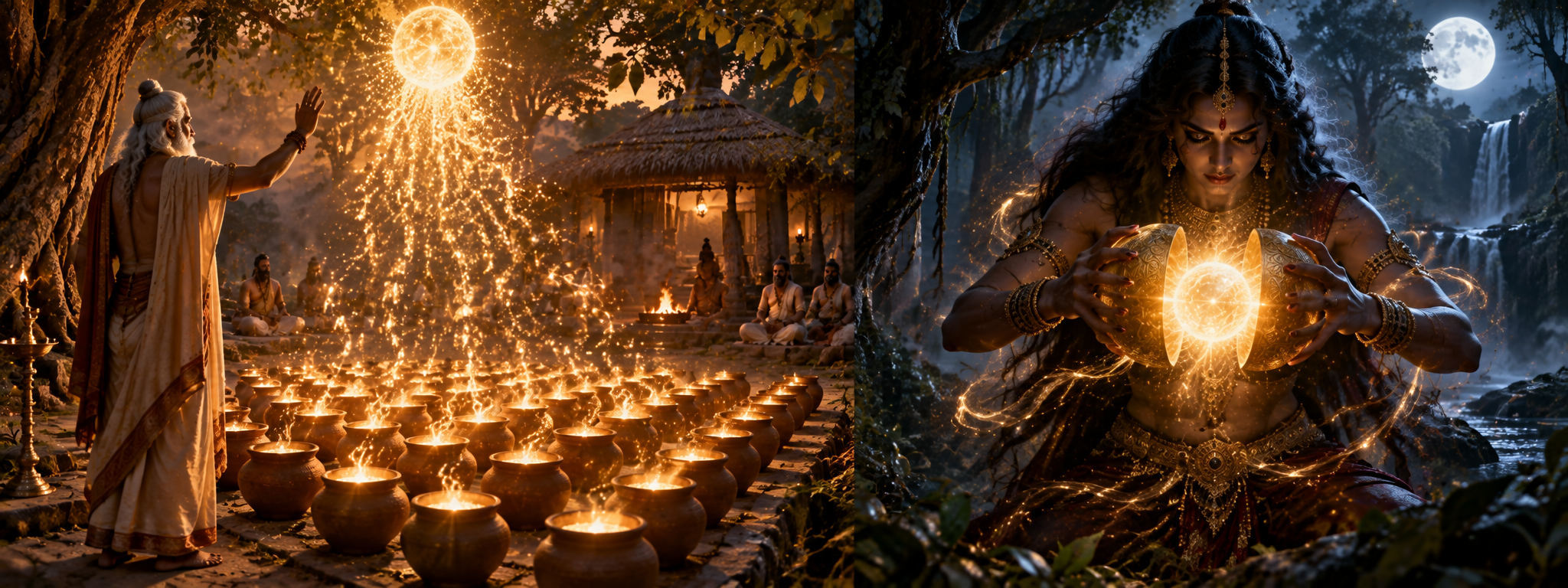
Every case in this Part turns on a single origin being acted upon by someone other than the parents themselves — divided into many, or, in one case, two halves fused into one. What distinguishes the four is not the arithmetic but the agent doing the dividing or joining, and why. A compassionate sage, a practical ritual fix, a demoness's accident, and a hostile god's weapon each produce a birth that would not otherwise have taken the shape it does.
Gandhari's Hundred Sons
Gandhari, married to Dhritarashtra, carries her pregnancy for two full years without delivering. On learning that Kunti has already given birth to Yudhishthira, and fearing her own son will lose his claim to be the eldest of the generation, she strikes her own womb in frustration. What emerges is not a child but a single hard mass of flesh, iron-grey and lifeless. Vyasa — already covered in Part II as one of this project's central vessel-born figures — is summoned, and rather than treating the mass as a failed pregnancy, has it divided into a hundred and one pieces, each placed in its own pot of clarified butter to mature. Over time, each pot yields a living child: a hundred sons, the Kauravas, and one daughter, Dussala.
Sagara's 60,000 Sons
King Sagara of the solar dynasty has two wives: Keshini, who bears him a single son, Asamanjas, and Sumati, who is granted a boon by a sage to bear sixty thousand sons instead of one. Sumati's pregnancy produces not sixty thousand separate births but a single gourd, containing that many seeds. Following the sage's own instruction, the seeds are placed individually into pots of clarified butter, and each grows into a son — sixty thousand of them, in total, all born from the one gourd Sumati herself delivers.
The sixty thousand later meet a common fate: digging through the earth in search of Sagara's sacrificial horse, they disturb the meditating sage Kapila and are burned to ash by his wrath in a single instant. It falls to their descendant Bhagiratha, generations later, to bring the Ganga down from the heavens specifically to touch their ashes and release them to the afterlife — the origin story most often told to explain why the Ganga descends to earth at all.
Jarasandha: Two Halves, One Child
King Brihadratha of Magadha has two wives, twin princesses of Kashi, but no children by either. The sage Chandakaushika, moved by his devotion, gives him a single mango enchanted to grant a son, with the explicit instruction that it be given to one wife alone. Unable to favor one queen over the other, Brihadratha splits the fruit and gives half to each.
Each queen conceives, and each delivers not a whole child but half of one — half a head, a single eye, one arm, one leg — neither half alive on its own. Horrified, the two halves are wrapped separately and abandoned in the forest. The rakshasi Jara, coming upon the two discarded pieces, presses them together simply to carry them off more easily — and at the moment of contact, the two halves fuse into a single, whole, living infant. Startled by the child's sudden cry, Jara — out of pity rather than hunger — returns him to Brihadratha instead of consuming him. The king names the boy Jarasandha, "joined by Jara," and later establishes a shrine and festival in her honor at Magadha.
The Maruts: Split by a Hostile God
Diti, grieving the deaths of her sons Hiranyakashipu and Hiranyaksha at Vishnu's hands, undertakes severe tapas to conceive a son powerful enough to kill Indra himself. Kashyapa grants the boon on the condition that she maintain strict ritual purity throughout the pregnancy. Indra, aware of what is growing inside her, watches and waits for a lapse. Late in the term, Diti briefly falls short of the observance — in most tellings, falling asleep without washing her feet — and Indra seizes the opening, entering her womb with his vajra and striking the embryo.
Rather than dying, each fragment struck by the vajra cries out, and Indra, moved or simply unable to stop, keeps striking — each blow producing another living fragment rather than ending the one before it — until the single embryo has become forty-nine separate beings: the Maruts, storm-gods who become Indra's own retinue and frequent companions of Rudra. Diti's plan for a single Indra-slayer fails entirely, but she is left with forty-nine sons where she had sought one destroyer.
The Puranic account above makes the Maruts sons of Kashyapa and Diti, split apart by Indra's weapon. An older Vedic layer of tradition instead treats the Maruts as sons of Rudra in their own right, independent of the Diti-and-vajra narrative entirely. This project does not attempt to merge the two into a single account — the Puranic birth-narrative is the one relevant to this series' mechanism, and the Rudra-parentage tradition is flagged here as a separate, older strand rather than folded into the same story.
| Case | Splitting/Fusing Agent | Motive | Outcome |
|---|---|---|---|
| Gandhari's Sons | Vyasa | Compassionate assistance, to fulfill a troubled pregnancy | 100 sons + 1 daughter, all viable |
| Sagara's Sons | An unnamed sage's boon, carried out via the ghee-pots | Practical necessity, fulfilling a boon for numerous progeny | 60,000 sons, all viable |
| Jarasandha | Jara, the rakshasi | Accidental — convenience in carrying, not intent to help | One whole child, viable |
| The Maruts | Indra | Hostile — actively trying to prevent the birth's intended purpose | 49 sons, all viable, despite the attack |
The pattern that stands out across all four: regardless of the splitting-agent's motive — helpful, practical, accidental, or hostile — every case in this Part ends in living children. Even Indra's attack, meant to destroy rather than multiply, produces forty-nine surviving sons rather than none.
Gandhari's case and Jarasandha's case are, in a sense, mirror images of each other: one is a single mass divided into many by a deliberate helper, the other is two separate halves joined into one by an accidental rescuer. Sagara's case follows Gandhari's pattern at far greater scale, and the Maruts invert the whole premise — the only case in the series where the splitting agent is trying to prevent a birth altogether, and multiplies it instead.
Jarasandha's boon-mango and the circumstances leading to the split are introduced in Part V, Nature and Multiplicity by Ritual Food, which this Part completes. Vyasa's own vessel-birth, and his role here as the one who divides Gandhari's mass into viable children, is covered in Part II, Vessel- and Medium-Born.
References
Primary Sources
- Mahabharata, Adi Parva — for the births of the Kauravas from Gandhari's mass of flesh, and for Jarasandha's split-mango birth and fusion by Jara.
- Vishnu Purana, Book 4, Chapter 4 — for Sagara's two wives, Sumati's gourd, the sixty thousand sons, and their destruction by Kapila's wrath.
- Ramayana, Bala Kanda — for the fuller account of Bhagiratha's descent of the Ganga to redeem Sagara's sons.
- Vishnu Purana, Book 1, Chapter 21, and Rigveda 1.23 and 5.58 (Vedic layer) — for the two accounts of the Maruts' origin, respectively as Diti and Kashyapa's split embryo and as Rudra's own sons.
The Maruts' two parentage traditions — Puranic (Diti/Kashyapa, split by Indra) and Vedic (sons of Rudra) — are presented as separate strands rather than reconciled into one narrative.