
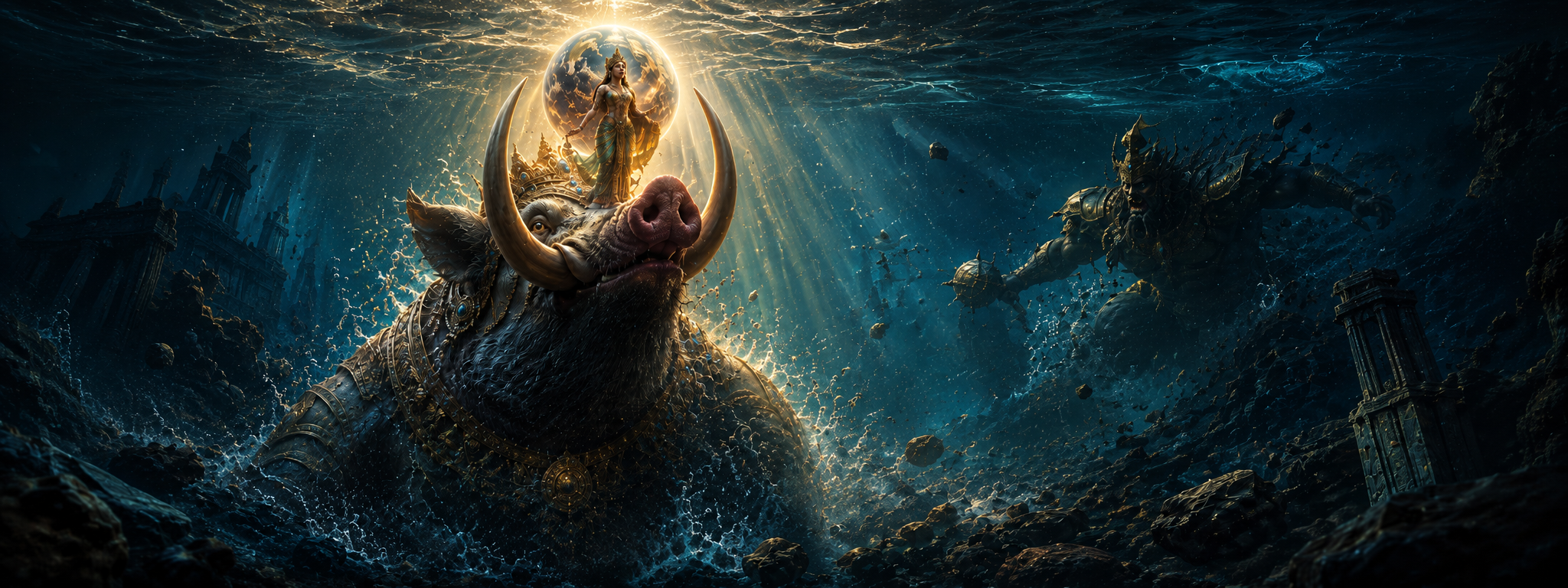
This article covers Varaha as an incarnation in its own right — why Vishnu took this particular form and what it represents theologically and iconographically. The full battle narrative, including the confrontation and thousand-year duel with Hiranyaksha, is told in complete detail in The Twelve Cosmic Wars — the Hiranyaksha War.
Context of Incarnation
Varaha is the first avatara in the sequence to meet a named adversary in direct combat. Where Matsya preserved creation from a natural catastrophe and Kurma bore the weight of a cooperative undertaking, Varaha responds to a deliberate act of aggression: the Asura Hiranyaksha seizes the earth and drags her to the bottom of the cosmic ocean, intending to keep her submerged permanently. There is no ambiguity or shared purpose here as there was with the Devas and Asuras at the churning — Hiranyaksha's act is a direct assault on the created order, and Vishnu's response is correspondingly direct: he takes the form of an immense boar, dives into the ocean after her, and fights Hiranyaksha in single combat before lifting the earth back into her place.
The choice of a boar is itself significant within the theology of the incarnation. A boar is an animal suited to exactly this task — a creature that roots and digs, capable of finding and raising something buried, powerful enough to carry immense weight on its tusks. The form fits the labor required of it, a pattern that recurs across the more overtly combative avataras that follow.
The confrontation with Hiranyaksha — his seizure of the earth, the search through the cosmic waters, and the extended duel that ends in his death — is told in full in the Twelve Cosmic Wars series.
Read the Hiranyaksha War →Symbolism & Iconography
Varaha carries agrarian symbolism that several of the other avataras lack — the boar as a creature of the earth itself, associated with digging, rooting, and physical labor rather than with water (Matsya, Kurma) or fire and violence (Narasimha). The earth Varaha raises, Bhudevi, is consistently personified as a goddess in the Puranic tellings, and the iconographic image of her seated or standing on the boar's raised tusk — sometimes depicted at a scale small enough to fit in the crook of his tusk, sometimes as a full goddess figure held against his chest — is among the most recognizable single images in the entire Dashavatara tradition.
Two iconographic conventions coexist for Varaha's form, and both are well attested rather than one being a later corruption of the other: a fully theriomorphic boar, monumental in scale, as in the well-known rock-cut Varaha panels of the Gupta period; and a hybrid form with a boar's head set on a muscular human body, often four-armed and bearing Vishnu's usual emblems, which becomes the more common convention in later temple sculpture and painting.
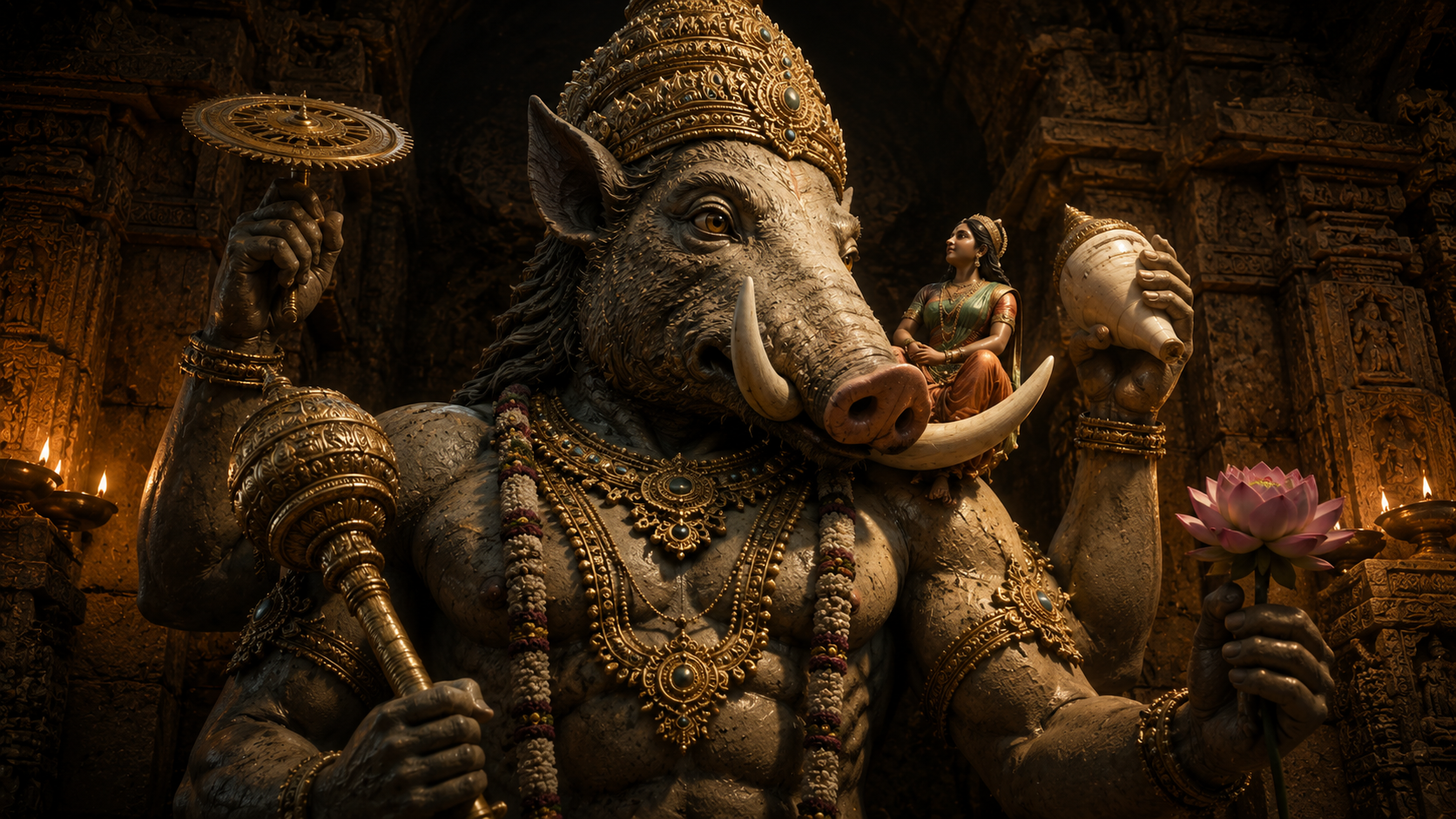
The hybrid boar-headed form, alongside the fully theriomorphic convention seen in earlier monumental sculpture.
The essential narrative — Hiranyaksha's seizure of the earth, Varaha's descent, and the duel that ends in the demon's death — is stable across the Bhagavata Purana, Vishnu Purana, and Varaha Purana, which, like the Matsya and Kurma Puranas before it, takes its name from this avatara while devoting most of its actual content to unrelated cosmological, geographical, and ritual material. Some tellings place the confrontation before the earth is fully submerged, others after; this article and the corresponding Cosmic Wars article follow the more common sequence, in which the earth is already at the ocean floor when Varaha arrives.
Varaha establishes the pattern that Narasimha, Vamana, and every subsequent avatara will follow more directly than Matsya or Kurma did: a specific adversary, a form suited to defeating that adversary, and a decisive act of combat. Hiranyaksha's death at Varaha's hands also sets the following avatara in motion — his brother, Hiranyakashipu, takes up the same grievance against Vishnu and turns it into the boon-driven tyranny that Narasimha will be required to answer.
References
Primary Sources
- Bhagavata Purana 3.13 — Vishnu's decision to take the boar form; 3.17–19, the duel with Hiranyaksha.
- Vishnu Purana 1.4 — parallel account of the earth's rescue.
- Varaha Purana, chapters 1–4 — avatara narrative within a larger geographical and ritual compendium.
Secondary Sources
- Dimmitt, Cornelia, and van Buitenen, J.A.B. Classical Hindu Mythology: A Reader in the Sanskrit Puranas. Temple University Press, 1978.
- Mani, Vettam. Puranic Encyclopaedia. Motilal Banarsidass, 1975. Entries: "Varaha," "Hiranyaksha," "Bhudevi."
This article covers the avatara's theology, symbolism, and sourcing only. For the complete battle narrative, see The Twelve Cosmic Wars — the Hiranyaksha War.