

The Aranya Kanda covers the bulk of the forest years and ends with the single event the rest of the epic exists to answer — Sita's abduction. Most of the kanda's early episodes are comparatively quiet; the abduction sequence, by contrast, is the hinge the entire Yuddha Kanda turns on.
The Early Forest Years
Rama, Sita, and Lakshmana spend the opening years of the exile moving between hermitages, encountering sages and, occasionally, danger — the demon Viradha, who seizes Sita before being killed by the brothers; the aged ascetic Sharabhanga, who transfers his accumulated spiritual merit to Rama before his own death; and the sage Agastya, who gifts Rama the divine bow and arrows he will carry for the rest of the epic. On Agastya's advice, the three eventually settle at Panchavati, on the banks of the Godavari, building a simple hermitage that becomes the base for the events that follow.
| Figure | Role in This Kanda |
|---|---|
| Surpanakha | Ravana's sister, whose rejected proposal and mutilation trigger the escalation toward war |
| Khara & Dushana | Rakshasa commanders, Surpanakha's brothers, defeated by Rama alone |
| Maricha | Demon who takes the form of a golden deer to lure Rama away from the hermitage |
| Ravana | King of Lanka, who abducts Sita in Rama's absence |
| Jatayu | Aged vulture-king who attempts to stop the abduction and dies in the attempt |
Surpanakha and the Battle at Panchavati
Surpanakha, Ravana's sister, encounters Rama at the hermitage and proposes marriage; when he declines — directing her, not entirely without mockery in most tellings, to the unmarried Lakshmana instead — she turns on Sita, and Lakshmana, in most versions of the story, mutilates her by cutting off her nose and ears to end the threat. Surpanakha flees to her brothers Khara and Dushana, who lead a large Rakshasa force against the hermitage in retaliation. Rama single-handedly defeats the entire force, a battle the text renders at a scale meant to establish, well before Lanka, exactly what kind of warrior he has become.
Surpanakha, defeated a second time, travels on to Lanka itself and appeals directly to Ravana — describing Sita's beauty in terms clearly calculated to provoke exactly the reaction that follows.
The Golden Deer and the Abduction
Ravana enlists Maricha — the same demon who fled Rama's arrow years earlier as a young man at Vishwamitra's sacrifice — to take the form of a radiant golden deer and draw Rama away from the hermitage. Maricha, who has already learned exactly what Rama is capable of, warns Ravana against the plan before ultimately complying out of fear. Sita, captivated by the deer, asks Rama to catch it for her; he pursues it deep into the forest, eventually killing it, at which point the dying Maricha cries out in Rama's own voice, drawing Lakshmana away from Sita as well despite his own suspicion that something is wrong.
With both brothers away, Ravana approaches Sita disguised as a wandering ascetic and abducts her by force, carrying her off in his flying chariot. The vulture-king Jatayu, an old ally of Dasharatha's, intercepts the chariot and fights Ravana in the air, delaying him at great cost — Ravana wounds Jatayu mortally before continuing on to Lanka. Rama and Lakshmana return to find the hermitage empty, and soon after find the dying Jatayu, who tells them what happened before he dies in Rama's arms.
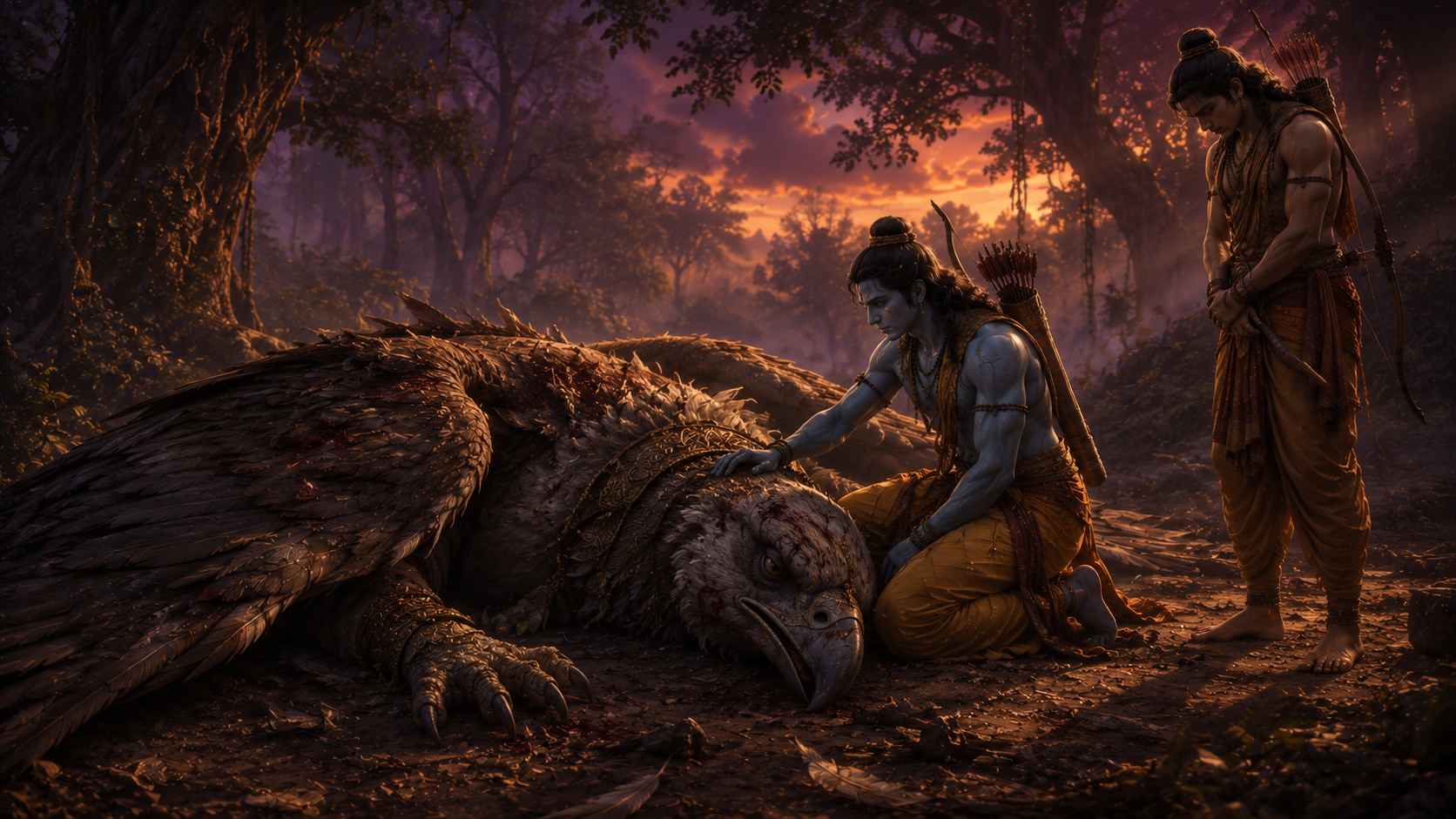
Jatayu's sacrifice — the first cost of the abduction, and the first news of where Sita has gone.
The Surpanakha episode is one of the more debated moments in the epic's modern reception: Valmiki's text and most classical retellings present Lakshmana's mutilation of her as a justified response to a genuine threat against Sita, but a number of modern readings — literary and popular alike — have questioned whether the punishment fits the offense, particularly given that her initial approach, however unwelcome, was a marriage proposal rather than an act of violence. This article presents the episode as the source describes it without either endorsing or erasing that later critical reading; the tension is worth naming rather than smoothing over.
Sources also vary on the exact number of Rakshasa troops at the Khara-Dushana battle — figures as high as fourteen thousand appear in some tellings — a scale generally read as symbolic rather than a literal troop count.
With Sita's location unknown and Jatayu dead, Rama and Lakshmana begin the search that leads them to Kishkindha, and to the alliance with Hanuman and Sugriva that makes the rest of the war possible.
References
Primary Sources
- Valmiki Ramayana, Aranya Kanda, chapters 1–11 — the early forest years, Viradha, Sharabhanga, and Agastya.
- Valmiki Ramayana, Aranya Kanda, chapters 16–30 — Surpanakha and the battle with Khara and Dushana.
- Valmiki Ramayana, Aranya Kanda, chapters 42–50 — the golden deer and Sita's abduction.
- Valmiki Ramayana, Aranya Kanda, chapters 51–68 — Jatayu's death and the beginning of the search.
Secondary Sources
- Goldman, Robert P., and Sally J. Sutherland Goldman (eds.). The Ramayana of Valmiki: Aranya Kanda. Princeton University Press, 1996.
- Mani, Vettam. Puranic Encyclopaedia. Motilal Banarsidass, 1975. Entries: "Surpanakha," "Jatayu," "Maricha."
- Richman, Paula (ed.). Many Ramayanas. University of California Press, 1991 — for the range of critical readings of the Surpanakha episode.
The Surpanakha episode is presented with its modern critical reception noted rather than omitted, consistent with this project's practice of flagging genuine interpretive tension rather than resolving it silently.