
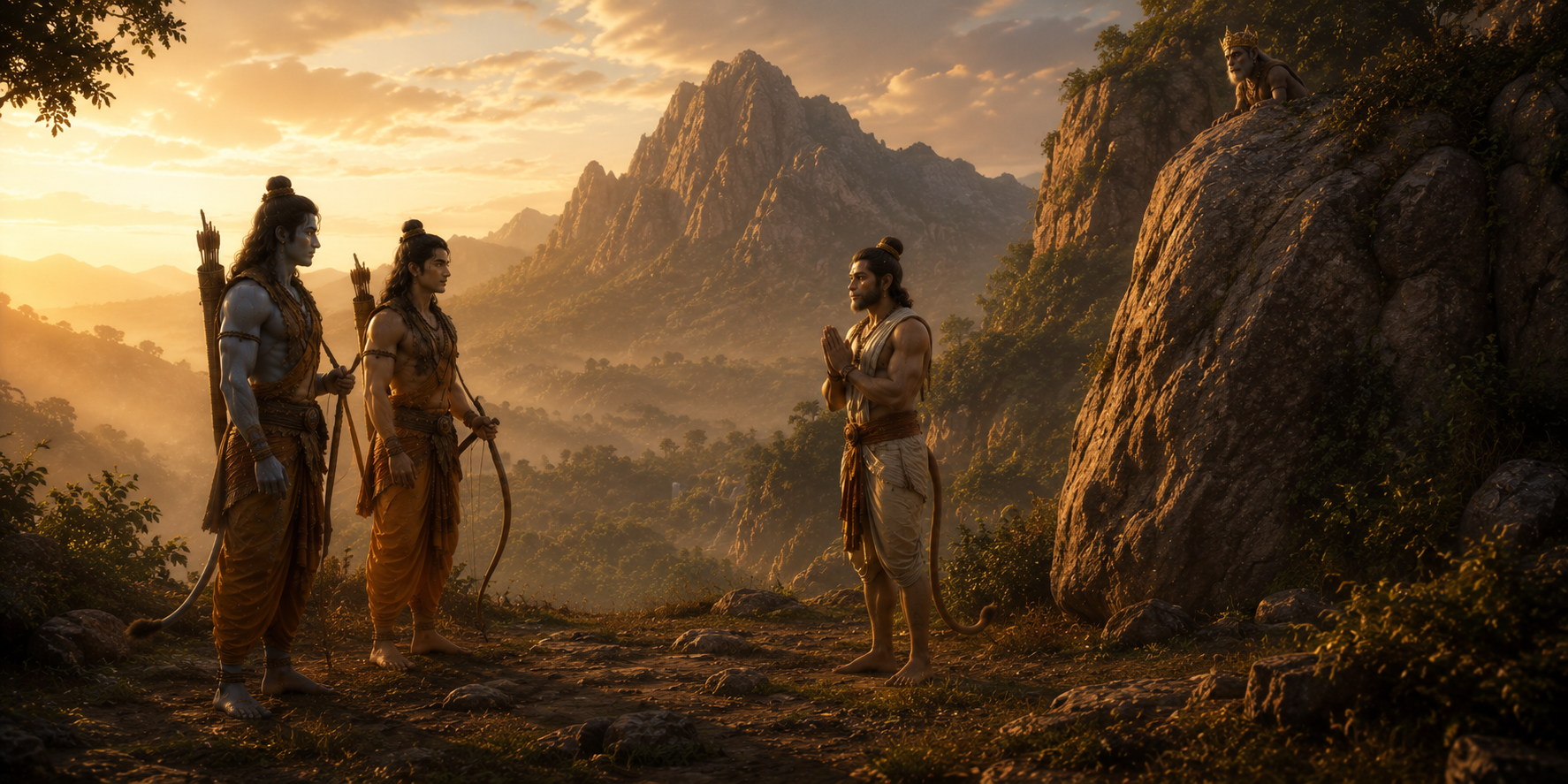
The Kishkindha Kanda is where the search for Sita becomes an organized effort rather than a grief-stricken wandering — but it opens with one of the epic's most morally contested episodes, which this article addresses directly rather than passing over.
Meeting Hanuman
Searching for Sita, Rama and Lakshmana arrive near Mount Rishyamukha, where they are approached by a vanara disguised as a wandering ascetic — Hanuman, sent by the exiled Sugriva to assess whether the two strangers are a threat or potential allies. Recognizing their sincerity, Hanuman reveals himself and brings them to Sugriva, who proposes a direct exchange: he will help find Sita in return for Rama's help reclaiming his own kingdom and wife from his elder brother, Vali.
| Figure | Role in This Kanda |
|---|---|
| Hanuman | Vanara minister to Sugriva, first to approach Rama and Lakshmana |
| Sugriva | Exiled from Kishkindha by his brother Vali; forms the central alliance with Rama |
| Vali | King of Kishkindha, Sugriva's elder brother, killed by Rama |
| Tara | Vali's wife, who argues against his final duel |
| Angada | Vali's son, later a commander in the search and the war |
| Sampati | Jatayu's brother, who reveals Sita's location in Lanka |
The Killing of Vali
The rift between the brothers traces back to a battle against the demon Mayavi, in which Sugriva, believing Vali dead inside a sealed cave, sealed the entrance and returned to Kishkindha — only for Vali, very much alive, to return later and, believing Sugriva had abandoned him deliberately, exile him and take his wife Ruma. Rama agrees to help Sugriva challenge Vali to single combat, and in the duel that follows, shoots Vali from concealment while the two brothers are fighting — an act Vali, dying, directly and at length protests as beneath a king who claims to act from dharma, questioning by what right Rama has killed him without ever having been challenged or wronged by Vali himself.
Rama's response, given at comparable length in the text itself, cites several justifications: that Vali, having taken his own brother's wife, has himself acted against dharma and forfeited the protection normally due a rival in single combat; that a king has both the right and duty to punish wrongdoing wherever he finds it, not only within his own realm; and that Rama, bound by his alliance with Sugriva, was acting on a debt of honor rather than as a neutral bystander. Vali, before he dies, accepts correction from Rama regarding his own past conduct, entrusts his son Angada to Sugriva's care, and the two are reconciled before his death.
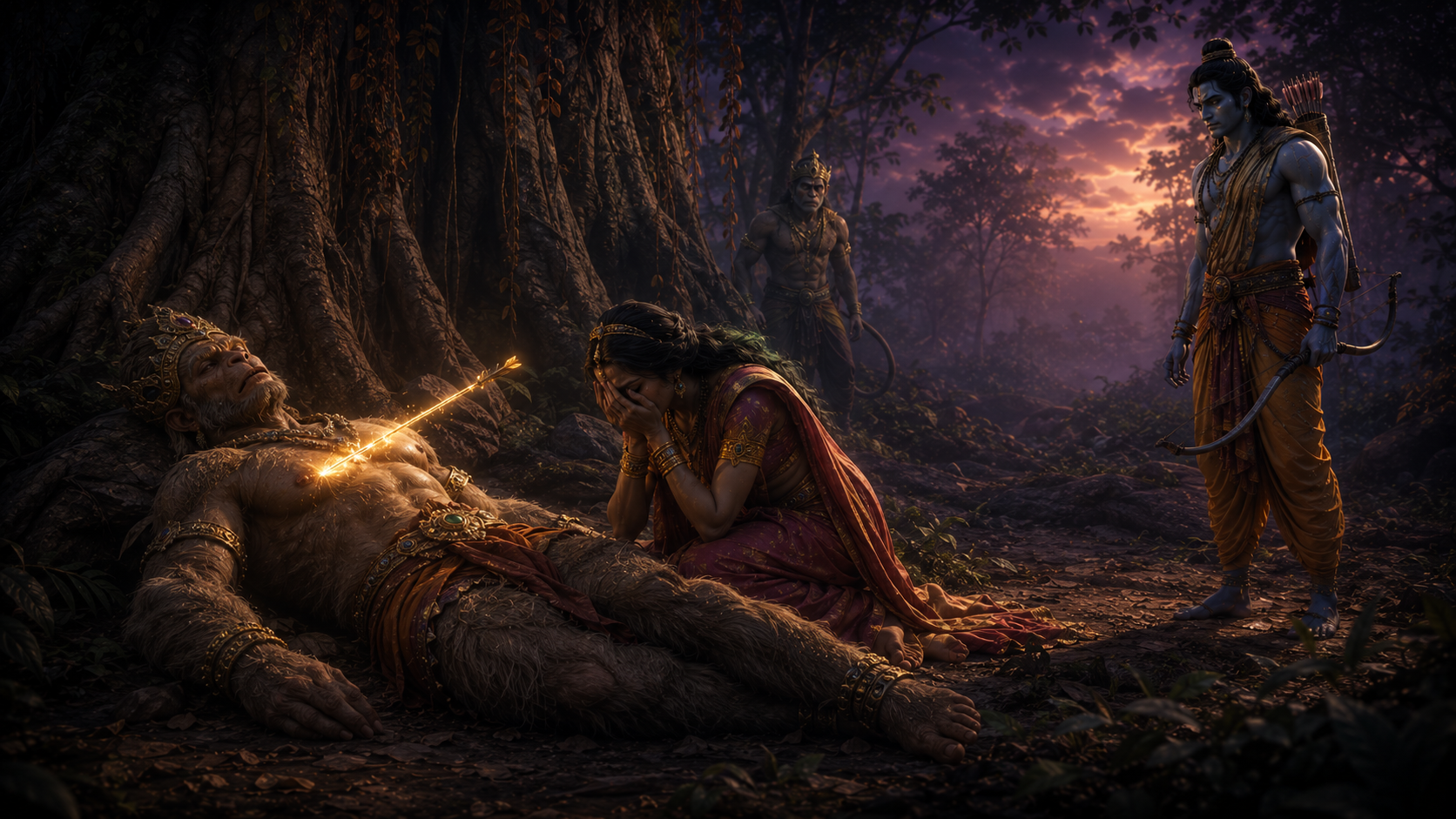
Vali's dying rebuke of Rama, and Rama's extended justification in response, are both preserved at length in Valmiki's own text.
Sugriva's Coronation and the Search Parties
Sugriva is installed as king of Kishkindha, with Angada named heir apparent, but the promised search for Sita stalls as Sugriva, freed from exile, indulges in the pleasures of his restored kingdom. Lakshmana, furious at the delay, confronts him directly, and Sugriva — mortified — immediately mobilizes vanara forces in all four directions. The southern search party, led by Angada and including Hanuman, proves decisive: after an arduous journey, they encounter the aged vulture Sampati, Jatayu's brother, who — his own wings burned in a youthful attempt to fly too close to the sun — can no longer fly himself, but retains far-seeing vision, and confirms that Sita is held in Lanka, across the ocean.
Unlike the modern critical reception surrounding the Surpanakha episode, the moral tension in Vali's death is staged directly within Valmiki's own text — Vali's rebuke and Rama's justification are both given substantial space in the Sanskrit original, meaning the ambiguity here is textually present rather than a later reading imposed on the story. Commentators across the tradition have offered varying resolutions to the exchange, from full endorsement of Rama's stated reasoning to more qualified readings that treat the episode as a genuine moral cost paid in service of the larger alliance; this article presents Rama's stated justification alongside Vali's objection without resolving which reading the tradition ultimately favors, since the text itself does not resolve it either.
With Sita's location confirmed, the search shifts from a question of where to a question of how — Lanka lies across open ocean, and only Hanuman, among the assembled vanaras, is capable of the leap the next kanda is named for.
References
Primary Sources
- Valmiki Ramayana, Kishkindha Kanda, chapters 1–8 — meeting Hanuman and Sugriva.
- Valmiki Ramayana, Kishkindha Kanda, chapters 9–19 — the Vali-Sugriva conflict and Vali's death.
- Valmiki Ramayana, Kishkindha Kanda, chapters 29–43 — the search parties and Sampati.
Secondary Sources
- Goldman, Robert P., and Sally J. Sutherland Goldman (eds.). The Ramayana of Valmiki: Kishkindhakanda. Princeton University Press, 1994.
- Mani, Vettam. Puranic Encyclopaedia. Motilal Banarsidass, 1975. Entries: "Vali," "Sugriva," "Hanuman."
- Pollock, Sheldon. "The Divine King in the Indian Epic." Journal of the American Oriental Society, 1984 — for the Vali episode's place in classical debates on kingship and dharma.
Vali's death is presented with both sides of the text's own internal debate given space, rather than treating Rama's justification as the story's final word on the matter.