
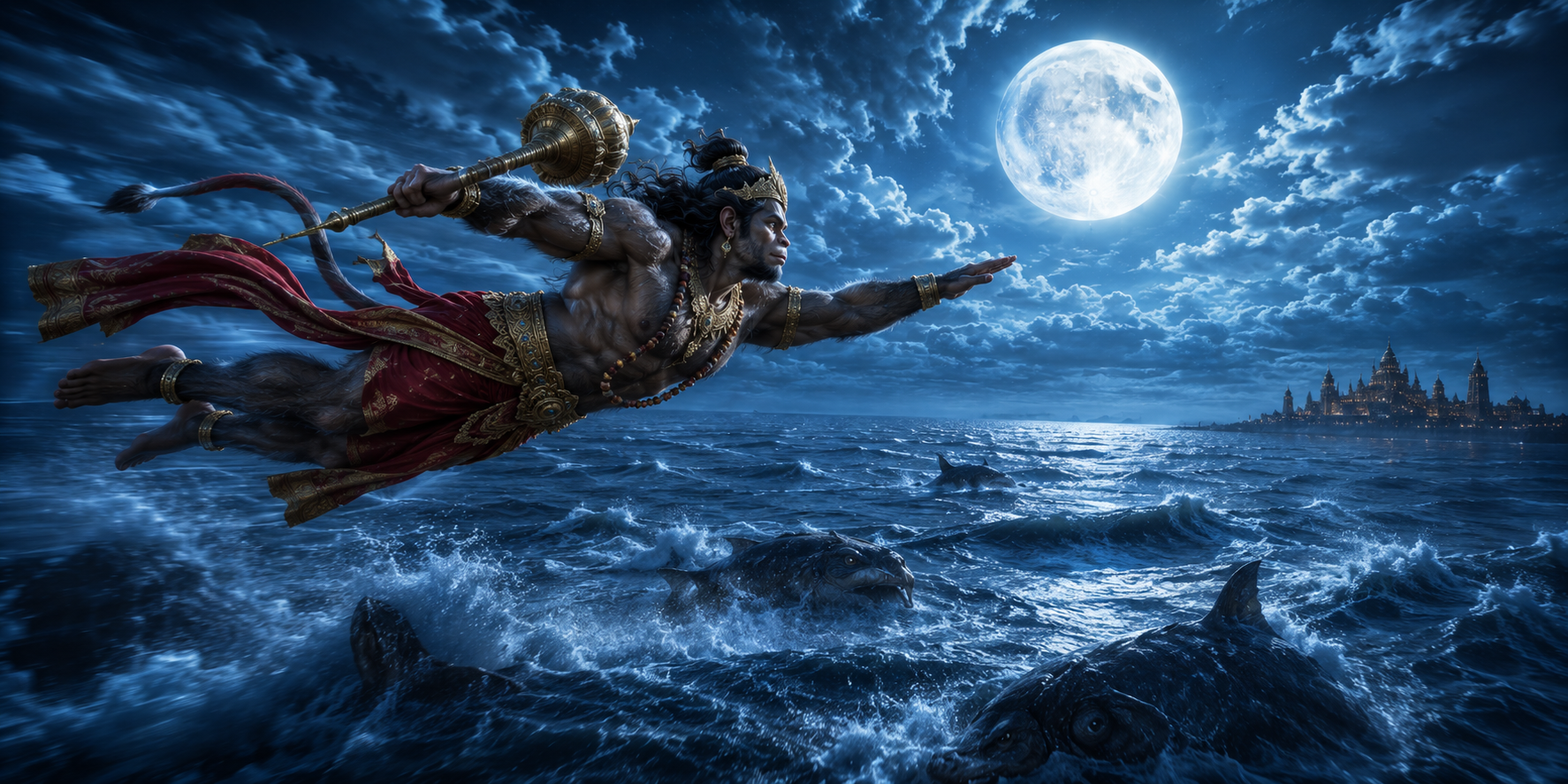
The Sundara Kanda is widely regarded within the tradition as the most beloved single book of the Ramayana — a solo mission of courage, devotion, and improvisation carried almost entirely by Hanuman, bridging the search of the previous kanda and the war of the one that follows.
The Leap
With Lanka's location confirmed but no vanara capable of crossing the ocean to it, Hanuman is reminded of his own forgotten powers of flight and size-shifting, and takes the leap alone. The crossing is not uneventful: the mountain Mainaka rises from the sea to offer him rest, which he politely declines without pausing; the sea-demoness Surasa tests his resourcefulness by demanding he enter her mouth, which he does by shrinking to the smallest possible size after first expanding to meet her own growing challenge; and the shadow-seizing demoness Simhika, who drags creatures down by their reflection, is killed by Hanuman when she attempts the same trick on him.
| Figure | Role in This Kanda |
|---|---|
| Hanuman | Carries the entire mission alone — the leap, the search, and the escape |
| Sita | Found in the Ashoka Vatika, held captive under threat but unbroken |
| Ravana | Continues to press Sita toward marriage, refused at every attempt |
| Trijata | A rakshasi guard who treats Sita with unexpected kindness after a dream she interprets as an omen of Rama's victory |
| Vibhishana | Ravana's brother, whose private doubts about the abduction begin to surface in this kanda |
Finding Sita
Arriving in Lanka, Hanuman shrinks to search the city unnoticed, eventually locating Sita in the Ashoka Vatika — a grove within Ravana's palace grounds where she is kept under guard by rakshasis, refusing food and comfort, and resisting Ravana's repeated attempts to persuade or threaten her into marriage. Among her guards, one — Trijata — treats her with unexpected gentleness, having had a dream she reads as an omen of Rama's eventual victory and Ravana's downfall, a detail the text uses to suggest that even within Lanka, Ravana's cause is not universally supported.
Hanuman reveals himself to Sita quietly, offering Rama's signet ring as proof of who sent him, and relays Rama's message. Sita, overjoyed but resolute, declines Hanuman's offer to carry her back to Rama immediately, insisting instead that her rescue come properly, at Rama's own hand — a decision that keeps her agency intact within a story that could easily have reduced her to a passive object of retrieval, and one the text treats as entirely her own choice rather than an oversight in Hanuman's plan.
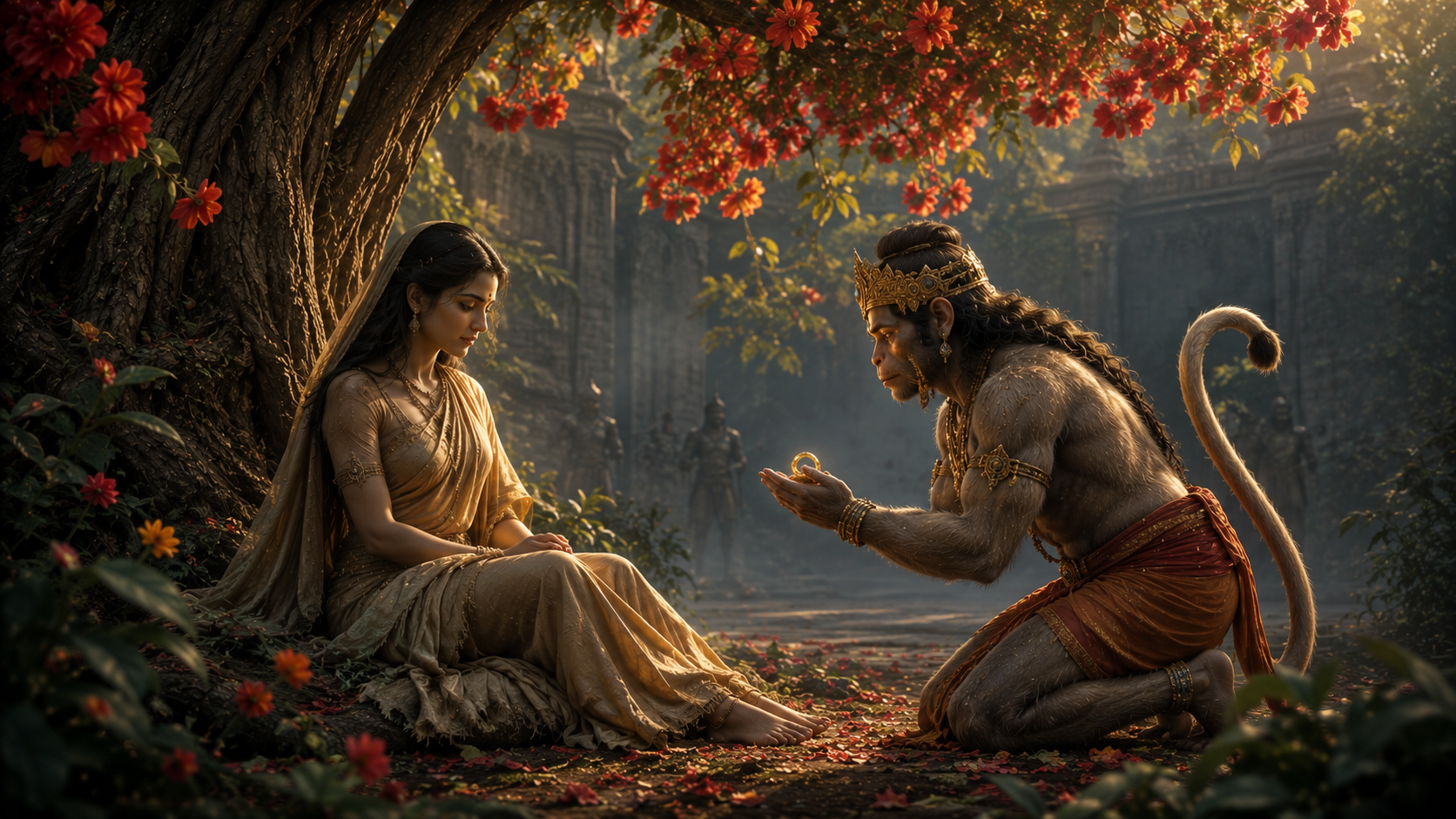
Sita's composure under captivity, and her insistence on being rescued by Rama himself rather than carried away.
The Burning of Lanka
Before leaving, Hanuman allows himself to be captured after a display of destructive strength in Ravana's gardens, engineering a direct meeting with the Rakshasa king. Ravana, in fury, orders Hanuman's tail set alight — an insult and punishment Hanuman turns entirely against him, using the burning tail to set fire to large sections of Lanka before extinguishing it in the sea and making his return leap to the mainland. He reports everything he has found to Rama and the assembled vanaras, turning the search that occupied the previous kanda into the certainty that makes the coming war possible.
Sources vary somewhat on the sequence of Hanuman's capture and the burning of Lanka — some tellings have him deliberately provoke capture specifically to gain an audience with Ravana, others present the capture as incidental to his earlier destruction of the garden. Several regional retellings also describe Sita using her own spiritual power to ensure the fire does not harm Hanuman himself, a detail not explicit in all versions of Valmiki's Sanskrit text but widely present in devotional retellings and popular memory of the episode.
With Sita's location and condition confirmed, Rama's forces begin the march to the coast — the opening movement of the Yuddha Kanda, the war this entire search has been building toward.
References
Primary Sources
- Valmiki Ramayana, Sundara Kanda, chapters 1–2 — the leap and the obstacles crossed.
- Valmiki Ramayana, Sundara Kanda, chapters 13–20 — the discovery of Sita in the Ashoka Vatika.
- Valmiki Ramayana, Sundara Kanda, chapters 47–54 — the capture, the audience with Ravana, and the burning of Lanka.
Secondary Sources
- Goldman, Robert P., and Sally J. Sutherland Goldman (eds.). The Ramayana of Valmiki: Sundarakanda. Princeton University Press, 1996.
- Mani, Vettam. Puranic Encyclopaedia. Motilal Banarsidass, 1975. Entries: "Hanuman," "Trijata," "Sundara Kanda."
The Sundara Kanda is often read and recited independently of the rest of the epic in devotional practice; this article follows Valmiki's own sequence rather than any devotional reordering.