
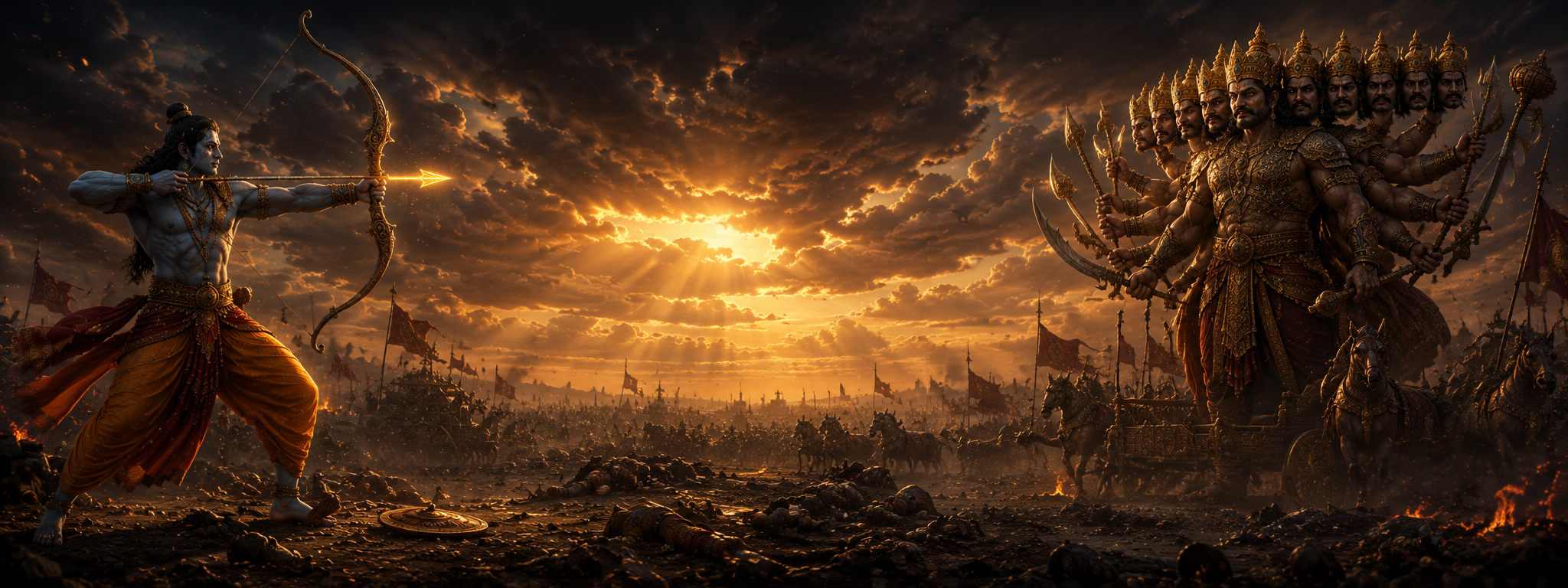
The Yuddha Kanda is the longest single book of the Ramayana and carries the story from the building of the bridge through the war itself to the coronation that closes fourteen years of exile. It also contains the epic's most debated single episode — Sita's trial by fire — addressed directly in its own section below rather than passed over.
The Bridge and Vibhishana's Defection
Rama's vanara army reaches the southern coast and, under the engineering of Nala and Nila, builds a great floating bridge — Rama Setu — across the strait to Lanka, stones inscribed with Rama's name said to float where ordinary stone would sink. Before the war begins, Vibhishana, Ravana's own brother, counsels him repeatedly to return Sita and avoid catastrophe; when Ravana refuses and banishes him for the advice, Vibhishana crosses to Rama's camp and offers his loyalty. Rama, over some of his commanders' open suspicion of a defector from the enemy's own royal house, welcomes him and promises him the throne of Lanka once the war is won — a promise that also formally reframes the coming war as a matter of succession within Lanka rather than simple conquest.
| Figure | Role in This Kanda |
|---|---|
| Vibhishana | Ravana's brother, defects to Rama and is promised Lanka's throne |
| Kumbhakarna | Ravana's giant brother, woken from long sleep to fight and die in the war |
| Indrajit (Meghanada) | Ravana's son, master of illusion, wounds Lakshmana before being killed |
| Ravana | King of Lanka, killed in the final duel with Rama |
| Agni | The fire god, who returns Sita unharmed from the trial by fire |
Kumbhakarna and Indrajit
With diplomacy exhausted — Angada is sent first as an envoy to demand Sita's return, an offer Ravana rejects outright — the war begins in earnest. Kumbhakarna, Ravana's monstrous brother, famed for sleeping for months at a stretch, is woken by force to join the defense; the text gives him a moment of private reluctance and even sound counsel to his brother before he nonetheless fights with tremendous power and is eventually killed by Rama.
Indrajit, Ravana's son and the war's most dangerous single combatant, proves far harder to overcome. His mastery of illusion allows him to bind both Rama and Lakshmana with the serpent-weapon Nagapasha, broken only when Garuda, the eagle, arrives to free them. Later in the war, Indrajit strikes Lakshmana with the Shakti weapon, wounding him near-fatally; the physician Sushena identifies a single herb, the Sanjivani, growing on the Himalayan peak Dronagiri as the only cure in time, and Hanuman — unable to identify the specific plant among the mountain's many — carries the entire mountain back to the battlefield rather than risk the delay of searching it, one of the most widely loved single images anywhere in the epic. Lakshmana revives, and in the battle that follows finally kills Indrajit.
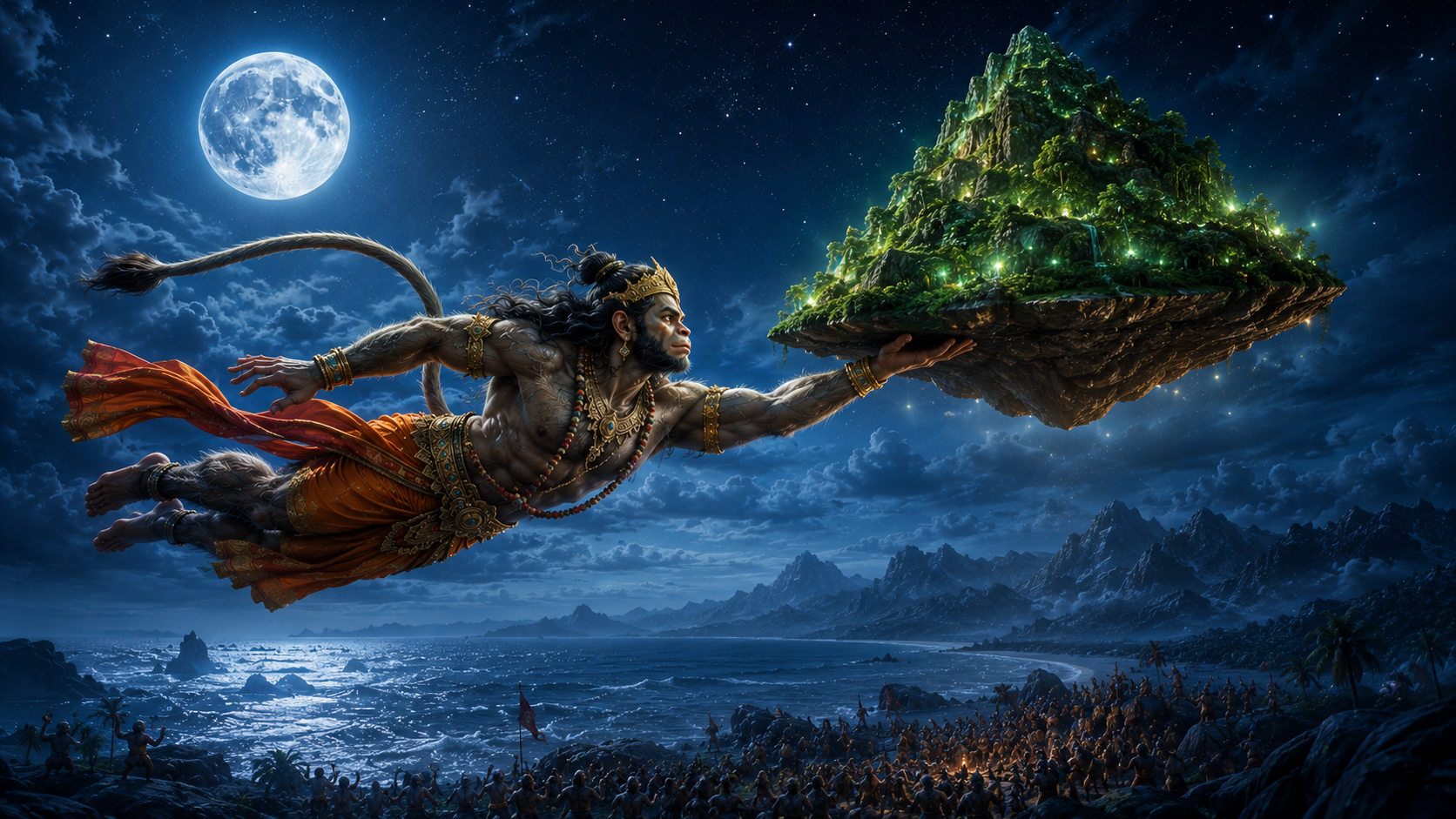
One of the epic's most beloved images — devotion expressed as decisive, oversized action rather than careful searching.
The Final Duel
Ravana himself enters the battle only after the deaths of his brother and son, and his duel with Rama spans several days of the text, chariots destroyed and re-supplied, weapon answered by weapon. Rama's final, decisive shot is delivered with an arrow associated with Brahma's own power; in several tellings Vibhishana or the sage Agastya first reveals to Rama that Ravana's accumulated boons make a simple wound insufficient, and that only a strike aimed with full and final intent can end him. Ravana dies on the battlefield, and Rama, over some of his own commanders' objection, insists that Vibhishana perform full funeral rites for his fallen brother — an act the text treats as consistent with, rather than in tension with, Rama's larger character.
Sita's Trial by Fire
Sita is brought before Rama following the war, and his first words to her are colder than anything else in the epic attributed to him — he questions, in front of the assembled army, whether her long captivity in another man's house has left her fit to return to him, and appears to suggest she is free to go wherever she wishes rather than back to him. Sita, devastated, asks Lakshmana to build a fire, and enters it herself rather than continue to have her fidelity doubted. Agni, the fire god, emerges from the flames bearing her unharmed, publicly testifying to her purity throughout the ordeal. Rama, in the text's own account, states that he never personally doubted her, but required this public vindication so that no one among his future subjects could ever question her character or, by extension, his own judgment as a king who took her back.
This episode is, by a wide margin, the most extensively debated single passage in the entire epic, both within the classical commentarial tradition and in modern scholarship. Rama's own stated reasoning — that the trial served public necessity rather than personal doubt — is given directly in Valmiki's text, but it has never fully settled the discomfort many readers, ancient and modern, have expressed at a wife made to prove her fidelity through physical ordeal after already having endured an unwilling captivity. Some later regional retellings soften or reframe the episode considerably; others, including some devotional traditions, read Sita's fire-walk itself as an act of her own sovereign choice and vindication rather than a punishment imposed on her. This project presents Rama's stated justification as the text gives it, alongside the episode's long and largely unresolved history of critical unease, rather than treating either the justification or the discomfort as the final word.
The Return and Coronation
With the fourteen years of exile at their end, Rama, Sita, and their companions return to Ayodhya aboard the Pushpaka Vimana, Ravana's own flying chariot, arriving to find Bharata — who had vowed to end his own life if Rama did not return by the appointed day — waiting at Nandigrama exactly as he had for fourteen years. The reunion of all four brothers, and Rama's coronation as king, close the kanda on the note the entire epic has been building toward: Rama Rajya, the reign the tradition holds up as the standard for just governance ever after.
Most tellings of the Ramayana end here, at the coronation. The Uttara Kanda, covered in its own chapter with an explicit note on its disputed canonicity, continues the story into Rama's reign and its far more difficult final chapters.
References
Primary Sources
- Valmiki Ramayana, Yuddha Kanda, chapters 1–22 — the bridge and Vibhishana's defection.
- Valmiki Ramayana, Yuddha Kanda, chapters 55–61, 90–101 — Kumbhakarna and Indrajit.
- Valmiki Ramayana, Yuddha Kanda, chapters 103–110 — the final duel with Ravana.
- Valmiki Ramayana, Yuddha Kanda, chapters 116–120 — the trial by fire.
- Valmiki Ramayana, Yuddha Kanda, chapters 122–131 — the return and coronation.
Secondary Sources
- Goldman, Robert P., and Sally J. Sutherland Goldman (eds.). The Ramayana of Valmiki: Yuddhakanda. Princeton University Press, 2009.
- Mani, Vettam. Puranic Encyclopaedia. Motilal Banarsidass, 1975. Entries: "Ravana," "Kumbhakarna," "Indrajit," "Agnipariksha."
- Richman, Paula (ed.). Many Ramayanas. University of California Press, 1991 — for the range of classical and modern readings of the Agni Pariksha.
- Sutherland Goldman, Sally J. "The Voice of Sita in Valmiki's Sundarakanda." In Questioning Ramayanas, ed. Paula Richman. University of California Press, 2001.
The trial by fire is presented with the text's own justification alongside its long history of critical reception, rather than resolved in favor of either reading.