
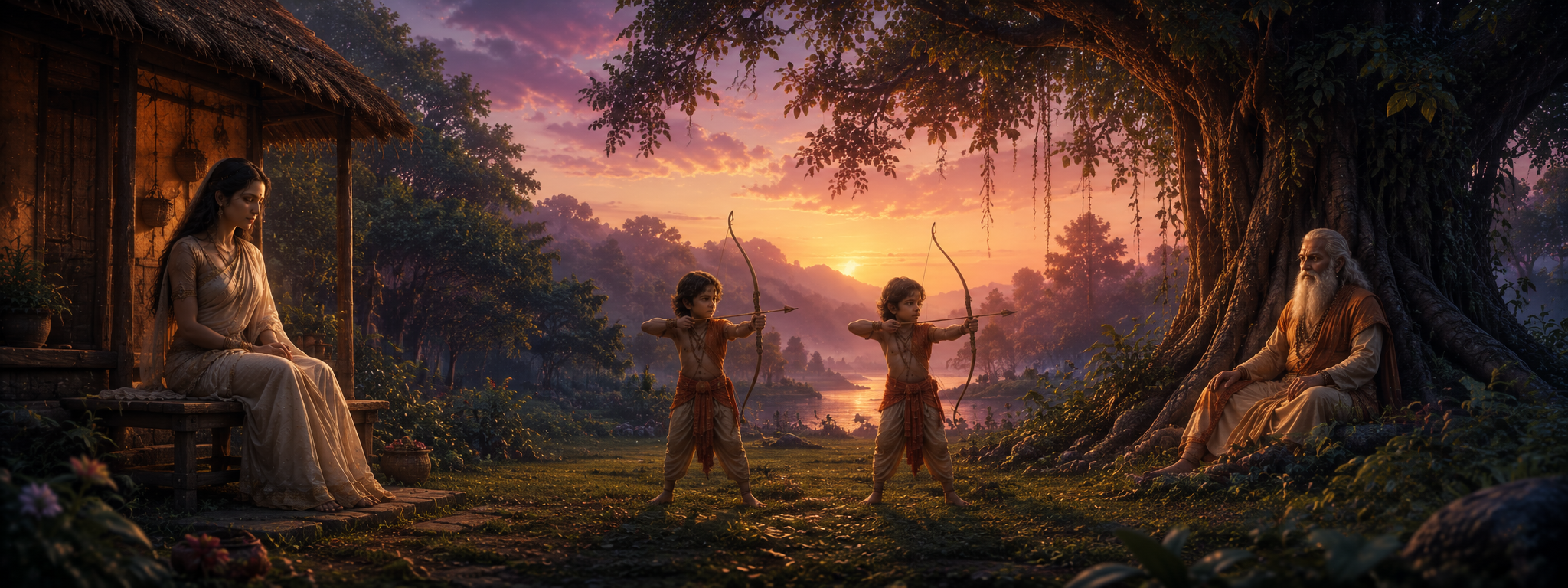
Before anything else: the Uttara Kanda's place in the Ramayana's canon is genuinely disputed. Many textual historians, ancient and modern, regard it — along with the Bala Kanda — as a later addition to a core narrative that may originally have ended at the coronation closing the Yuddha Kanda. Differences in style, internal inconsistencies with the rest of the epic, and its own distinct tone have all been cited as evidence for this view across centuries of commentary, not only in recent scholarship. This series includes the Uttara Kanda because it is part of the Ramayana as most traditions have received and transmitted it, but its contested status is stated here plainly rather than treated as a settled question.
This chapter also contains the single most ethically debated episode attributed to Rama anywhere in the epic — his decision to exile Sita a second time, this time on the basis of public rumor alone. It is addressed directly below, with the text's own account given in full and the extensive critical reception, both classical and modern, presented alongside it.
Sita's Second Exile
Some time into Rama's reign, with Sita pregnant, rumors begin circulating among the citizens of Ayodhya questioning whether a king should have taken back a wife who had lived, however unwillingly, in another man's house — doubts the fire trial had been meant to settle but had not, in the public mind, fully erased. The text singles out one specific remark, from a washerman rebuking his own wife by comparing himself unfavorably to Rama's supposed leniency, as the moment that crystallizes the gossip for Rama. Acting now explicitly in his capacity as king rather than as husband — the text is direct that this is a decision about what a ruler owes his subjects' confidence rather than a private judgment about Sita's character — Rama orders Lakshmana to take Sita to the forest and leave her there, without revealing the reason to her beforehand. Lakshmana, anguished, obeys.
| Figure | Role in This Kanda |
|---|---|
| Sita | Exiled a second time while pregnant; raises her sons alone at Valmiki's hermitage |
| Valmiki | Sage who shelters Sita, raises Luv and Kusha, and composes the Ramayana itself |
| Luv & Kusha | Rama and Sita's twin sons, raised without knowledge of their father's identity |
| Lakshmana | Carries out Rama's order, though the text preserves his anguish at doing so |
This episode has drawn sustained criticism across the tradition's own history, not only from modern readers. Even within classical and devotional commentary, various strategies have been used to soften or reframe Rama's culpability — some retellings shift more of the responsibility onto court ministers or advisors who report the rumor and press for action; some devotional traditions minimize or omit the episode entirely, ending the story at the Yuddha Kanda's coronation instead; a number of regional and vernacular Ramayanas alter the sequence, tone, or outcome substantially. In modern scholarship, this episode — more consistently than the earlier trial by fire — has been treated as the central case study in broader critical readings of gender, power, and the limits of the epic's own ideal of kingship. This project presents Valmiki's account as it is given, together with this long history of both classical softening and modern critique, without resolving the tension the episode itself creates.
The Hermitage Years and Luv-Kusha
Sita is received at the sage Valmiki's own hermitage, where she gives birth to twin sons, Luv and Kusha, and raises them without their father's knowledge of their existence or, for years, their own knowledge of who their father is. Valmiki, in the poem's own account of itself, composes the Ramayana during this period and teaches it to the twins as a recited poem — meaning the epic contains, within its own final book, an account of its own composition and its first performance by the very children at its story's center.
The Ashvamedha and Reunion
Years later, Rama performs the Ashvamedha, the royal horse sacrifice, releasing a consecrated horse to wander freely as a mark of unchallenged sovereignty. The horse wanders into the forest near Valmiki's hermitage, where Luv and Kusha, unaware of whose horse it is, capture it — leading to a confrontation with the soldiers sent to retrieve it, and eventually with members of Rama's own court, none of whom the two boys' skill in single combat can match. Recognition follows once Valmiki brings the twins before Rama's assembly and performs the completed Ramayana in full — Rama recognizing his own sons, and through them, learning where Sita has been all along.
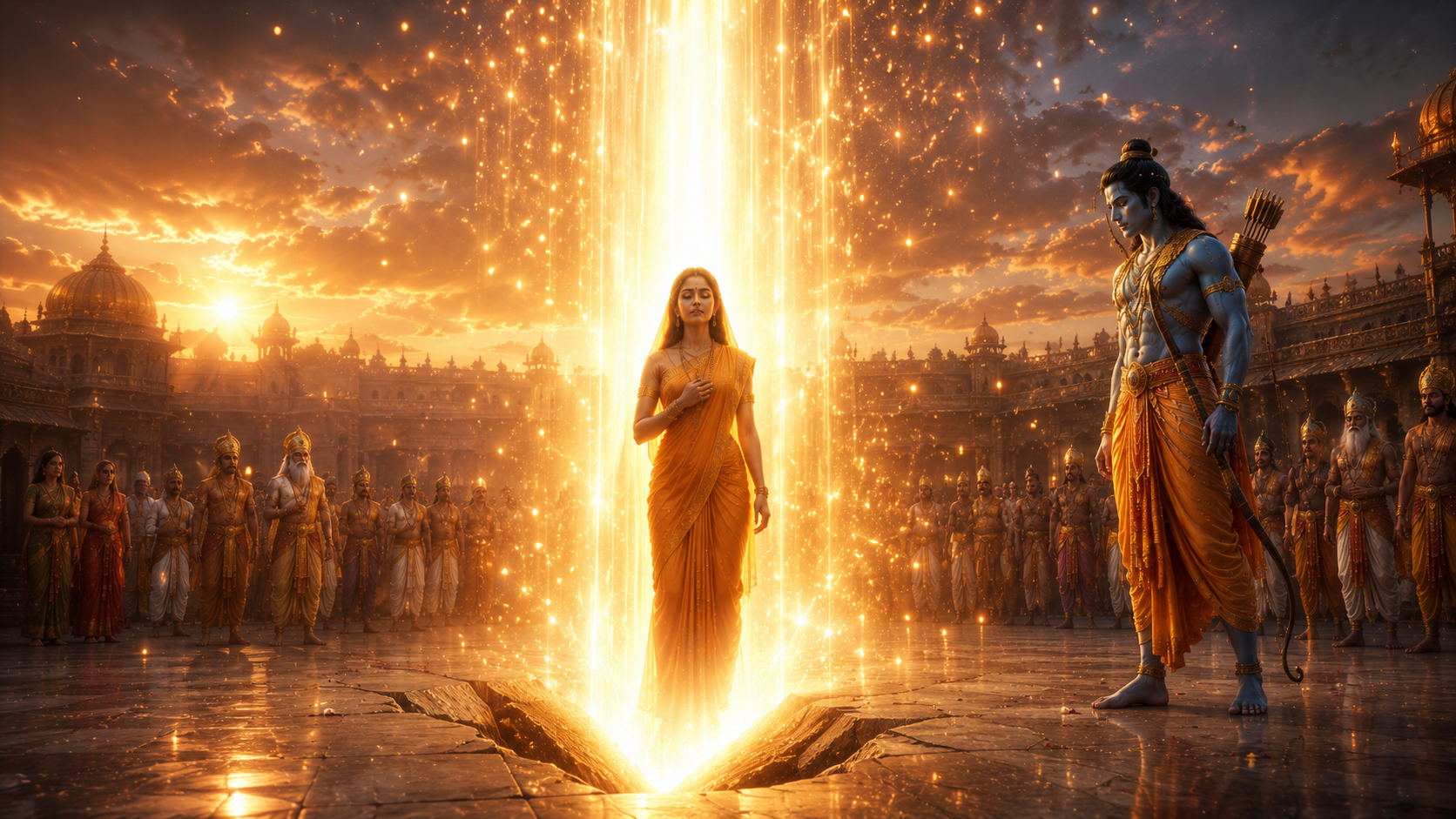
Rather than undergo another public trial, Sita calls on the earth itself to bear witness — and it opens to receive her.
Sita's Return to the Earth
Rama, having recognized his sons, asks Sita to return to Ayodhya and, once again, to prove her purity publicly before the court. This time Sita does not submit to a further ordeal. She calls instead upon her mother, the earth goddess Bhumi — from whom, in the tradition, she was originally found rather than born in the ordinary sense — declaring that if she has been entirely faithful in thought as well as deed, the earth itself should receive her. The ground opens, and Bhumi rises to take Sita down into the earth, ending her life among mortals not through death by violence or grief but through a willed return to her own origin — read by most of the tradition as a final and complete vindication, delivered on her own terms rather than granted through another trial.
Rama's Own Departure
The kanda closes with the end of Rama's own reign. In time, his brothers die by various means, and Rama, his earthly purpose fulfilled, walks into the river Sarayu accompanied by the people of Ayodhya who choose to follow him, returning to his identity as Vishnu as the waters close over him. It is, in the tradition's own reading, not a death in the ordinary sense but a conscious return — the avatara's task, begun with a broken bow at Mithila, ending in a river outside the city where it began.
This closes the seven-kanda account of Rama's avatara. Taken as a whole, it is a story that resists a single simple reading — a lifetime of promises kept at real cost, alongside decisions, particularly toward Sita, that the tradition itself has argued over for centuries without final resolution. That unresolved quality is presented here deliberately rather than smoothed away. Krishna, the avatara that follows, will draw on Rama's example of dharma-bound kingship while operating at a scope — teacher, statesman, and warrior together — that the tradition regards as the fullest single expression of the entire avatara doctrine.
References
Primary Sources
- Valmiki Ramayana, Uttara Kanda, chapters 42–49 — the rumor and Sita's second exile.
- Valmiki Ramayana, Uttara Kanda, chapters 50–66 — the hermitage years, the Ashvamedha, and the reunion.
- Valmiki Ramayana, Uttara Kanda, chapters 97–99 — Sita's return to the earth.
- Valmiki Ramayana, Uttara Kanda, chapters 108–111 — Rama's own departure.
Secondary Sources
- Goldman, Robert P., and Sally J. Sutherland Goldman (eds.). The Ramayana of Valmiki: Uttarakanda. Princeton University Press, 2016 — including extensive discussion of the kanda's textual history and disputed authorship.
- Brockington, John. The Sanskrit Epics. Brill, 1998 — for the dating and textual-layer arguments regarding the Bala and Uttara Kandas.
- Richman, Paula (ed.). Many Ramayanas and Questioning Ramayanas. University of California Press, 1991 and 2001 — for the range of classical and modern critical responses to Sita's second exile.
- Mani, Vettam. Puranic Encyclopaedia. Motilal Banarsidass, 1975. Entries: "Sita," "Luv," "Kusha," "Valmiki."
The disputed canonicity of this kanda, and the extensive critical history surrounding Sita's second exile, are treated here as established facts about the text's reception rather than as this project's own editorial position.