

With Dwaraka established at the close of the previous chapter, this one covers Krishna's expanding role as a political and marital power across Bharatavarsha's ruling houses — a period that ends with him drawn directly into the disputes that will eventually erupt at Kurukshetra.
Rukmini's Marriage
Rukmini, princess of Vidarbha, sends Krishna a secret message before her own swayamvara: her brother Rukmi has arranged her marriage to Shishupala, king of Chedi, against her wishes, and she asks Krishna to abduct her from the ceremony itself before the marriage can be completed — a request the tradition treats as her own decisive act of agency rather than a passive rescue. Krishna arrives, takes her from the assembly in his chariot, and defeats the pursuing forces sent after them, including Rukmi himself, whom Krishna spares at Rukmini's direct intercession but marks with a public humiliation — shaving his head and beard — rather than killing him outright.
| Figure | Role in This Chapter |
|---|---|
| Rukmini | Princess of Vidarbha, arranges her own abduction to avoid a forced marriage to Shishupala |
| Satrajit & Satyabhama | Owner of the Syamantaka jewel and his daughter, later one of Krishna's principal wives |
| Jambavan & Jambavati | The bear-king who briefly duels Krishna over the jewel, and his daughter, also later married to Krishna |
| Narakasura | Asura king who imprisons 16,100 princesses, defeated by Krishna and Satyabhama |
| Shishupala | King of Chedi, killed by Krishna at Yudhishthira's Rajasuya sacrifice |
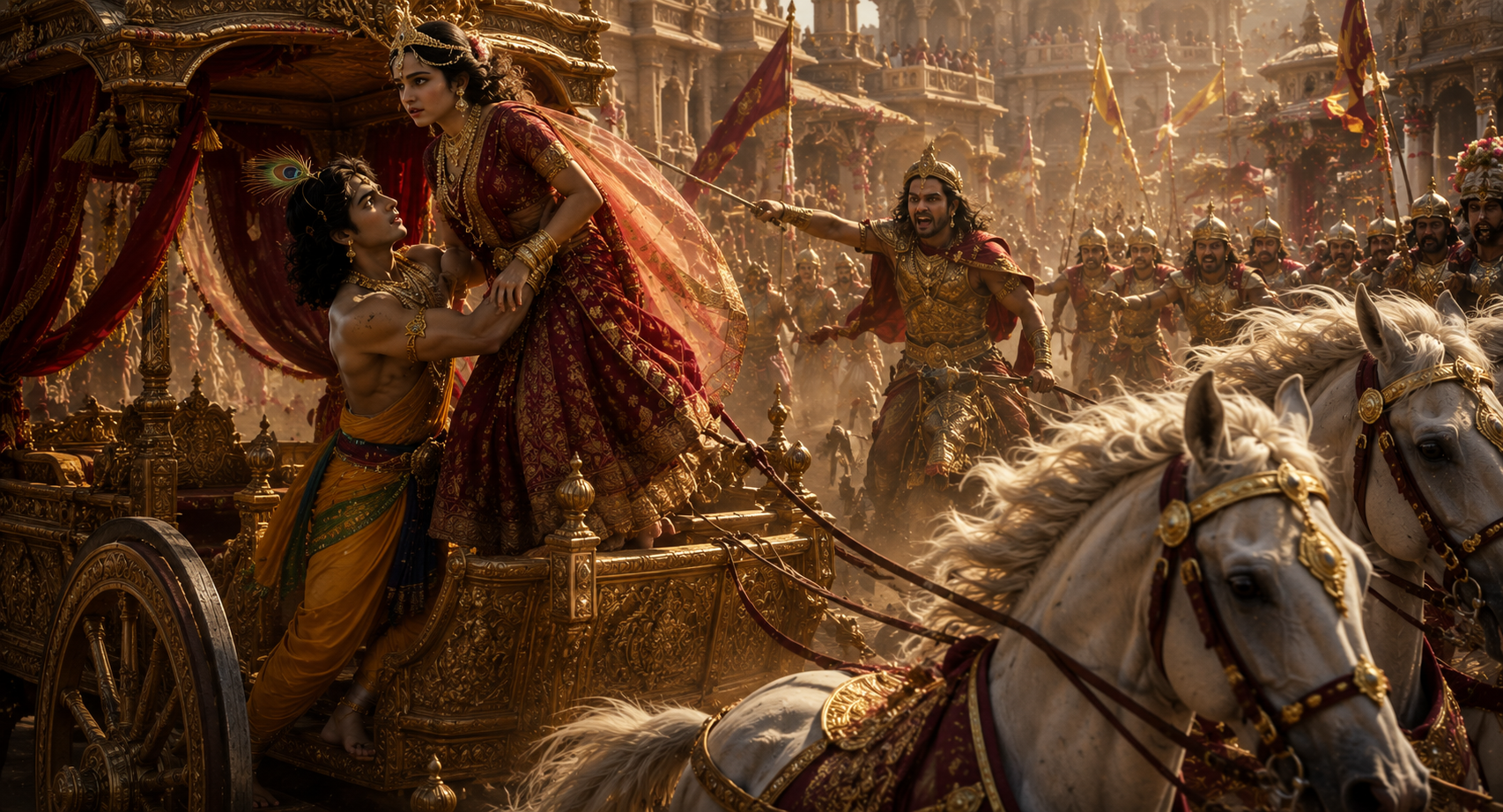
Rukmini's marriage begins with her own letter and her own request — agency the text preserves throughout the episode.
The Syamantaka Jewel
A separate episode centers on the Syamantaka, a radiant jewel gifted to the nobleman Satrajit by the sun-god Surya, said to produce gold and ward off calamity wherever it is properly maintained. When the jewel disappears along with its keeper, suspicion falls unjustly on Krishna, prompting him to track it down himself to clear his name — a rare instance of Krishna needing to prove his own innocence rather than judge someone else's. The trail leads to the bear-king Jambavan, who is found to possess the jewel and, after an extended duel with Krishna lasting many days, recognizes his opponent's true identity and yields, offering both the jewel and his daughter Jambavati in marriage as reconciliation. Satrajit, informed of the truth, offers his own daughter Satyabhama's hand as well, along with the jewel itself, in apology for his earlier suspicion.

A duel fought to clear Krishna's own name — an unusual position for an avatara more often shown judging others.
Narakasura and the Rescued Princesses
Narakasura, an asura king ruling from Pragjyotisha, has by this point in the story accumulated vast oppressive power, including the imprisonment of 16,100 princesses seized or coerced from ruling houses across the region. Krishna, accompanied by Satyabhama — who takes an active combat role in several tellings rather than a passive one — defeats Narakasura and frees the captive women. Recognizing that their captivity has left them without secure social standing to return to, Krishna marries all of them himself, an act the tradition presents as restoring their dignity and protection rather than as a conventional romantic union.

The 16,100 marriages that follow are presented in the sources as social protection, a framing addressed directly below.
The figure of 16,100 wives, and Krishna's mass marriage to Narakasura's freed captives, is one of the more frequently discussed numerical details in his story. Traditional commentary reads the marriages as a social and legal solution to a real problem the narrative itself identifies — women whose captivity would otherwise have left them without standing or protection in a society that placed heavy weight on marital status — rather than as a literal romantic harem in the way the number might suggest to a modern reader unfamiliar with that context. Some modern scholarship treats the number itself as symbolic or formulaic (echoing large round numbers used elsewhere in the Puranic corpus) rather than a literal historical count. This article presents the episode with both the tradition's own stated reasoning and this later interpretive caution, rather than only the more striking surface number.
Shishupala and the Rajasuya
Krishna's growing political standing draws him into the affairs of the wider Kuru dynasty when Yudhishthira, eldest of the Pandavas, performs the Rajasuya sacrifice to affirm his sovereignty, with Krishna presiding over its central rite of honor. Shishupala, the king Rukmini was originally meant to marry and a long-standing rival of Krishna's, publicly objects to the honor shown him and hurls a lengthy string of insults. Krishna, who had promised Shishupala's own mother he would forgive up to one hundred offenses before responding, kills him with the Sudarshana Chakra once the hundredth insult is spoken — an act framed in the text as restraint exhausted rather than impulsive violence, and one that draws Krishna directly and permanently into the Pandava-Kaurava rivalry that will culminate at Kurukshetra.
Shishupala's death at the Rajasuya marks Krishna's formal entry into the political conflict between the Pandavas and Kauravas — a conflict the next chapter follows to its full and catastrophic conclusion at Kurukshetra.
References
Primary Sources
- Bhagavata Purana 10.52–10.54 — Rukmini's marriage.
- Bhagavata Purana 10.56 — the Syamantaka jewel.
- Bhagavata Purana 10.59 — the defeat of Narakasura and the freed princesses.
- Mahabharata, Sabha Parva, chapters 33–42 — the Rajasuya and the death of Shishupala.
Secondary Sources
- Mani, Vettam. Puranic Encyclopaedia. Motilal Banarsidass, 1975. Entries: "Rukmini," "Satyabhama," "Narakasura," "Shishupala."
- Hiltebeitel, Alf. Rethinking the Mahabharata: A Reader's Guide to the Education of the Dharma King. University of Chicago Press, 2001 — for the Rajasuya and Shishupala's death in the wider Mahabharata narrative.
The mass-marriage detail following Narakasura's defeat is presented with the tradition's own social reasoning alongside later interpretive caution about the number itself.