
This chapter covers the failed peace mission, Krishna's role as Arjuna's non-combatant charioteer, the Bhagavad Gita's teaching, and the war's most strategically decisive — and most ethically debated — turning points, each addressed directly rather than passed over.
The Peace Mission
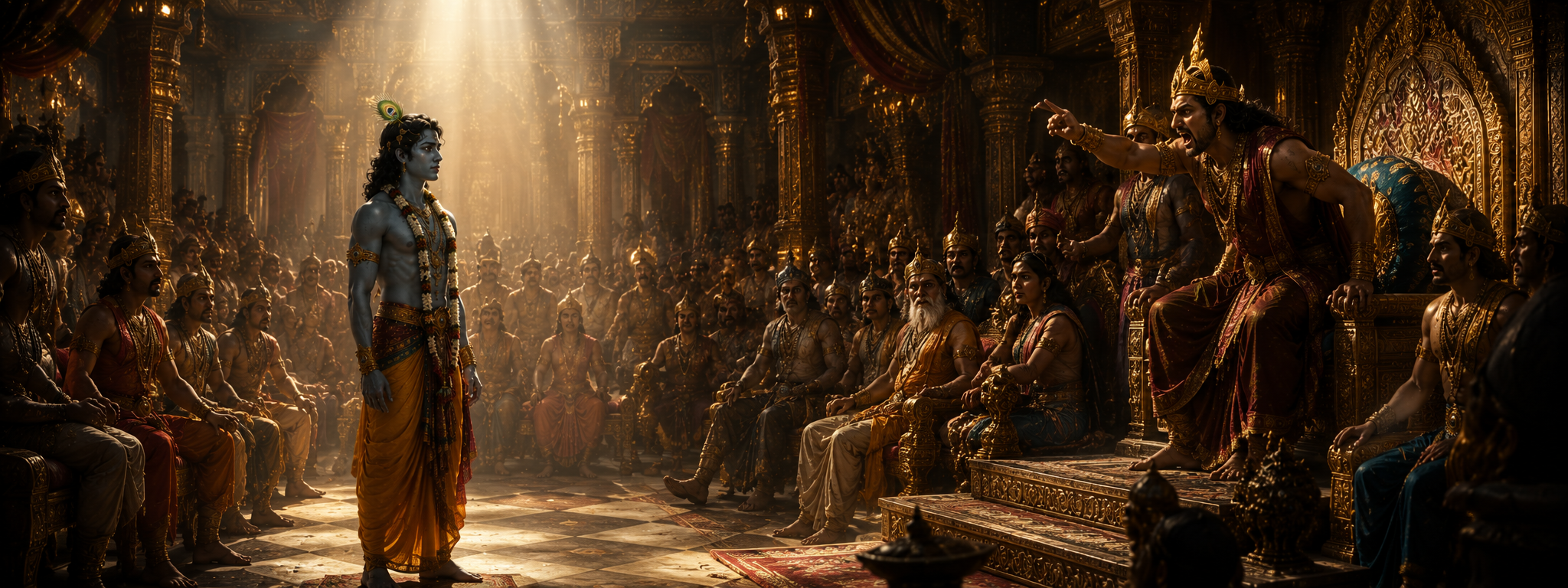
Before the war, Krishna travels to Hastinapura as the Pandavas' envoy, offering Duryodhana a settlement so minimal it is difficult to read as anything but a genuine last attempt at peace: just five villages, one for each Pandava brother, in place of the kingdom's rightful half. Duryodhana refuses outright, declaring he will not yield land "even enough to fit on the point of a needle" without war. When he moves to have Krishna seized in violation of diplomatic protocol, Krishna reveals a portion of his Vishvarupa — the cosmic, universal form — filling the hall with a vision of overwhelming divine scale that ends the confrontation without violence, though not the coming war itself. Krishna returns to the Pandavas having exhausted every peaceful option available to him.
| Figure | Role in This Chapter |
|---|---|
| Duryodhana | Kaurava prince, rejects Krishna's peace offer outright |
| Arjuna | Pandava warrior, chooses Krishna over the Narayani Sena, receives the Gita's teaching |
| Bhishma | Kuru patriarch, bound by his own vow of near-invincibility, dies with Krishna's indirect involvement |
| Drona | Teacher to both sides, dies after a deliberately ambiguous report of his son's death |
| Karna | Kaurava commander, killed while disarmed and vulnerable at Krishna's urging |
The Choice Before the War
Before battle lines are drawn, both Duryodhana and Arjuna separately approach Krishna to request his support, and he offers each the same choice: one may have the Narayani Sena, his vast personal army, fully armed and ready to fight; the other may have Krishna himself, alone and unarmed, on the condition that he will not personally wield a weapon in the war. Duryodhana, given first choice as the one who arrived first but spoke second out of deference, takes the army without hesitation. Arjuna chooses Krishna — a decision the text frames as wisdom rather than a poor bargain, since it places Krishna directly at the Pandavas' side for the entire war as counselor and charioteer, even bound by his own vow not to fight.
The Bhagavad Gita
As the armies stand ready on the battlefield, Arjuna, surveying kin, teachers, and friends arrayed against him on both sides, is overcome with despair and lowers his bow, unwilling to fight a war that will require killing people he loves and reveres. Krishna's response — delivered entirely from the chariot between the two armies before a single arrow is loosed — becomes the Bhagavad Gita: a sustained teaching on duty performed without attachment to its results (nishkama karma), the imperishability of the soul across bodily death, and several complementary paths toward liberation, including disciplined action, devotion, and knowledge. At the discourse's climax, Krishna reveals his full Vishvarupa to Arjuna directly — an overwhelming vision of all creation contained within him simultaneously, terrifying as much as it reassures, after which Arjuna, resolved, takes up his bow.
"You have the right to your actions, but never to the fruits of those actions. Do not let the fruits of action be your motive, nor let your attachment be to inaction."
Bhagavad Gita, Chapter 2, Verse 47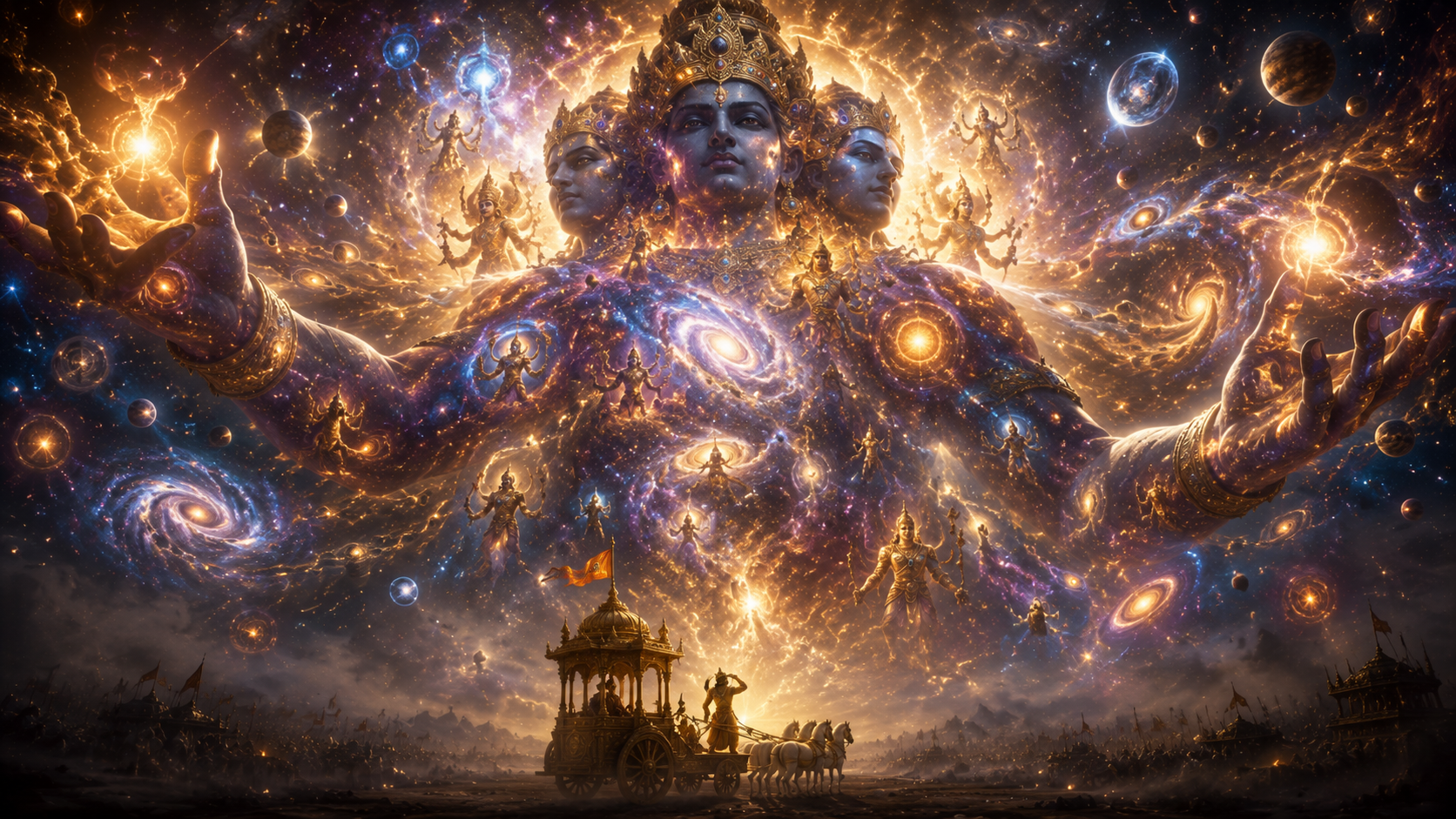
The vision that resolves Arjuna's despair — not an argument alone, but a direct revelation of scale.
The War's Turning Points
Bound by his vow not to fight directly, Krishna's role in the war itself is that of strategist and counselor rather than combatant — a role that puts him at the center of several of the war's most consequential and most debated decisions.
Bhishma
Bhishma, bound by his own vow of near-total invincibility and reluctant to kill his beloved grandnephews, fights without full commitment for days, prolonging the war. When Arjuna hesitates to press the attack, Krishna — in several tellings — nearly breaks his own vow and moves to attack Bhishma himself, stopped only by Arjuna's renewed promise to fight in earnest. Bhishma's eventual fall comes through the intervention of Shikhandi, a warrior Bhishma refuses to fight due to a vow from an earlier life; Arjuna uses Shikhandi's presence as cover to strike Bhishma down, a tactic Krishna advises.
Drona
Drona, teacher to both sides and a formidable commander for the Kauravas, proves nearly unstoppable until Krishna devises a plan turning on his devotion to his son Ashwatthama. An elephant named Ashwatthama is killed in battle, and Yudhishthira — renowned across the epic for absolute truthfulness — is persuaded to announce "Ashwatthama is dead," adding "man or elephant" in a deliberately inaudible undertone. Drona, believing his son has died, lays down his weapons in grief and is killed by Dhrishtadyumna. This episode is among the most extensively discussed moral turning points in the entire epic, and is addressed directly in the note below.
Jayadratha
Arjuna vows to kill Jayadratha, responsible for events leading to his son Abhimanyu's death, before sunset or die by his own fire — a vow the Kauravas exploit by shielding Jayadratha until the day nearly runs out. Krishna, using his discus to briefly obscure the sun and simulate an early sunset, draws Jayadratha out from hiding in apparent safety, at which point the real sun reappears and Arjuna kills him within the vow's true deadline.
Karna
Karna, whose formidable skill is offset across the war by a series of curses — including, in this project's Parashurama chapter, the curse that his own teacher's training would fail him at his moment of greatest need — finds his chariot wheel sunk in the battlefield mud during his climactic duel with Arjuna. Disarmed and struggling to free the wheel, he calls on the rules of war that should grant a shieldless, weaponless combatant safety; Krishna, over Arjuna's own hesitation, urges him to shoot regardless, citing Karna's own earlier participation in the unfair killing of the underage Abhimanyu as forfeiting that same protection. Arjuna kills him at Krishna's urging.
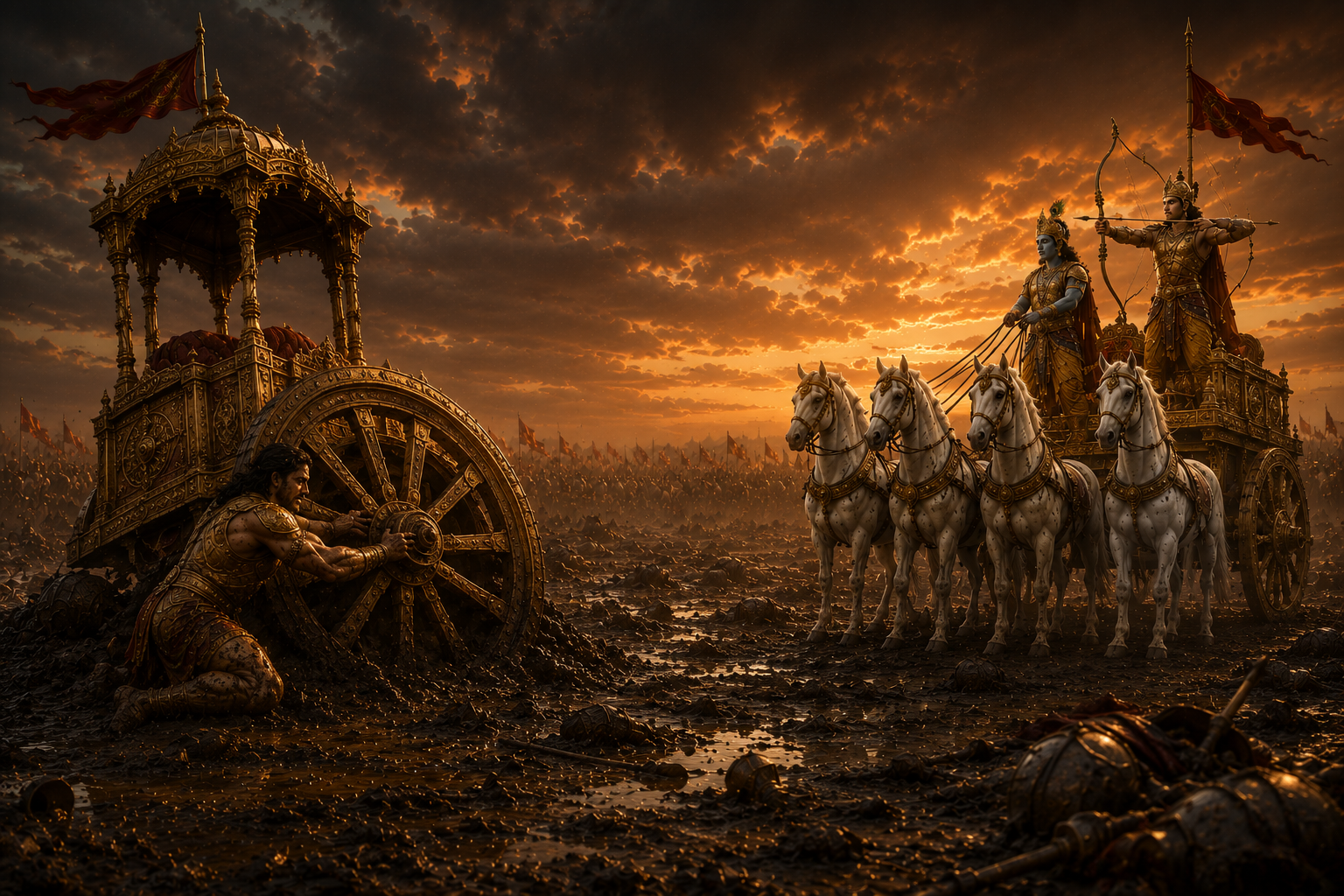
Krishna's counsel here, like several others in this chapter, is presented with its own justification and its long history of critical debate.
Ghatotkacha
Late in the war, Karna deploys the Shakti weapon — a single-use divine spear he had been saving specifically for Arjuna — against Bhima's son Ghatotkacha instead, when the Rakshasa warrior's rampage threatens to overwhelm the Kaurava army by night. Krishna, watching Ghatotkacha fall, expresses open relief rather than grief, recognizing that the weapon meant for Arjuna has now been permanently spent — a moment the text presents candidly as Krishna prioritizing Arjuna's survival and the war's eventual outcome over open mourning for an ally's death.
The wartime interventions described above — particularly Drona's death and Karna's — are collectively the most sustained site of ethical debate surrounding Krishna anywhere in the Mahabharata, discussed at length within the epic's own text as well as by classical commentators and modern scholars alike. The Mahabharata does not present these moments as uncomplicated victories: Yudhishthira's guilt over his role in Drona's death is given real weight in the narrative that follows, and Karna's death has been read by generations of commentators and audiences as tragic even where Krishna's justification is accepted as strategically or morally necessary. Krishna's own defense, given at various points in the text, rests on a consistent logic — that the Kauravas had already broken the conventions of righteous warfare first (Abhimanyu's death chief among the examples cited), and that ending a catastrophic war decisively outweighed strict adherence to combat protocol once that threshold had been crossed. This project presents that justification alongside the discomfort it has generated across the tradition's own history, rather than treating either the justification or the discomfort as final.
The war ends with the Kaurava line destroyed and the Pandavas victorious, but the peace that follows is fragile and short-lived. The final chapter of Krishna's story covers the curse that follows the war's end, and the years that lead to Dwaraka's own destruction and Krishna's death.
References
Primary Sources
- Mahabharata, Udyoga Parva — the peace mission and the choice between Krishna and the Narayani Sena.
- Bhagavad Gita (Mahabharata, Bhishma Parva, chapters 23–40) — the complete teaching.
- Mahabharata, Bhishma Parva, chapters 108–120 — Bhishma's fall.
- Mahabharata, Drona Parva, chapters 190–200 — Drona's death.
- Mahabharata, Drona Parva, chapters 121–145 — Jayadratha's death.
- Mahabharata, Karna Parva, chapters 66–90 — Karna's death.
- Mahabharata, Drona Parva, chapters 178–182 — Ghatotkacha's death.
Secondary Sources
- Hiltebeitel, Alf. Rethinking the Mahabharata. University of Chicago Press, 2001.
- Matilal, Bimal Krishna. "Krsna: In Defence of a Devious Divinity." In Essays on the Mahabharata, ed. Arvind Sharma. Brill, 1991 — a sustained scholarly treatment of the ethical debates surrounding Krishna's wartime counsel.
- Mani, Vettam. Puranic Encyclopaedia. Motilal Banarsidass, 1975. Entries: "Krishna," "Bhagavad Gita," "Drona," "Karna."
The ethical debate surrounding Krishna's wartime counsel is treated here as a documented feature of the epic's own reception across centuries, not resolved in favor of either the justification or the criticism.