
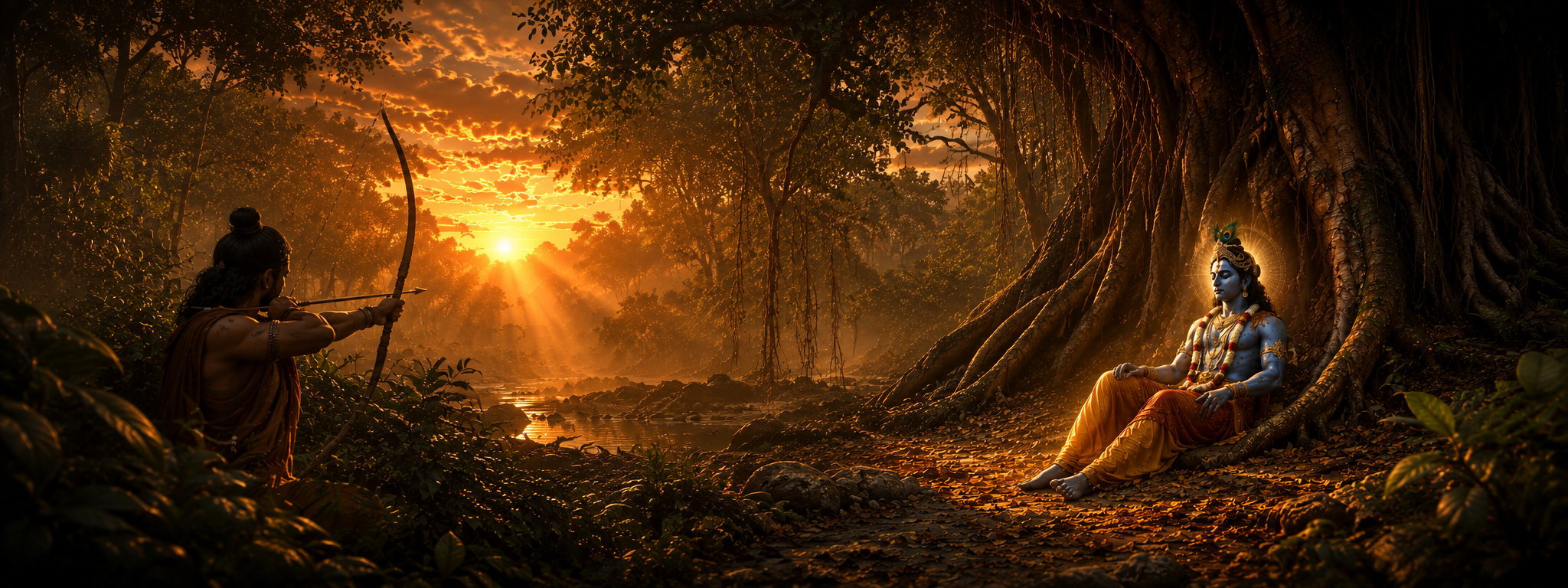
This final chapter carries Krishna's story from the war's immediate aftermath through thirty-six years of relative peace to the self-destruction of his own clan and his own quiet death — an ending the tradition frames not as tragedy imposed from outside, but as a fate Krishna accepts and, in several readings, has already willed.
Gandhari's Curse
In the war's immediate aftermath, Gandhari, mother of the hundred slain Kaurava princes, confronts Krishna directly, holding him responsible for failing to prevent a war he had the power and the foresight to stop. In her grief she curses him: that thirty-six years hence, his own Yadu clan will destroy itself in the same kind of internecine slaughter that consumed her sons, and that he himself will die alone, unmourned, in the forest, struck down as if by accident rather than in the field of a war fitting his stature. Krishna, remarkably, accepts the curse without protest or defense — several tellings make explicit that the fate Gandhari pronounces is one he had already foreseen and, in some sense, already intended for himself, treating her curse less as an external imposition than as confirmation of a course already set.
| Figure | Role in This Chapter |
|---|---|
| Gandhari | Mother of the Kauravas, pronounces the curse that shapes the rest of this chapter |
| Samba | Krishna's son, at the center of the mocking prank that provokes the Mushala prophecy |
| Balarama | Krishna's elder brother, departs in serpent form shortly before Krishna's own death |
| Jara | The hunter whose mistaken arrow kills Krishna |
The Mushala Prophecy
Decades later, with Dwaraka prosperous and the Yadu clan's younger generation grown increasingly indulgent, a group of sages visiting the city are mocked by a party of drunken young princes, who dress Krishna's son Samba as a pregnant woman and ask the sages, as a joke, to prophesy the "child's" gender. The sages, recognizing the insult, respond in earnest: Samba, they say, will give birth to an iron mace that will bring about the destruction of the entire Yadu line. When an iron mace duly appears, Krishna orders it ground to powder and cast into the sea to avert the prophecy — but the powder washes ashore as sharp-edged reed grass, and a single fragment is swallowed by a fish, later caught and cut open by a hunter who fashions its iron sliver into an arrowhead.
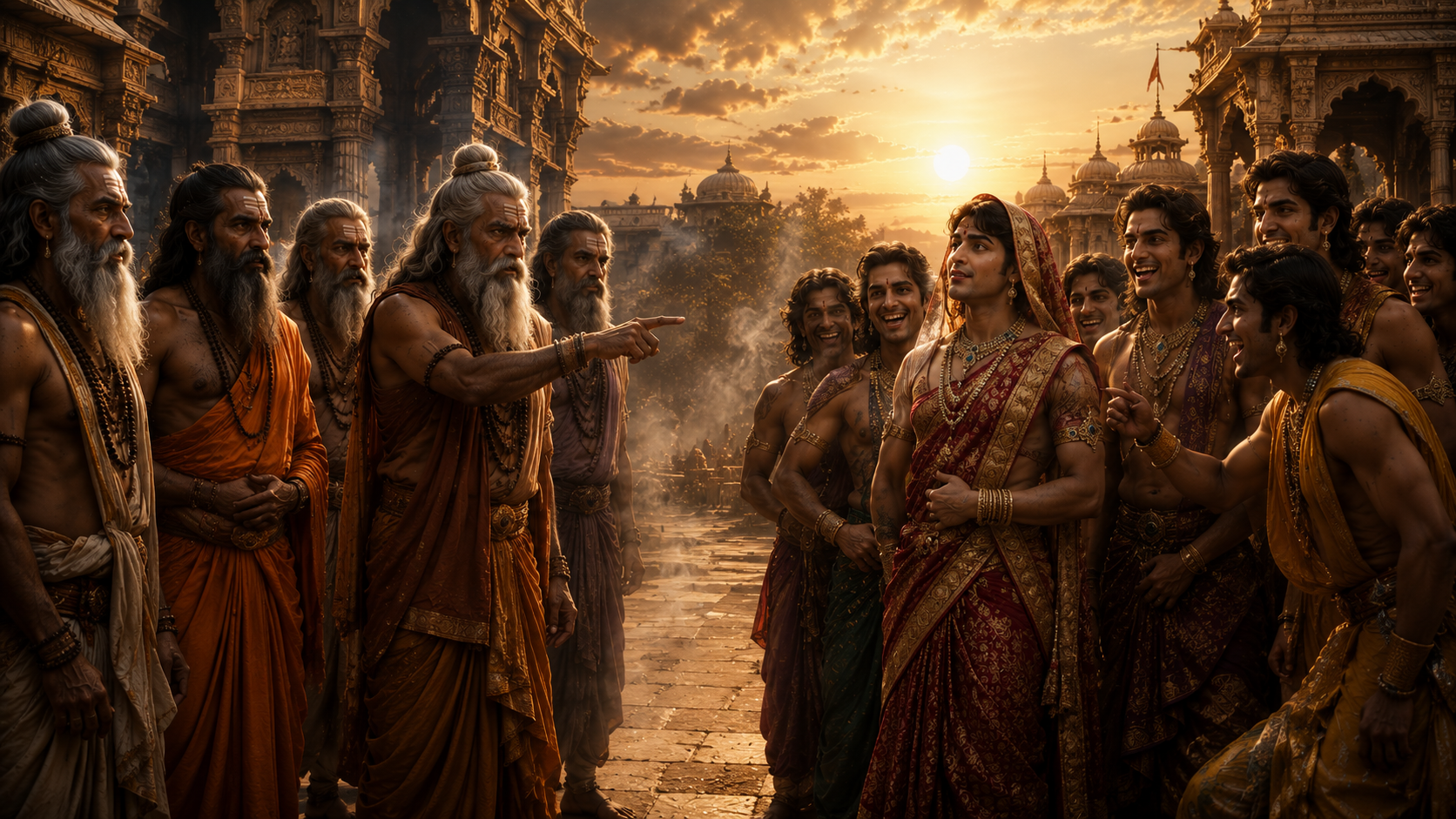
A moment of careless mockery sets in motion the destruction the rest of this chapter follows.
Balarama's Departure
Sensing the approaching end, Balarama withdraws alone to a quiet stretch of shore near Dwaraka and enters deep meditation. From his mouth emerges a great white serpent — Shesha, the cosmic serpent Balarama is understood to be an incarnation of — which returns directly to the ocean, Balarama's mortal body left behind as his true form departs ahead of his brother's own death by only a short span.

Balarama's presence has run through every chapter of this account; his quiet departure here closes that thread.
The Destruction at Prabhasa
At a festival gathering on the shore at Prabhasa, old grievances among the Yadu clan's younger generation resurface, fueled by drink, and a brawl erupts. Krishna, attempting to avert exactly this outcome, had earlier ordered conventional weapons removed from the gathering — but the cursed reed grass grown from the mushala's scattered powder lies along the shore in abundance, and the fighting escalates into a full massacre using it as improvised weaponry. Krishna, initially trying to separate the combatants, is eventually drawn into the fighting himself once his own sons are threatened, and by the time the violence ends, nearly the entire Yadu clan — the people he spent his life protecting, from Kamsa's threats in his own childhood through Jarasandha's invasions to this final self-inflicted catastrophe — lies dead.
Krishna's Death
In the aftermath, Krishna withdraws alone into the forest and sits in meditation beneath a tree, his foot resting among the fallen leaves. A hunter named Jara, glimpsing the reddish sole of Krishna's foot through the foliage and mistaking it for a resting deer, looses an arrow — tipped, in the fullest tellings, with the very iron fragment recovered from the fish that had swallowed a piece of the mushala. The arrow finds the one point of true vulnerability on Krishna's body. Rather than anger, Krishna's response to the mortified Jara is calm recognition and forgiveness; in most tellings he grants Jara a blessing before consciously releasing his body and returning to his eternal form as Vishnu.
The manner of Krishna's death closes a thread this project opened several avataras earlier. In the Kishkindha Kanda of the Rama avatara, the dying Vali — killed by Rama's arrow while fighting Sugriva, struck from concealment rather than in open challenge — rebukes Rama at length for the manner of his death. Several Puranic and epic traditions read Krishna's death at Jara's hands, struck without warning by an arrow aimed in error at his one vulnerable point, as the working-out of that same debt: the same being, in a later incarnation, meeting an end that echoes the grievance Vali raised centuries of story-time earlier. This project treats the connection as one the tradition itself draws rather than an invention of its own, and flags it as a rare instance of the Dashavatara's ten avataras being read as genuinely continuous rather than as ten separate stories.
Dwaraka Submerged
Word of the catastrophe reaches Arjuna, who travels to Dwaraka to find the city already beginning to disappear beneath the rising sea — within days of Krishna's departure, the ocean reclaims it entirely, leaving nothing behind. Arjuna gathers the surviving women, children, and elders of the Yadu clan and attempts to lead them to safety, but discovers along the journey that his own legendary strength and skill with the bow have diminished now that Krishna's presence no longer sustains it — the convoy is overwhelmed and scattered by bandits, a final, understated demonstration of how much of what the Pandavas achieved depended on Krishna directly rather than on their own power alone. The tradition marks these events as the close of Dvapara Yuga and the beginning of Kali Yuga, the current and final age before Kalki's prophesied arrival.
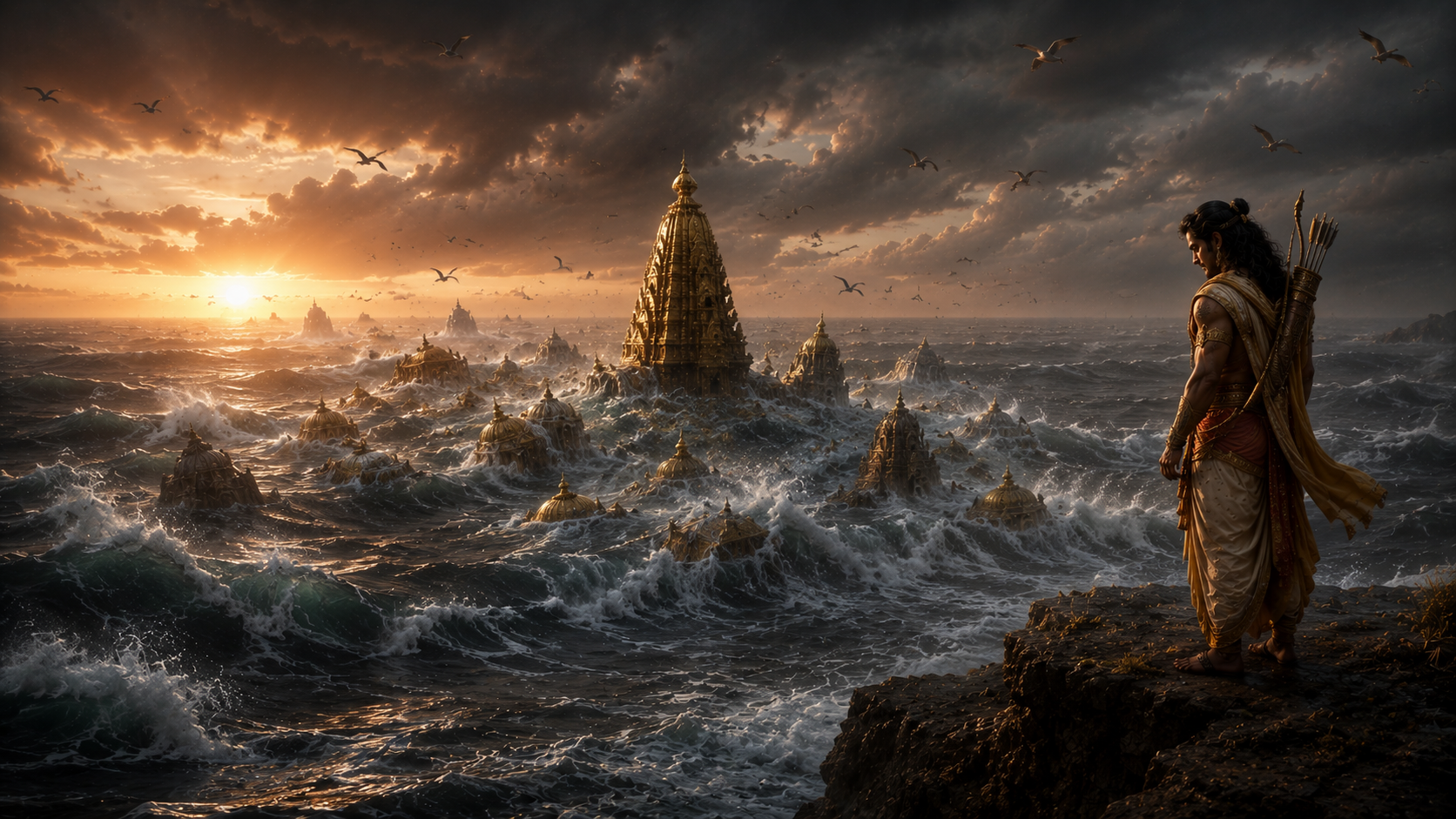
The city built to protect a people outlives its founder by only days.
This closes the five-chapter account of Krishna's avatara — the fullest, most varied single life in the entire Dashavatara, ending not in triumph but in a quiet forest death Krishna himself appears to have anticipated and accepted rather than resisted. The purna avatara's task complete, the sequence turns next to Buddha, where the emphasis shifts from statecraft and love to compassion and withdrawal — and where this project's decision to cover Balarama within Krishna's chapters, rather than as the ninth avatara in his own right, is explained in full.
References
Primary Sources
- Mahabharata, Stri Parva, chapter 25 — Gandhari's curse.
- Mahabharata, Mausala Parva, chapters 1–3 — the Mushala prophecy.
- Mahabharata, Mausala Parva, chapters 4–7 — the destruction at Prabhasa.
- Mahabharata, Mausala Parva, chapter 4, and Bhagavata Purana 11.30–11.31 — Krishna's death.
- Mahabharata, Mausala Parva, chapters 7–8 — Dwaraka's submersion and Arjuna's diminished strength.
- Bhagavata Purana 3.4 (Kishkindha Kanda cross-reference) — Vali's rebuke of Rama, relevant to the continuity note above.
Secondary Sources
- Mani, Vettam. Puranic Encyclopaedia. Motilal Banarsidass, 1975. Entries: "Gandhari," "Mausala," "Jara," "Dvaraka."
- Hiltebeitel, Alf. Rethinking the Mahabharata. University of Chicago Press, 2001 — for the Mausala Parva's place in the epic's larger structure.
The Vali-Krishna continuity note reflects a connection drawn within the Puranic and epic tradition itself, presented here as documented rather than as this project's own interpretive addition.