
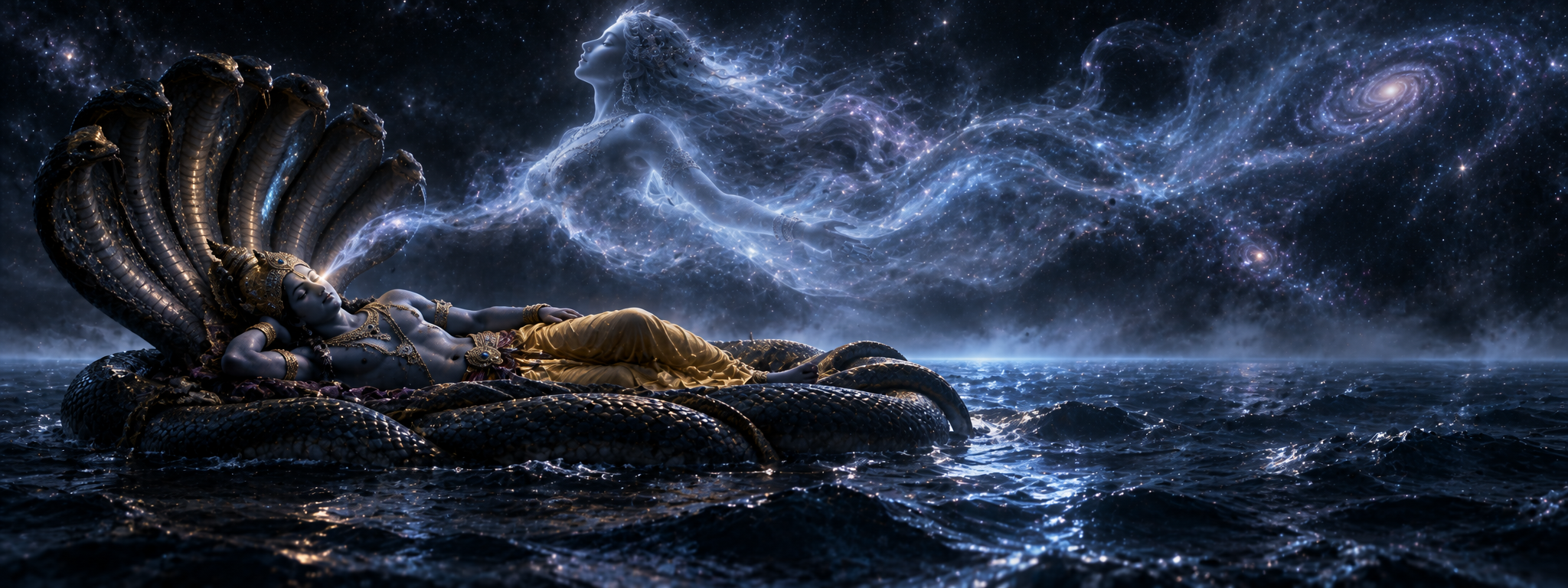
Every figure elsewhere in this series sits at the edge of the cosmology it's part of — a supporting cast member, however important, to a story that's fundamentally about something else. This one doesn't. She sits at the actual switch that turns the universe on and off, and the tradition doesn't treat that as incidental: one of the standard commentaries on the source text identifies her, in a single breath, with illusion, ignorance, and the Goddess herself.
Between Dissolution and Creation, Someone Has to Sleep
Between one cosmic cycle and the next, the tradition describes Vishnu resting on the coiled serpent Shesha, afloat on the cosmic ocean, in a state of deep sleep that isn't simply his own tiredness — it's a personified state in its own right, with a name: Yoganidra, also called Nidra. She is, at this point in the cycle, effectively occupying his closed eyes, holding the universe suspended in potential rather than active creation. Nothing moves until she moves.
The Madhu-Kaitabha Myth: When Sleep Has to Be Asked to Leave
The Devi Mahatmya, embedded within the Markandeya Purana, tells the story that puts Yoganidra's importance beyond doubt — told in full, as its own narrative, in this project's Three Charitas series, in The First Charita: The Madhu-Kaitabha War. As Vishnu sleeps, a lotus grows from his navel, and on it sits Brahma, beginning the work of creation. Two demons, Madhu and Kaitabha, emerge from Vishnu's own body and threaten to kill Brahma outright. Brahma's obvious solution — wake Vishnu — turns out to be impossible on his own authority, because Vishnu's sleep isn't simply biological; it's Yoganidra herself, occupying his eyes and keeping him under. Brahma has no choice but to turn to her directly: not command her, but praise and petition her, asking her to withdraw from Vishnu's form so that he can open his eyes and act.
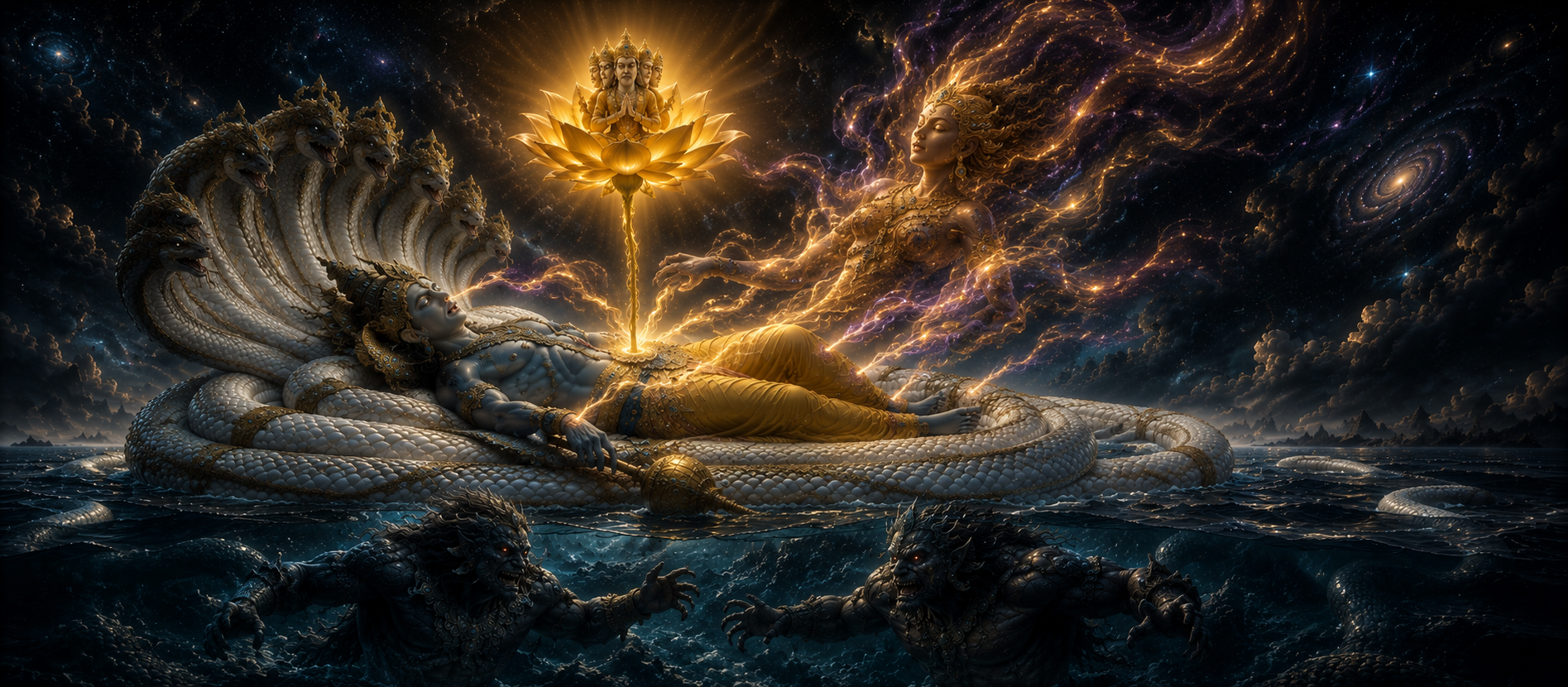
Brahma petitions Yoganidra to withdraw from Vishnu's eyes — the only way to wake him and save creation from Madhu and Kaitabha.
She withdraws. Vishnu wakes, and the ensuing battle with Madhu and Kaitabha runs on for an extraordinarily long time before Vishnu resorts to a trick: he offers the two demons any boon they desire, and in their arrogance they turn the offer back on him, telling him to ask something of them instead — at which point Vishnu asks only to be allowed to slay them in a place with no water. By then the great flood covering everything has receded enough that his own thighs are the only dry ground left in creation, and that is where Madhu and Kaitabha meet their end.
One Figure, Four Names
The commentarial tradition doesn't treat Yoganidra as a minor functionary who happens to control sleep. H. H. Wilson's notes on the Vishnu Purana describe her directly as "the active principle of illusion, personified, and also termed Maya and Mahamaya, also Avidya" — ignorance itself — and go on to identify her with Durga, with Shakti, with the Goddess in her fullest sense. That's four names converging on one figure: sleep, illusion, ignorance, and the Goddess, all naming the same presence depending on which angle the text approaches her from.
Sleep, illusion, ignorance, and the Goddess herself — one commentary names all four as the same figure, without treating that as remarkable.
Yogamaya: The Same Figure in a Different Story?
A separate figure, Yogamaya, does comparable work in the Bhagavata Purana's account of Krishna's birth. To protect the infant Krishna from Kamsa, who has been killing his sister's children on a prophecy that one of them will end him, the child born to Yashoda alongside Krishna in the same night is switched in a divinely arranged exchange — and when Kamsa seizes that child to kill it, it rises into the air as an eight-armed goddess, warns him that his true slayer already lives elsewhere, and vanishes. This figure is named Yogamaya.
Whether Yogamaya and Yoganidra are meant to be understood as the same figure operating in two different cosmic contexts, or as two related but distinct developments of the same underlying concept across different textual traditions, isn't something the sources settle cleanly, and this piece doesn't force a resolution either. What's consistent across both accounts is the function: a figure whose job is concealment and substitution in the service of a larger divine plan, intervening at exactly the moment a plan would otherwise be exposed or interrupted.
This series' Part I vice-genealogy contains its own figure named Maya — deceit, several generations down from Adharma, with no connection to cosmic illusion or the Goddess whatsoever. Wilson's commentary above uses "Maya" as one of Yoganidra's own names in a completely different register — cosmic illusion as a divine principle, not a personified vice. Same name, two entirely separate figures in two entirely separate registers of this series; the collision is coincidental, not a sign either account is mistaken.
Every other figure in this series illustrates one mechanism of personification — a genealogy invented, a phenomenon given a face, an existing god handed a new assignment. Yoganidra doesn't fit neatly into any single one of those categories, because she isn't peripheral to the cosmology she belongs to — she's the mechanism itself, the thing that has to move for the universe to resume. That she gets named, in the same breath, as illusion, ignorance, and the Goddess suggests the tradition wasn't trying to keep those concepts separate in the first place. Of everything catalogued in this entire series, this is the figure where the line between "an idea given a body" and "the body an idea already had" is hardest to draw.
The unrelated Maya of the vice-genealogy is covered in Part I, Two Trees, One Root: Dharma and Adharma. The Madhu-Kaitabha war itself is told in full in The First Charita: The Madhu-Kaitabha War, part of this project's Three Charitas series.
References
Primary Sources
- Devi Mahatmya (Markandeya Purana) — the full Madhu-Kaitabha episode, Brahma's petition to Yoganidra, and Vishnu's defeat of the two demons on his own thighs above the receding flood.
- H. H. Wilson's translation and commentary on the Vishnu Purana — for the direct identification of Yoganidra with Maya, Mahamaya, Avidya, and Durga/Shakti.
- Bhagavata Purana — the account of Yogamaya's role in the infant-exchange that protects Krishna from Kamsa, and her manifestation as an eight-armed goddess before Kamsa.
The relationship between Yoganidra and Yogamaya is presented here as the sources leave it — functionally similar, textually distinct — rather than resolved into a single continuous figure.