
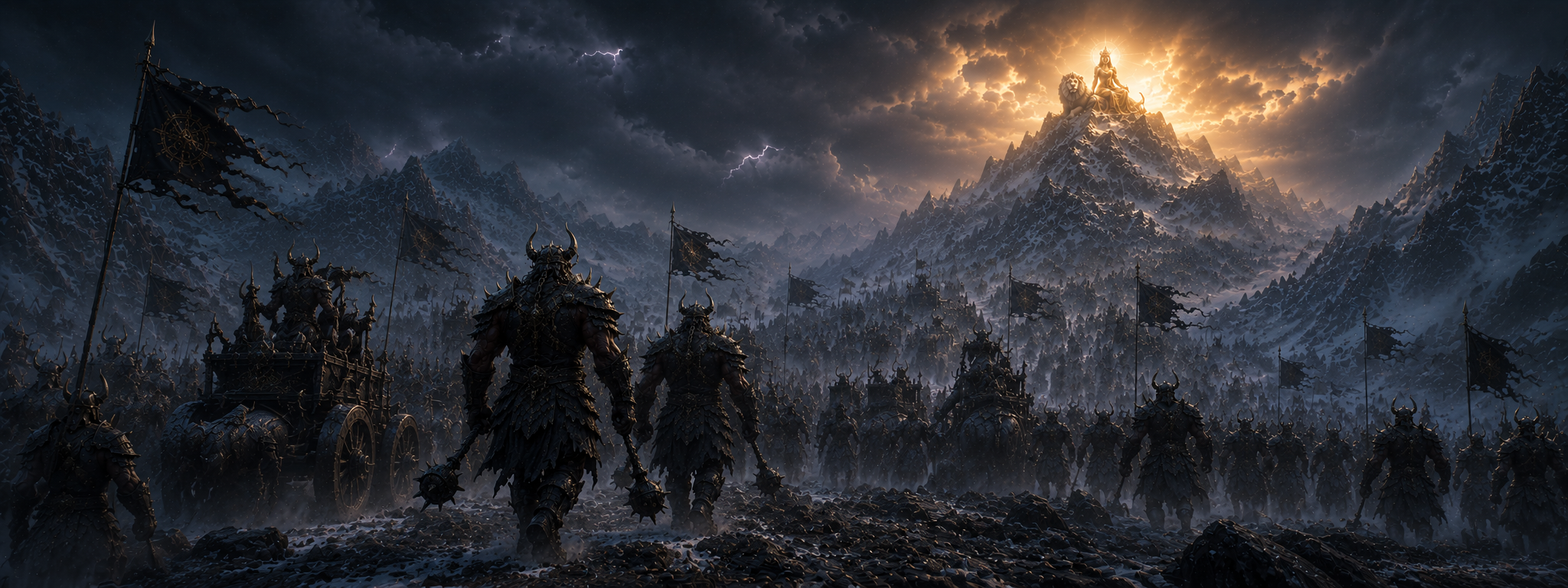
The war's second campaign ends with the goddess's composure breaking for the first time — and from that fracture emerges the single most consequential image in the entire Devi Mahatmya. Chanda and Munda, the very scouts who started this war with a beauty report, fall to the goddess they helped summon into being.
I. The Second March
Chanda and Munda climbed the same mountain Dhumralochana had climbed, but they did not make his mistake of underestimation — not because they had grown wiser, but because Shumbha had left them no room to. Their orders were explicit and considerably more violent than anything given before: bind the goddess and drag her by the hair if she would not come willingly; kill her outright if even that failed; and kill her lion as well. They came this time with a force large enough that the previous engagement's total destruction could plausibly be read as a fluke rather than a verdict.
There is a particular, quiet cruelty in the fact that Chanda and Munda are the demons sent to execute this order. They are the same two scouts whose breathless report of a beautiful woman on a mountain had begun the entire war in Act I. They had seen her once already, unarmed and at peace. They were now climbing back toward her with instructions to kill her if she so much as hesitated.
II. The Goddess's Fury
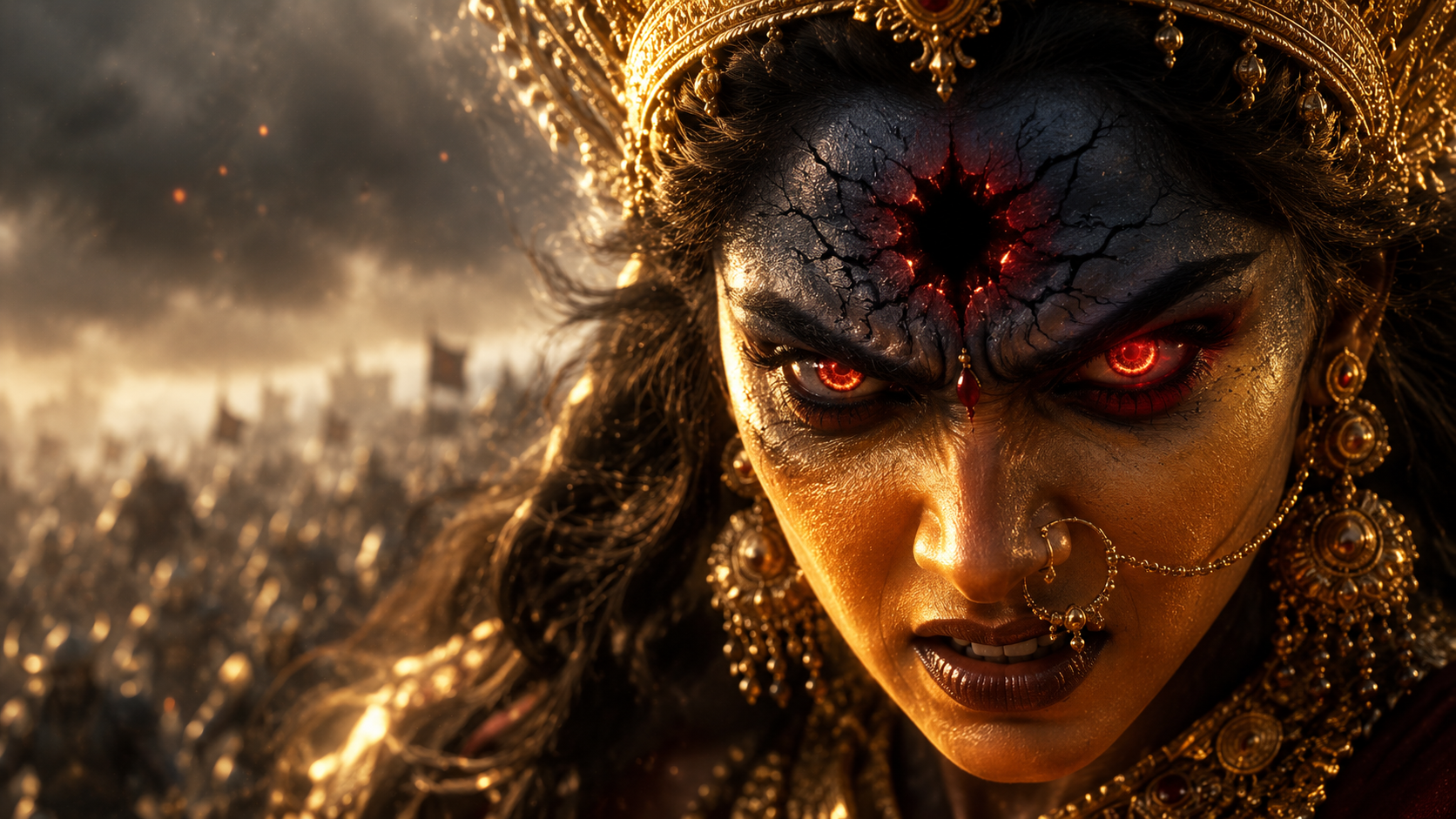
Kaushiki's countenance darkens with rage as Chanda and Munda's army closes — the instant before Kali is born.
For the first time in the war, the text shows us Kaushiki's composure actually breaking. Through the Dhumralochana campaign she had met annihilation with a gentle smile; here, watching the scale of the army climbing toward her and hearing the explicit order to kill her lion alongside her, something in her shifts. Her face darkens. Her brow contracts into a deep furrow — the text's specific word for which translators have rendered as a knot, a crease violent enough to seem almost like a wound opening rather than an expression forming.
And from that furrow — not from a sheath, not from any gentle process of division, but torn directly from the force of the goddess's own anger — a second goddess is born.
III. What Came From the Brow
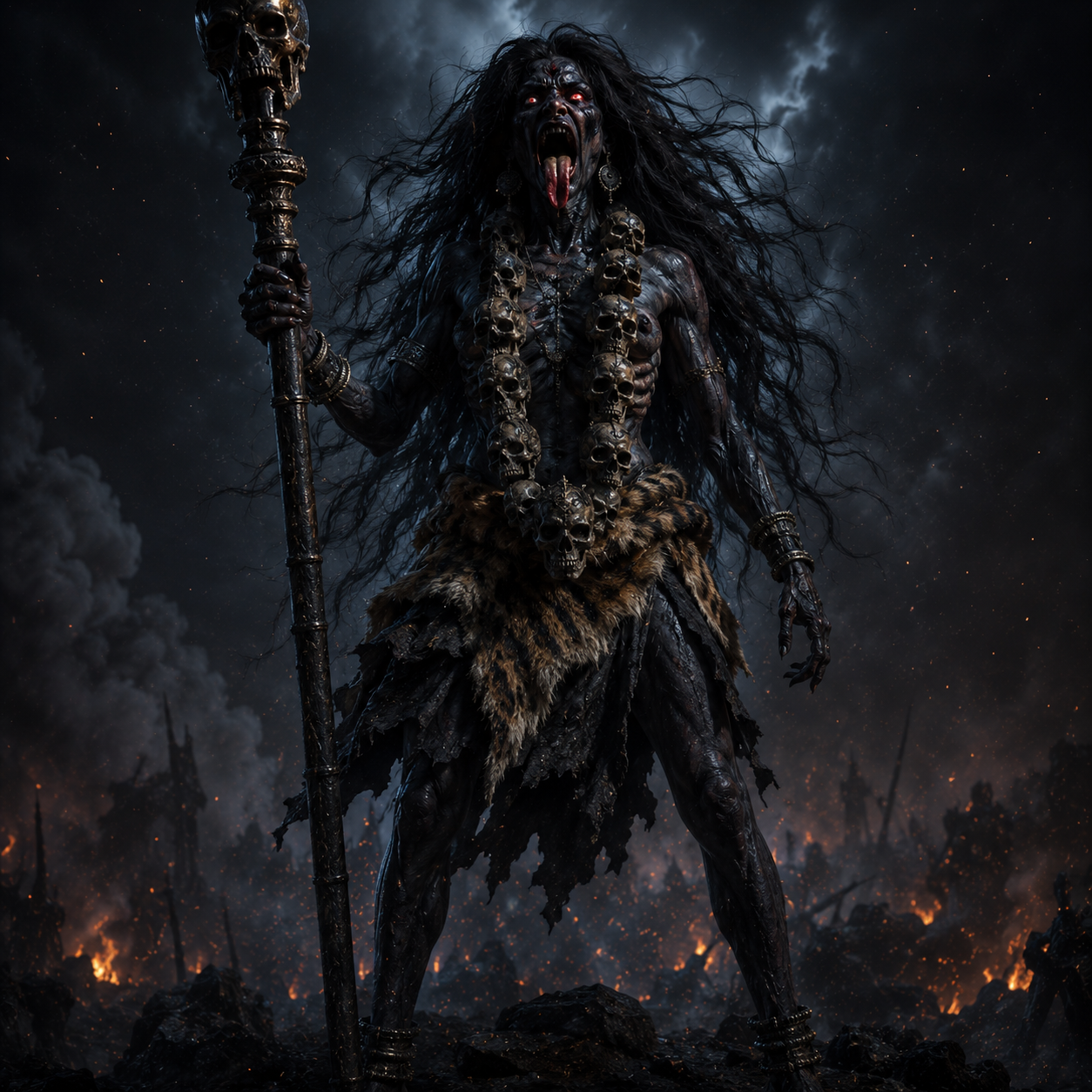
Kali, torn from Kaushiki's furrowed brow — gaunt, garlanded in skulls, and entirely unlike the goddess who produced her.
The Devi Mahatmya's description of this new goddess is one of the most vivid and frequently illustrated passages in the entire text. She emerges dark as collyrium, with a face frightful in appearance, armed with a skull-topped staff, draped in a tiger's skin, her body gaunt and emaciated to the point that her ribs and bones show plainly. Her mouth gapes wide, her tongue lolls out and downward, her eyes are deep-set and reddened, and the war-cry she gives upon emerging fills every direction of the compass at once.
This is Kali — not a new creation summoned from elsewhere, but a being torn directly out of Kaushiki's own anger. The furrowed-brow mechanism of birth becomes, in later iconography, one of the most recognisable visual shorthand devices for divine fury anywhere in Hindu art.
The Kali who appears here, born mid-battle from Kaushiki's fury, is one of several distinct origin-accounts for Kali across the Puranic corpus. The Devi Mahatmya itself elsewhere implies an older, independent Kali tradition that this episode draws on rather than originates. Later Tantric and Shakta literature elevates Kali to her own fully independent theology as one of the ten Mahavidyas, with iconography, mantra-tradition, and philosophical literature considerably larger than this single battlefield appearance.
IV. The Slaughter and the Beheading
What Kali does to Chanda and Munda's army is described with a relish that stands in deliberate, almost shocking contrast to the gentler emergence-narrative of Act I. She does not fight with weapons in any conventional sense — the text describes her seizing war-elephants, riders and all, and crushing them between her jaws. She devours soldiers whole, crushes others underfoot. Where Kaushiki's earlier battles had the controlled quality of a duel, Kali's rampage reads as something closer to a natural disaster given a hungry consciousness.
When Chanda came within reach, she seized him by the hair and severed his head with her sword in a single stroke. Munda met an equally direct end moments later. With both heads in her grip, Kali returned across the broken battlefield and laid the trophies at Kaushiki's feet — not as a report of victory delivered in words, but as a physical offering.
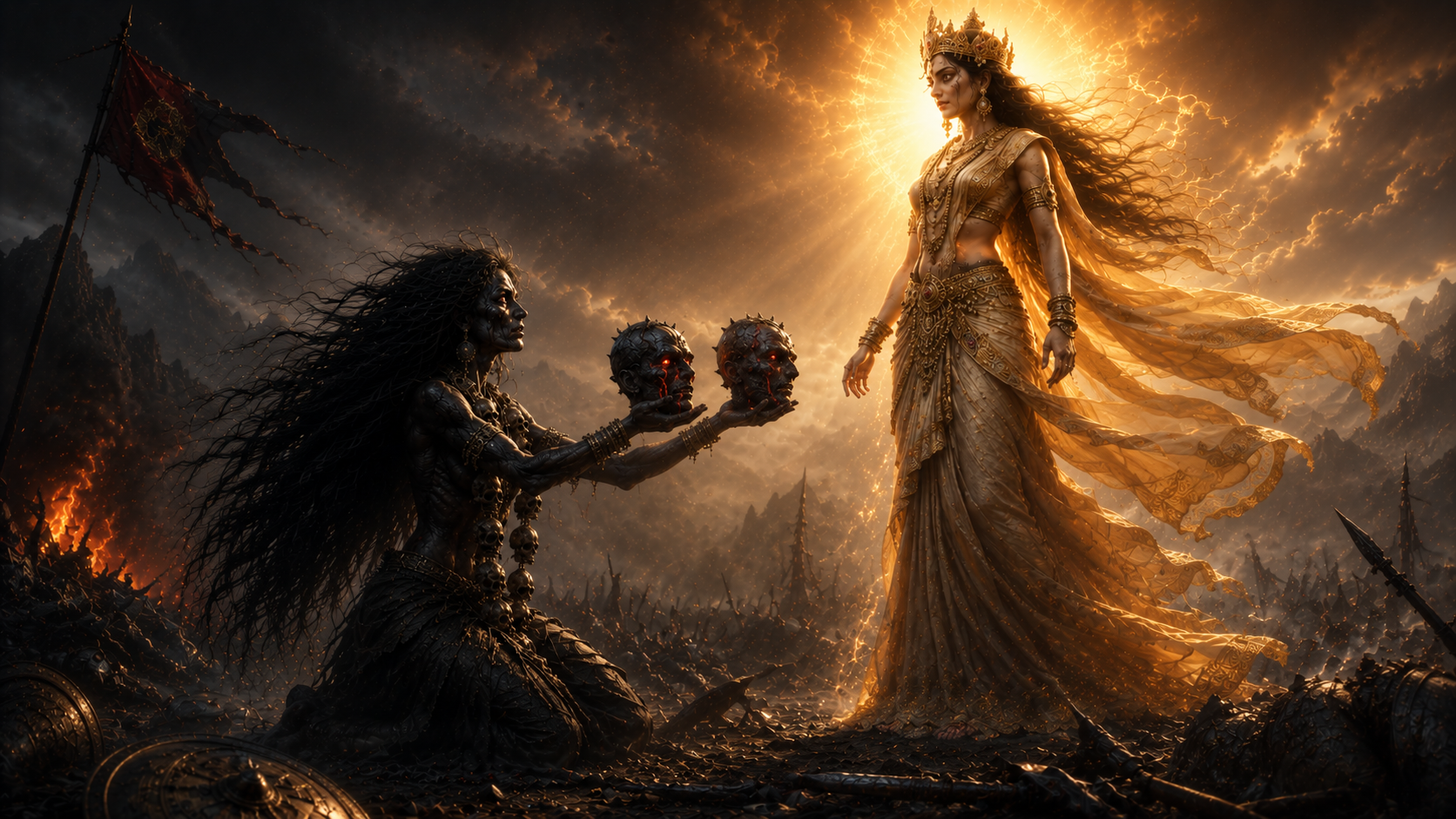
Kali lays the heads of Chanda and Munda before Kaushiki — and receives in that moment the name that will outlast the war.
"Because you have brought me the heads of Chanda and Munda with your own hands, you shall be known among all beings, from this day, as Chamunda."
— Kaushiki naming Kali, Devi Mahatmya ch. 7 (paraphrased)V. The Name That Outlasted the War
The naming of Chamunda is, within the structure of this saga, a small moment with an outsized afterlife. Within the Devi Mahatmya itself, it is simply the conclusion of the second campaign — a battlefield christening. But Chamunda goes on, in the centuries after this text was composed, to become one of the most widely worshipped independent goddess-forms in the subcontinent, with her own temples, her own distinct iconographic tradition (frequently depicted seated on a corpse, gaunt and skeletal in a manner directly descended from this exact verse-description), and her own place among the Sapta-Matrikas who are about to be introduced in the very next act of this war.
- Chanda — "the fierce one"; scout-general whose report of Kaushiki's beauty began the war in Act I
- Munda — "the shaven-headed" or "the truncated one"; Chanda's companion-general, killed in the same engagement
- Chamunda — the compound name given to Kali for bringing the heads of Chanda and Munda; one of the most widely worshipped independent goddess-forms in later Shakta and Tantric tradition
When news of the second annihilation reached the demon court — an entire army gone, two generals beheaded, and a second more terrifying goddess now fighting alongside the first — even Shumbha could no longer treat the mountain as a minor administrative inconvenience. The response this time would not be another general with another army. It would be a demon whose own body carried a defence against the kind of decisive, single-stroke victories that had ended both previous campaigns: a demon who could not be defeated by being wounded, because every wound only made more of him.
Sources for This Act
Primary Sources
- Markandeya Purana, ch. 87 (Devi Mahatmya, Durga Saptashati ch. 7, "The Slaying of Chanda and Munda") — the full physical description of Kali, the destruction of the army, the beheading of Chanda and Munda, and the naming of Chamunda.
Secondary Sources
- Kinsley, David. The Sword and the Flute. University of California Press, 1975 — close analysis of this birth-passage and its place in the wider development of Kali's iconography.
- Kinsley, David. Hindu Goddesses. University of California Press, 1986 — on Chamunda's later independent cult and her place among the Sapta-Matrikas.
- Coburn, Thomas B. Encountering the Goddess. SUNY Press, 1991 — translation notes on the chapter 7 description of Kali and the etymology of Chamunda.
- Mani, Vettam. Puranic Encyclopaedia. Motilal Banarsidass, 1975 — entries on Chanda, Munda, and Chamunda.