
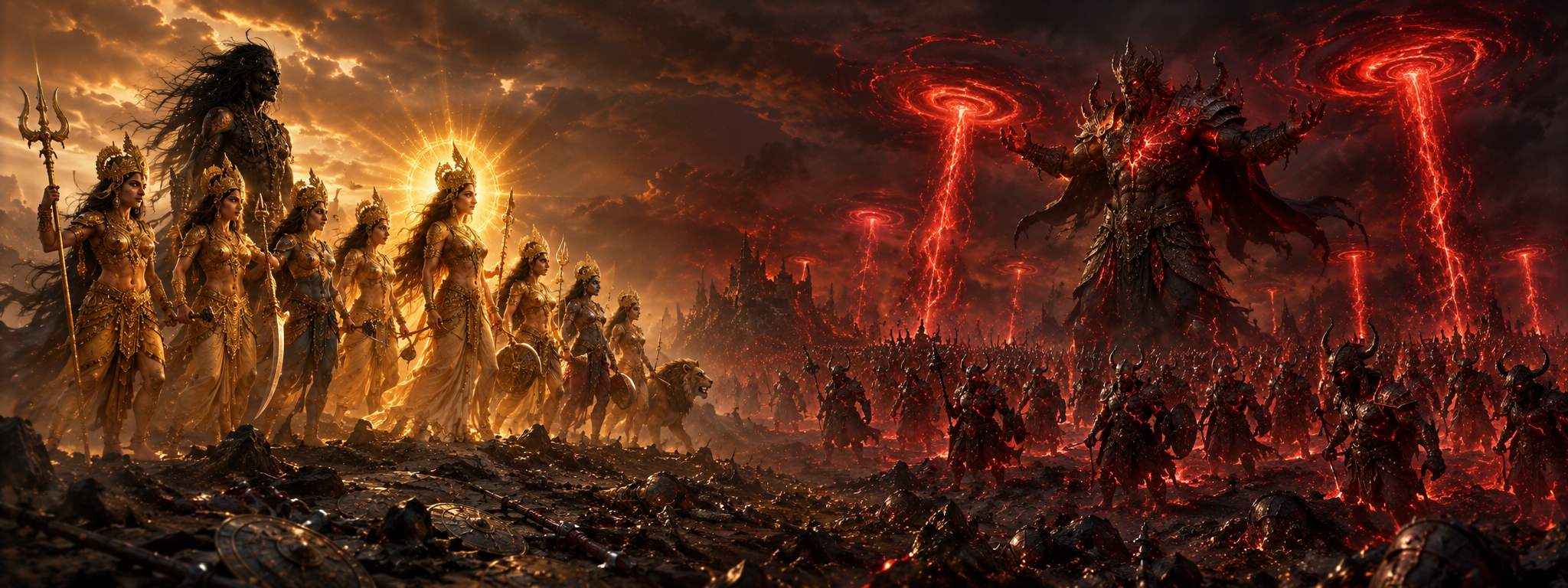
The war's central crisis: a demon whose body makes conventional victory impossible. Every wound multiplies the threat rather than diminishing it. To meet him, Kaushiki produces the war's most celebrated instruments — the seven Matrikas — and devises the only strategy that can neutralize a self-replicating enemy rather than feed him.
I. The Demon Who Could Not Be Wounded
With two generals dead, their armies annihilated, and a new and terrifying goddess now fighting alongside the first, Shumbha finally sent a demon whose nature made the previous campaigns' strategy — fight, wound, kill — structurally impossible. Raktabija carried a boon that was, in the context of a battlefield, the single most dangerous gift a demon could possess: every drop of his blood that fell to the earth would immediately produce a new demon of identical size, strength, and ferocity. Wound him with an arrow and each drop of blood from the wound would rise as a new Raktabija. Strike him with a sword and the blood streaming from the cut would become a crowd. In theory, the more decisively you fought him, the faster his army grew.
The name makes the mechanism explicit: Rakta — blood; bija — seed. He is, literally, the blood-seed. Every drop is a planted thing.
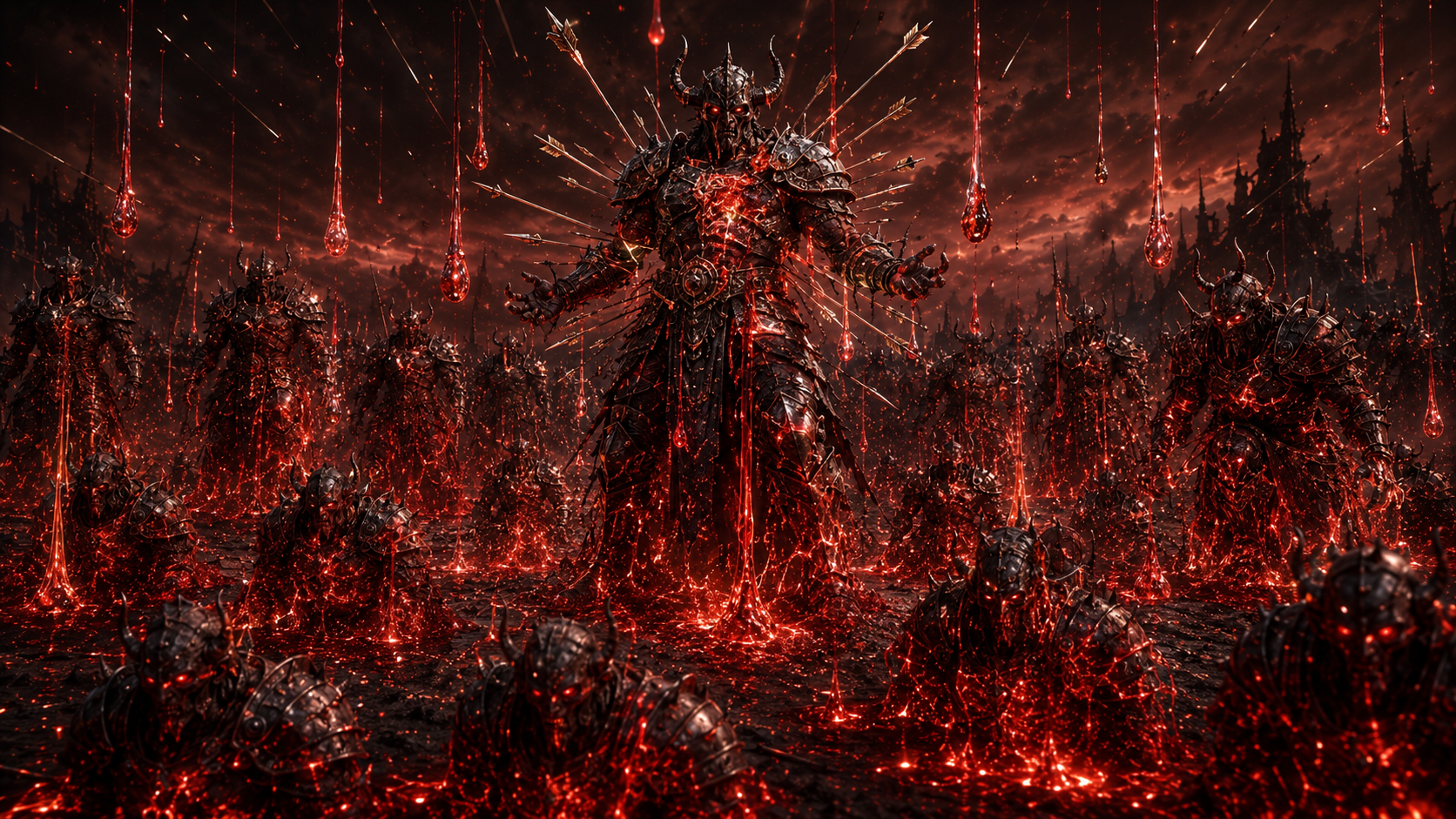
Raktabija's boon in action: each wound opens, each drop falls, each drop rises — the field fills with copies of him.
II. The Crisis Deepens
The Devi Mahatmya is explicit about what happens when the existing divine forces — Kaushiki's weapons, Kali's attacks — are turned against Raktabija: every blow draws blood, every drop of blood produces a new Raktabija, and the field rapidly fills with thousands of copies of him until the very ground is crowded with the multiplied demon-forms and the sky darkens with the blood-mist rising from each new wound. This is not a gradual difficulty — the text describes the situation escalating to something close to a rout, with the gods who had joined the fighting retreating from what had, in a matter of minutes, become an uncountable enemy.
Kaushiki, watching the crisis unfold, recognized that the standard instruments of war were not merely ineffective against Raktabija — they were actively counterproductive. Every sword stroke was farming more opponents. The only viable strategy was the reverse of what any army would naturally do: not to wound the demon at all in the conventional sense, but to ensure that his blood never reached the ground.
The Devi Bhagavata Purana's account of the Raktabija episode expands considerably on the Devi Mahatmya's own: it lists a company of ten goddesses (rather than the Mahatmya's seven Matrikas plus Kali) deployed against Raktabija, and elaborates the multiplication sequence in greater detail. The Vamana Purana's parallel account of blood-drinking as a crisis-response strategy in the Andhakasura episode predates the Devi Mahatmya's version and is likely a structural antecedent — both episodes end with the same logic: a blood-born proliferation threat neutralized by ensuring the blood is consumed before it can reach the ground.
III. The Seven Mothers
To meet Raktabija, Kaushiki produced the war's most famous instruments: seven goddess-forms, each emanated directly from her own body and each bearing the attributes and weapons of a specific male deity — not as that deity's consort, but as his power in female form, his shakti distilled into a separate warrior. In some readings these Matrikas have an independent Puranic existence prior to this episode; in the Devi Mahatmya's own framing they emerge specifically in response to Raktabija's crisis, as projections of Kaushiki's need rather than independent recruits.
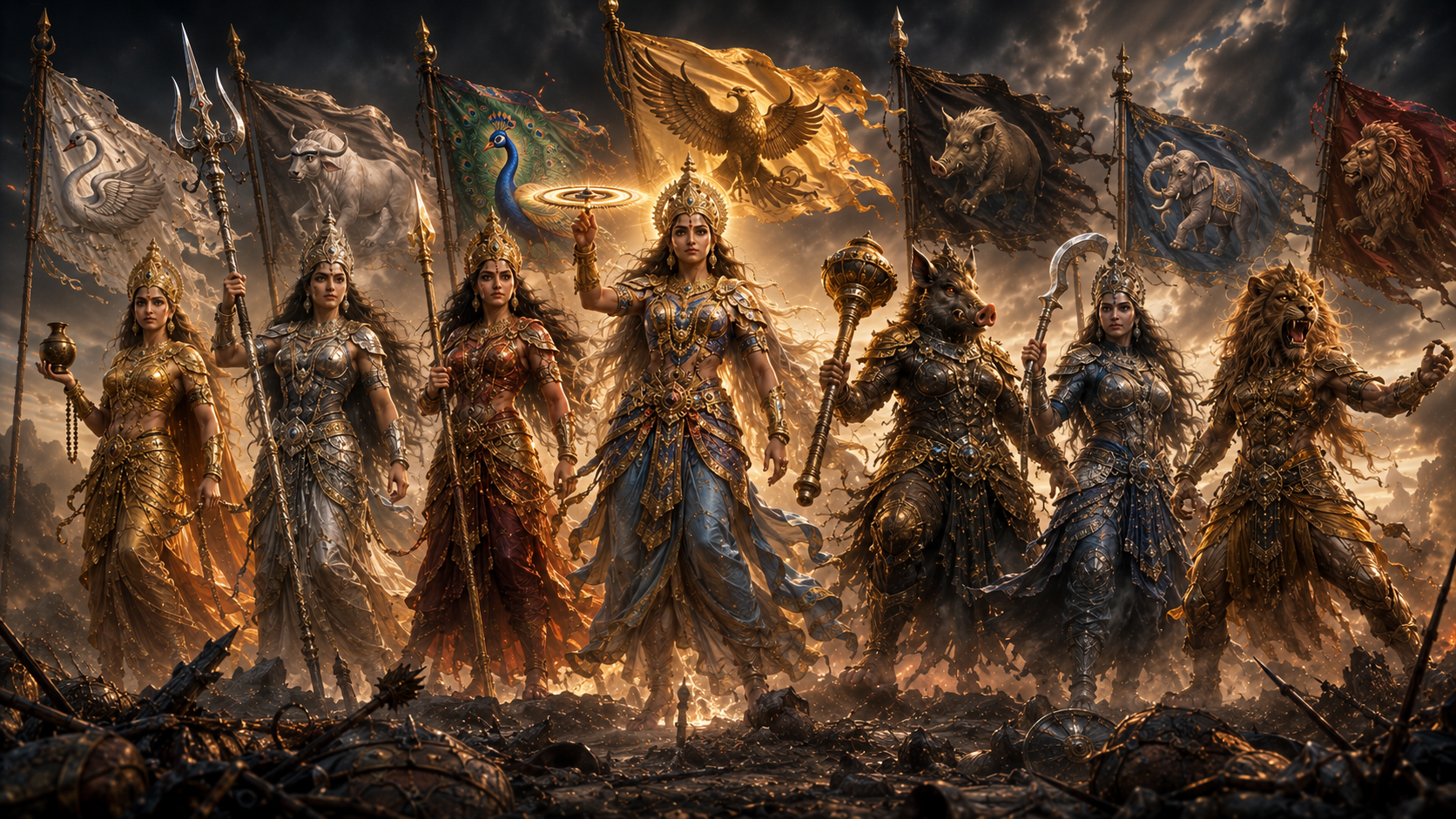
The seven Matrikas in crescent formation: each a projection of Kaushiki's own power in the form of a distinct cosmic attribute.
| Matrika | Emanated From | Mount / Emblem | Weapons |
|---|---|---|---|
| Brahmani | Brahma's power | Swan; four-faced | Kamandalu, rosary, lotus, water-pot |
| Maheshvari | Shiva's power | Bull; three-eyed | Trident, noose, serpent, moon-crest |
| Kaumari | Kumara-Skanda's power | Peacock | Spear, cock-banner |
| Vaishnavi | Vishnu's power | Garuda; four-armed | Discus, conch, mace, lotus |
| Varahi | Varaha's (boar-Vishnu's) power | Boar-headed | Plough, mace, sword |
| Aindri (Indrani) | Indra's power | Elephant; thousand-eyed | Thunderbolt, noose |
| Narasimhi | Narasimha's power | Lion-maned, mane-wearing | Claws, trident |
IV. The Strategy That Could Work
Kali's Mouth as the Battlefield's Solution
The solution Kaushiki devises is as logistically precise as it is visually extreme: Kali, whose appetite the previous act had already established as something in excess of any ordinary goddess, would advance on Raktabija with her mouth held open — as wide as the battlefield itself required — and would drink his blood directly from each wound the Matrikas inflicted before a single drop could reach the ground.
The strategy requires every combatant to act in perfect coordination: the Matrikas striking and wounding while Kali's extended tongue covers the ground beneath each wound, catching and consuming each drop before it can touch the earth and rise. Executed successfully, each wound would diminish Raktabija rather than multiply him — not because wounding had changed, but because the blood-reaching-earth stage of the cycle had been eliminated.
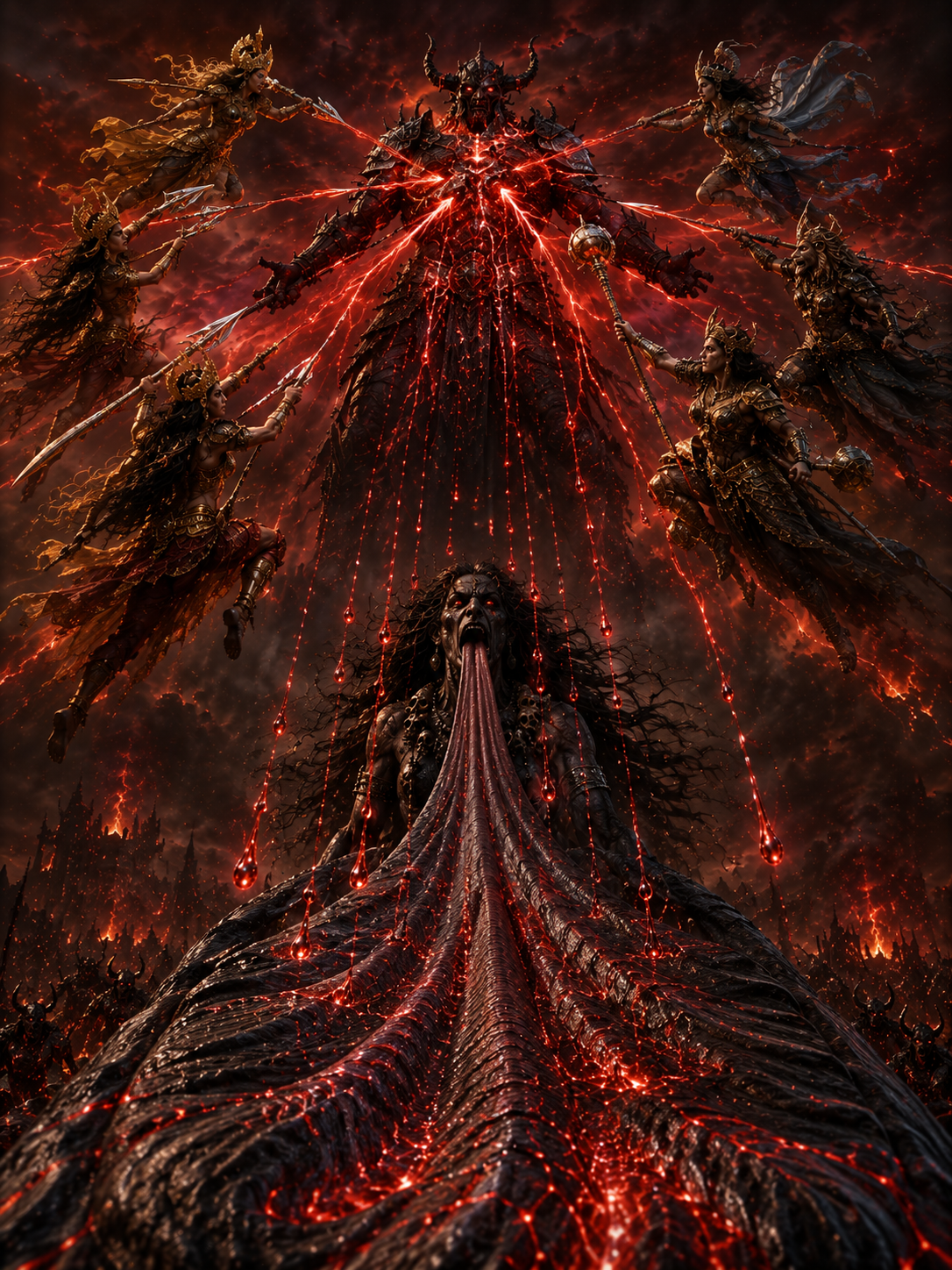
Kali's extended tongue becomes the battlefield's solution — the only surface that can neutralize a blood-seed demon.
V. The End of Raktabija
The combined assault worked precisely as designed. The Matrikas struck and wounded; Kali drank. Struck again; drank again. With each cycle, Raktabija was diminished rather than multiplied — his blood consumed before it could seed the earth, his body weakened by wounds that were now doing the work wounds are supposed to do rather than the reverse. The field of multiplied copies that had earlier crowded the ground began to thin rather than grow. When Kaushiki finally struck Raktabija with her own trident, running him through directly, there was nothing left in the mechanism of his boon to save him. He fell, and his blood — now streaming free of any multiplication, Kali having consumed the last of his replicative fuel — simply stained the ground like the blood of any other fallen demon.
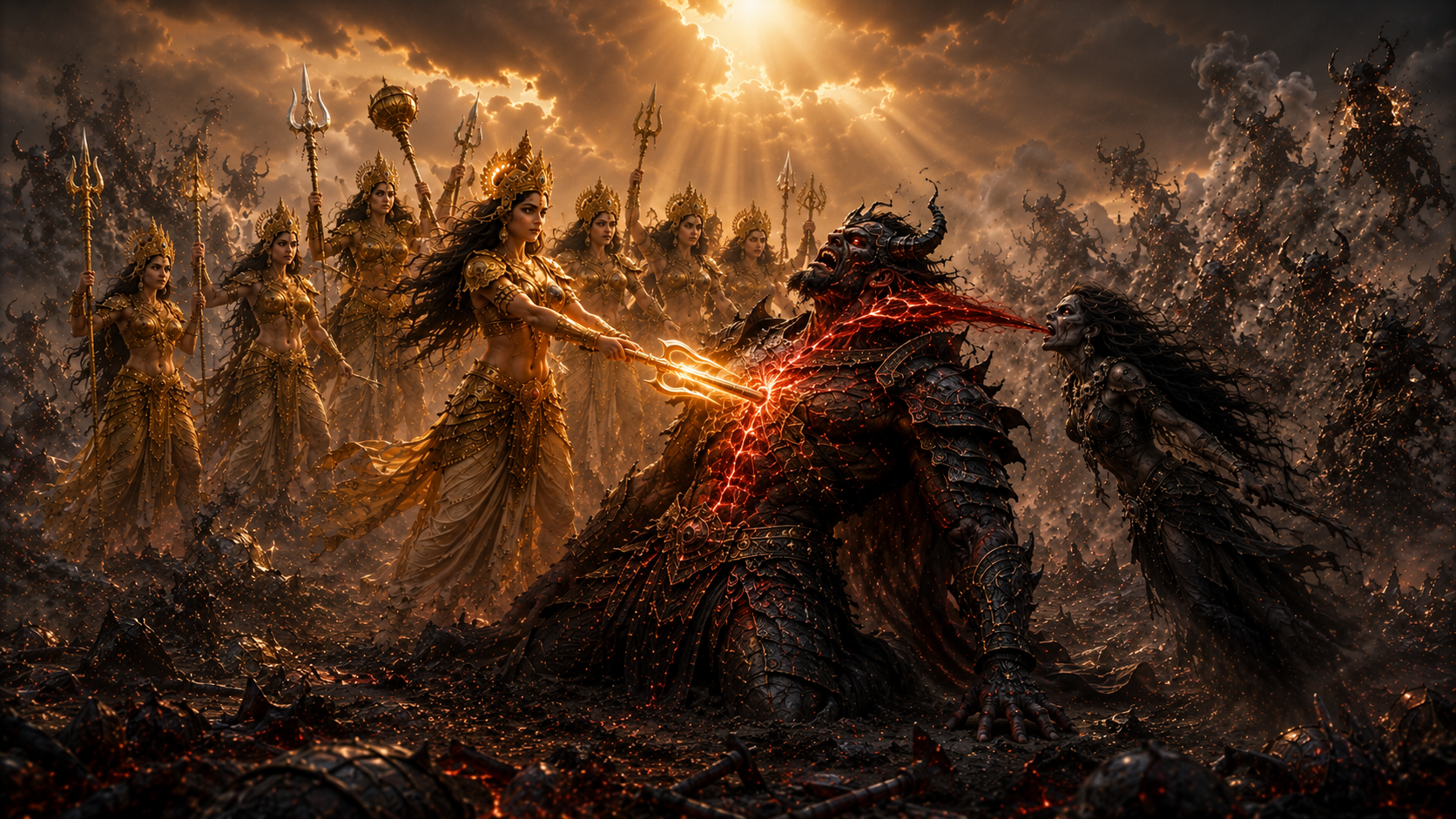
Raktabija finally falls: his multiplication cycle broken, the blood-seed demon undone by strategy rather than force alone.
With Raktabija dead, the war loses its most structurally interesting opponent. What remains is simpler in tactical terms but larger in mythological weight: the two kings who began it, who had so far stayed safely behind the armies they kept sending up the mountain, would now have to decide whether to enter the field themselves.
Sources for This Act
Primary Sources
- Markandeya Purana, ch. 88 (Devi Mahatmya, Durga Saptashati ch. 8, "The Slaying of Raktabija") — Raktabija's boon, the multiplication crisis, the emergence and catalogue of the seven Matrikas, and the blood-drinking strategy that ends him.
- Devi Bhagavata Purana, Book 5 — expanded ten-goddess company in the Raktabija episode.
- Vamana Purana, chs. 56–57 — Matrikas' specific bodily emergence points; the Andhakasura blood-drinking parallel.
Secondary Sources
- Coburn, Thomas B. Devi-Mahatmya: The Crystallization of the Goddess Tradition. Motilal Banarsidass, 1984 — structural analysis of chapter 8 as the war's central crisis.
- Kinsley, David. Hindu Goddesses. University of California Press, 1986 — on the Matrikas' origins, their catalogue in this episode, and their independent cult development.
- Mani, Vettam. Puranic Encyclopaedia. Motilal Banarsidass, 1975 — entries on Raktabija and each of the seven Matrikas.