
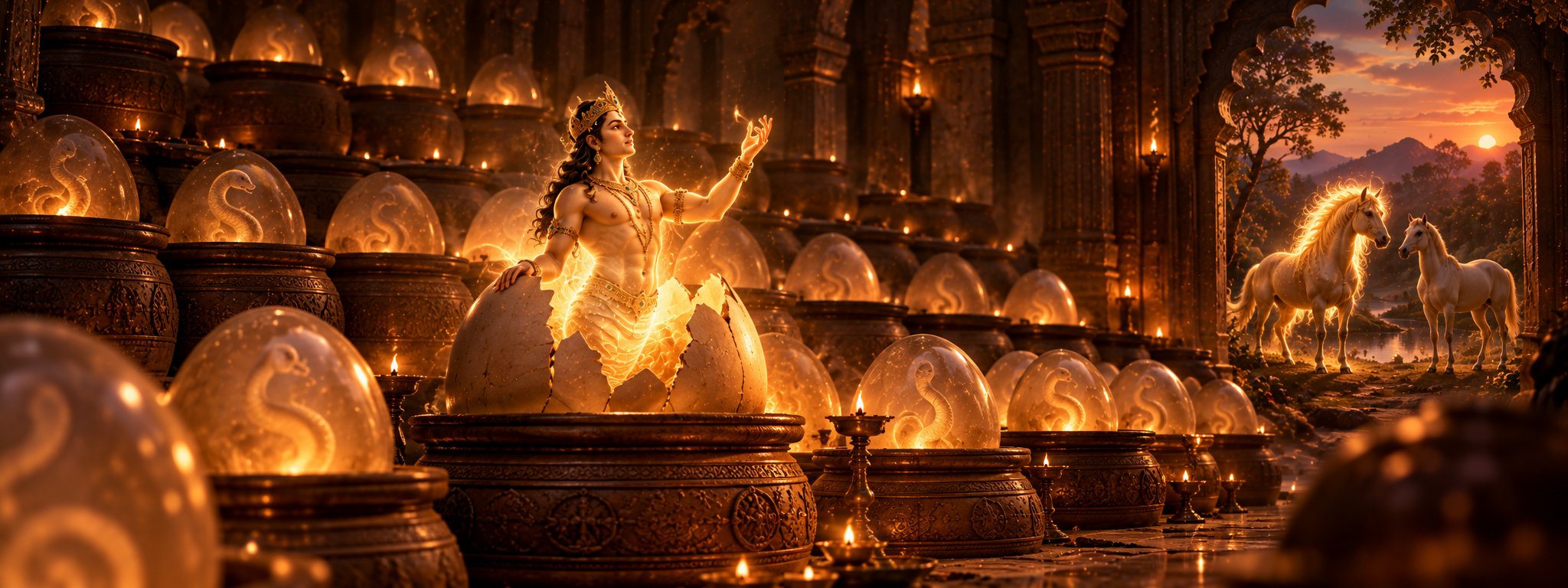
Every other Part in this series has, however strangely, still been about a human or divine body producing a child: a womb, a vessel, a diverted seed, a substitute. This Part covers the two ways that assumption breaks. In one, the mother lays eggs, and the child hatches rather than being born. In the other, the parents take animal form, and the twins who result are conceived in a shape neither ordinarily wears.
The two clusters have little else in common, and are grouped only because neither fits an earlier Part without stretching it: eggs are not vessels, and a mare and stallion are not animals incubating a stray seed.
Kadru's Thousand Eggs: The Nagas
The sisters Kadru and Vinata, both wives of the sage Kashyapa, each ask him for sons. Kashyapa grants Kadru a thousand sons of equal strength, and Vinata two, stronger than any of Kadru's. Kadru lays a thousand eggs and Vinata two. Their attendants place the eggs in warm vessels and leave them, and after five hundred years Kadru's thousand eggs break open: from them come the Nagas, the serpents.
Vinata's Two Eggs: Aruna and Garuda
Vinata's eggs do not hatch. After five hundred years, watching her sister's sons grow while hers remain unborn, she breaks one open early. The son inside is only half-formed, with the lower part of his body undeveloped, and he is furious. Aruna curses his mother: for her haste she will be a slave for five hundred years, to the very sister she was trying to keep pace with, and only her second son, if she waits for him without repeating her mistake, will free her. Aruna then rises into the sky and becomes the charioteer of the sun. Five hundred years later the second egg hatches on its own, and Garuda emerges whole.
The slavery itself comes about through a wager between the sisters over the colour of the tail of Uchchaihshravas, the horse that rises from the churned ocean in Part IV.
The two sisters' eggs are treated identically: the same vessels, the same five hundred years. What separates the outcomes is only whether the wait is honoured. Kadru's thousand hatch on time; Vinata's first is broken open early and leaves a son unfinished. Elsewhere in this series an interrupted birth does the opposite of what the interrupter intends: Indra's vajra multiplies the embryo into the Maruts in Part VI, and Parashara's recitation in Part IX comes from a fetus that would not be silenced. Aruna is the one case in which interruption simply leaves the child incomplete, a body cut short as Abhimanyu's knowledge is cut short in Part IX.
The Ashwini Kumaras: Born to a Mare
Sanjna, wife of the sun-god Surya, cannot bear his radiance. She leaves her shadow-double in her place and withdraws to the forest, where she takes the form of a mare. Surya, learning what has happened, follows in the form of a stallion, and from their union the twin Ashwini Kumaras (Nasatya and Dasra) are born: physicians of the gods, named for the horse. In one tradition the seed is received through the mare's nostrils, and the twins are born from there rather than in an ordinary birth.
The same episode has a second half, Surya's later children by Sanjna's shadow-double, whom he takes for Sanjna. That is a substitution the husband does not know about, and it belongs to this project's Children of Deception material rather than here.
Most accounts say only that the twins are born of the mare-and-stallion union. The nostril-birth detail rests on a minority tradition found in Puranic and commentarial sources, and is included as such rather than as the settled account.
The two clusters here remove the human womb from the picture in different ways. Eggs kept in vessels and hatched after five hundred years make the birth a matter of waiting, not of labour, and let a single haste leave a child half-made. The mare and the stallion make the birth a matter of shape: the parents change their form, and the children carry the mark of it in their name. Neither fits the series' earlier mechanisms cleanly, which is the reason for a Part of their own.
Vessels kept warm for a birth recall the pot-births of Part II, Vessel- and Medium-Born. Uchchaihshravas, whose tail decides the sisters' wager, appears in Part IV, The Samudra Manthan Births. The Ashwini Kumaras appear as the physicians who extract Mandhata in Part V, Nature and Multiplicity by Ritual Food, and as the divine fathers of Nakula and Sahadeva in Part VIII, Given, Not Conceived. Aruna's incompleteness is set beside Abhimanyu's in Part IX, In the Womb, Already Shaped.
Across ten parts, this series has traced the mechanisms standing in for an ordinary birth: mind-birth, earth-birth, fire-birth, and deliberate construction (Part I), seed diverted into an inanimate vessel (Part II), a stray substance carried by an animal, a river, or a fire (Part III), emergence from a churned ocean with no parent at all (Part IV), a ritual or sacrifice determining a child's nature, number, bearer, sex, or fate (Part V), an outside agent dividing or fusing an origin (Part VI), a being condensed from another deity's own body under fury, accident, or deliberate boon (Part VII), a deity's boon substituting for union or for the entire birth process itself (Part VIII), a child's trait, affliction, knowledge, or fate fixed before birth ever occurs at all (Part IX), and, finally, hatching from an egg or birth in animal form (Part X). No single explanation covers all of them — what unites the series is only the shared refusal, case by case, of the ordinary pattern the tradition otherwise takes for granted.
References
Primary Sources
- Mahabharata, Adi Parva (Astika Parva) — for Kadru and Vinata's boons, the eggs kept in warm vessels, the hatching of the Nagas, Vinata's breaking of the first egg, Aruna's curse, Garuda's hatching, and the wager over Uchchaihshravas.
- Markandeya Purana, Harivamsha, and Vishnu Purana — for Sanjna's flight, the mare and stallion union, and the birth of the Ashwini Kumaras; the nostril-birth detail is from a later commentarial tradition.
Sanjna's shadow-double and the children Surya has by her are part of the same Puranic episode but are treated in this project's Children of Deception material, not here. The nostril-birth of the Ashwini Kumaras is a minority tradition and is noted as such.